

Your ad account is currently a leaky bucket, and the algorithm does not care about your bottom line. With the median Meta CPA now sitting at $38.19, watching your budget evaporate without a return is more than just frustrating; it is a threat to your growth. If you are staring at a dashboard full of expensive clicks but zero sales, you are likely wondering why my ads are not converting in this hyper-competitive market. You have done the work, you have launched the campaigns, and you are tired of reporting red numbers to your stakeholders while your competitors seem to scale effortlessly.
It is time to stop the bleeding and reclaim your ROI. You can transform your digital presence from a cost center into a high-velocity growth engine by aligning your technical infrastructure with bold, visionary creative. This guide reveals the exact gaps killing your performance, from Meta’s recent attribution window shifts to Google’s June 2026 Enhanced Conversions unification. We will walk through five critical fixes, including server-side tracking and high-impact video production, to give you a clear roadmap to profitable scaling and a lower CPA starting today.
Key Takeaways
- Master the 2026 attribution landscape with advanced server-side tracking to ensure the algorithm never misses a conversion signal.
- Identify the critical leaks in your funnel to finally understand why my ads are not converting and stop the drain on your ad spend.
- Replace low-quality assets with professional video production that builds authority and commands attention in a saturated market.
- Streamline your post-click experience with high-performance website development that eliminates mobile friction and secures the sale.
- Adopt an integrated ad buying approach where data and design work together to drive massive audience growth and lower your CPA.
Diagnosing the Ghost Click: Why Traffic Does Not Equal Sales
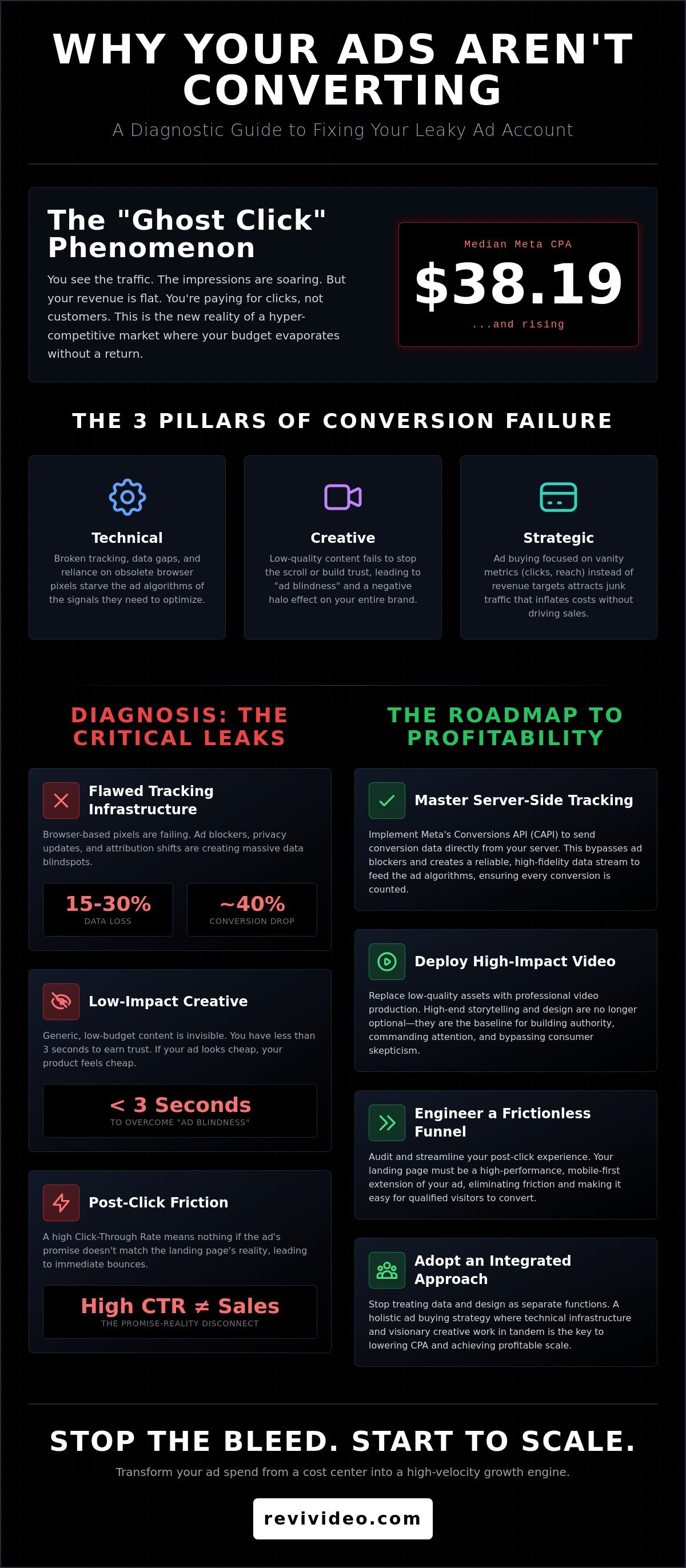
High traffic is a vanity trap. You see the clicks climbing, the impressions soaring, and your dashboard flashing green; yet, your bank account remains stagnant. This is the “Ghost Click” phenomenon. In 2026, the digital marketplace is more saturated than ever, with global digital ad spend projected to reach up to $835.82 billion. If you are constantly asking yourself why my ads are not converting, you are likely suffering from a widening Conversion Gap. You’ve captured their attention, but you haven’t earned their confidence. Clicks are easy to buy, but trust is harder to build.
To win in this environment, you must move beyond vanity metrics like impressions and focus on revenue metrics. A high Click-Through Rate (CTR) means nothing if the traffic is “junk” traffic that bounces within seconds. Solving this requires a holistic look at the Three Pillars of Conversion:
- Technical: Your tracking infrastructure must capture every signal to feed the AI.
- Creative: Your content needs to stop the scroll and build immediate authority through high-end video production.
- Strategic: Your ad buying must target buyers, not just browsers who inflate your metrics.
The Psychology of the 2026 Consumer
The 2026 consumer is hyper-aware and incredibly impatient. They’ve developed a profound “ad blindness” to generic, low-budget content that feels like digital noise. You have less than 3 seconds to prove you are a legitimate solution. High-end storytelling and professional design are no longer luxuries; they are the baseline for entry. When your creative looks professional, it triggers a “halo effect” that makes your entire offer feel more reliable. If your ads look cheap, your product feels cheap. It’s that simple. Brand building is the ultimate shortcut to bypassing skepticism and securing a conversion.
Reach vs. Results: The Analytics Trap
Don’t let a 3.52% average Google Search CTR fool you into thinking your campaign is a success. High engagement without sales often points to a disconnect between the ad’s promise and the landing page’s reality. This misleading creative attracts clicks from people who aren’t your target audience, inflating your costs while killing your ROI. Identifying this junk traffic is the first step toward profitable scaling. The Conversion Gap is the distance between interest and trust. You need to stop chasing reach and start demanding results. Profitable ad buying isn’t about getting the most clicks; it’s about getting the right ones to move the needle on your bottom line.
Technical Infrastructure: Fixing Tracking Blindspots and Data Gaps
Your tracking is the central nervous system of your entire marketing funnel. If the data is broken, your campaigns are flying blind. Many creators and brands are still stuck using basic browser pixels while wondering why my ads are not converting. The truth is often found in the reporting, not the creative. On January 12, 2026, Meta retired legacy 7-day and 28-day view attribution windows. This single update caused reported conversions to plummet by up to 40% overnight for accounts that failed to adjust their settings. You aren’t just losing visibility; you are starving the AI algorithms that power your ad buying.
Modern advertising requires a server-side approach. Meta’s April 15, 2026, release of the AI-enhanced Pixel and simplified Conversions API (CAPI) setup made technical precision accessible to everyone. These tools enrich your event data with product details automatically. If you haven’t migrated to a server-side setup, you’re likely losing 15-30% of your conversion data to browser-based ad blockers and privacy updates like the latest CCPA regulations. High-performance ad buying depends on feeding the machine learning engine the highest quality data possible.
Step-by-Step: Auditing Your Tracking Setup
Verify your Pixel events immediately using the real-time Test Events tool. Ensure every high-value action, from “Add to Cart” to “Purchase,” fires without delay. You must cross-reference these browser signals with your server-side CAPI events to close the data loop. Pay close attention to deduplication. If your system reports the same sale twice, it confuses the AI-driven bidding system and leads to inefficient spend. A clean, frictionless tracking setup is the foundation of every successful scale and the first place to look when asking why my ads are not converting.
Attribution Models: Choosing the Right Lens
Stop relying on last-click attribution to measure your success. It ignores the multi-touch journey of the modern consumer. Google Ads simplified this in June 2026 by unifying Enhanced Conversions, but you still need to select the right model for your specific business. Luxury brands with longer sales cycles benefit from data-driven models that recognize the power of early-stage brand building. For service-based businesses, offline conversion tracking is the missing link. It connects digital interest to real-world revenue, ensuring your budget is focused on the channels that actually deliver results.
The Creative Quality Gap: Why Cheap Content Costs You More
Most advertisers are stuck in 2022. They still think low-fi User-Generated Content (UGC) is the ultimate conversion hack. It isn’t. In 2026, the “shaky phone video” look has become synonymous with low-effort marketing and digital noise. If you’re constantly asking why my ads are not converting, look at your visual assets first. Cheap content is the most expensive thing you can buy because it fails to earn trust. High-end storytelling has replaced raw authenticity as the primary driver of brand authority and ROI.
Your hook is your most valuable asset. The modern scroller decides to stay or leave in less than 3 seconds. Cinematic hooks stop the thumb. They use professional motion, lighting, and composition to signal that your brand is a leader, not a follower. When your creative lacks polish, you’re telling the audience that your product lacks it too. You can’t scale a professional brand on amateur assets. It’s time to bridge the gap between your ad spend and your creative quality by learning how to explore Influencer Marketplace Access for professional creator partnerships.
Cinematic Storytelling as a Conversion Driver
High-production value isn’t about vanity; it’s about reducing the skepticism barrier for new customers. Professional commercial video production leverages sound design and color grading to trigger specific emotional responses. A crisp audio track and a deliberate color palette can drive a purchase faster than any discount code. It transforms your business from a generic vendor into a visionary partner that people actually want to follow.
Creative Testing vs. Creative Strategy
Stop testing 100 bad ads. It’s a massive waste of time and budget. Instead, launch three professionally crafted pieces built on a solid creative strategy. You must match your visual aesthetic to your specific target demographic. A Scottsdale luxury buyer expects a completely different visual language than a Gilbert family. Creative is the ultimate “variable of success” in modern algorithms. If the creative doesn’t hit, the most sophisticated ad buying in the world won’t save your performance.
Creative fatigue is the silent killer of profitable campaigns. You’ll spot it when your CPC stays low but your conversion rate drops off a cliff. This is another reason why my ads are not converting after a successful launch. Don’t start from zero every time. Refresh your hooks or your calls-to-action with cinematic-grade visuals to breathe new life into your winning funnels. This strategic approach ensures your brand stays relevant while your CPA stays low.
Post-Click Friction: Auditing Your Landing Page Experience
Your ad stopped the scroll. The click happened. But if your landing page doesn’t deliver on the promise instantly, you’ve just paid for a bounce. This post-click friction is a primary reason why my ads are not converting despite high engagement. You must maintain the “Ad-to-Page” scent. This means your visual design and verbal tone must match perfectly. If a cinematic ad leads to a cluttered, slow-loading site, the psychological disconnect kills the sale before the page even finishes rendering.
Mobile-first design is no longer optional. In 2026, 90% of your conversion failures happen on a phone. If your checkout flow isn’t optimized for a single thumb, you are leaving revenue on the table. Speed is your silent killer. A one-second delay in load time can spike your bounce rate and tank your ROI. Follow the “One Goal” rule: remove every navigation link, sidebar, and pop-up that doesn’t lead directly to the checkout. Every distraction is an exit ramp for your potential customer.
User Experience (UX) for High-Conversion Brands
Friction is the enemy of profit. Reduce your form fields to the absolute minimum. Every extra box is a reason for a lead to quit. Place high-authority social proof like verified reviews and partner logos strategically near your CTA button to reinforce trust at the moment of decision. To truly captivate your audience, work with a local video production company to create high-impact video headers that keep users on the page longer and drive deeper brand engagement.
Technical Web Performance in 2026
Core Web Vitals are the benchmark for a frictionless transition. Generic templates often carry heavy code that bloats load times and frustrates users. Custom website development ensures your site is lean, fast, and built specifically to convert high-end traffic. When you move beyond templates, you create a unique checkout flow that mirrors the quality of your brand. Stop settling for “good enough” and start building for results. A high-performance site is the final bridge between a curious click and a loyal customer.
Audit your digital storefront today and eliminate the technical gaps why my ads are not converting with our expert website development services to ensure every click counts toward your bottom line.
Strategic Ad Buying: The Integrated Agency Solution
Ad buying isn’t a game of hidden buttons or secret dashboard hacks anymore. In 2026, the major platforms rely on sophisticated machine learning to find your audience. Your primary job is to feed that AI the highest quality signals possible. When your ad buyer is siloed from your video production team, the feedback loop breaks. This disconnect is a silent killer and a primary reason why my ads are not converting. You need a unified front where every pixel of creative is engineered to satisfy the algorithm and the end consumer simultaneously.
Most traditional agencies operate in fragmented departments. The creative team builds what looks aesthetically pleasing, while the media buyers struggle to make those assets work in the real world. We reject that inefficiency. Successful scaling requires an integrated approach where data drives design. When your production team understands real-time campaign performance, they can iterate on winning hooks within hours, not weeks. This agility removes tedious production barriers and ensures your budget is always focused on what actually drives ROI.
Targeting Local Excellence: The Phoenix Advantage
Local market dynamics require a specific targeting nuance that national agencies often miss. Phoenix is not a monolith. Resonating with an audience in Scottsdale or Paradise Valley requires a completely different visual and verbal tone than reaching families in Gilbert or Mesa. High-end demographics in these areas expect a level of sophistication and professional brand building that generic templates cannot provide. You need local social proof and geographic sentiment to build immediate trust across Tempe and Chandler. Choosing the right branding agency in Phoenix ensures your identity aligns with the specific expectations of the Arizona market.
The REVI Approach: Data Meets Design
Our integrated model is built for the modern content creator who values impact and speed. We bridge the gap between expensive clicks and actual revenue by aligning your ad buying, video production, and website development into a single, high-velocity growth engine. This eliminates the confusion of why my ads are not converting by identifying and fixing the specific leaks in your funnel in real-time. We move your brand from simply “running ads” to establishing a dominant market presence that commands attention and drives action.
Stop guessing with your ad spend. Reclaim your ROI and scale your brand with a professional audit of your technical, creative, and strategic infrastructure. We identify the exact gaps killing your performance and provide a clear roadmap to profitable scaling. Your audience is active and ready to buy; let’s give them a reason to choose you.
Reclaim Your ROI and Scale Faster
Stop letting technical gaps and outdated creative assets drain your budget. We’ve identified the specific leaks in your funnel, from broken attribution windows to the lack of cinematic storytelling. You now have the roadmap to move beyond vanity metrics and start driving real revenue. No more wondering why my ads are not converting; it’s time for precise execution. Successful brands in 2026 don’t just run ads; they build dominant market presences through integrated strategy.
Our Phoenix-based local market specialists understand the nuance of the Arizona landscape. We pair this local expertise with an award-winning video production team and ad buying experts who have managed millions in spend. We remove the production barriers that hold you back. Stop wasting your ad budget—Get a professional REVI audit today. You have the tools and the vision. It’s time to turn your clicks into customers and dominate your market.
Frequently Asked Questions
How long should I wait before deciding my ads are not converting?
Give your campaigns at least 7 to 14 days to exit the initial learning phase. In 2026, AI-driven bidding strategies require a significant volume of conversion signals to optimize effectively. Cutting your budget too early starves the algorithm of the data it needs to find your ideal buyers. Monitor your metrics daily, but avoid making major structural changes until the machine has enough data to settle.
Can a bad website ruin a good ad campaign?
A poorly designed website is the most common reason for wasted ad spend. Even the most sophisticated ad buying strategy cannot save a landing page that loads slowly or feels untrustworthy. Your website development must prioritize mobile speed and a frictionless path to the checkout. If users encounter technical errors or confusing layouts after clicking your ad, they will bounce immediately and take your ROI with them.
Is my ad budget too low to see results in the Phoenix market?
Success in the Phoenix market depends on targeting precision rather than just the size of your bank account. While competitive areas like Scottsdale require a healthy spend to maintain visibility, a strategic approach to local brand building can make a modest budget highly effective. Focus on winning specific neighborhoods or demographics where you have high social proof before attempting to dominate the entire Valley at once.
What is the difference between ad fatigue and a bad offer?
Ad fatigue occurs when your audience sees the same creative too many times, causing your click-through rate to drop. A bad offer is the likely culprit if you have high engagement but are still wondering why my ads are not converting at the point of sale. If people are clicking but not buying, your price point, value proposition, or landing page experience is likely failing to close the deal.
Should I focus on Facebook, Instagram, or TikTok for the best ROI?
Your choice depends on your product; TikTok Shop currently boasts a strong 3.7% conversion rate for e-commerce, while Meta remains dominant for broader audience reach. Diversifying your ad buying across platforms ensures you aren’t vulnerable to a single algorithm shift. Analyze where your specific demographic spends their time and allocate your budget based on which platform delivers the lowest cost per acquisition for your brand.
How does professional video production impact my cost per click (CPC)?
Professional video production lowers your CPC by significantly increasing your relevance score on major platforms. High-quality visuals stop the scroll and drive higher click-through rates, which the algorithm rewards with cheaper ad placements. When your content looks cinematic and authoritative, users are more likely to engage. This efficiency reduces the overall cost of reaching your audience while simultaneously elevating your brand’s perceived value.
Why are my competitors converting while I am not?
Your competitors are likely winning because they have synchronized their technical tracking, creative quality, and post-click experience. They probably use server-side tracking to capture the 15% to 30% of data that standard pixels miss in 2026. If you are struggling with why my ads are not converting, it is often because of a break in this chain. They aren’t just running ads; they are running a complete, frictionless system.
What is a good conversion rate for digital ads in 2026?
Benchmarks vary by channel, but the average Google Search conversion rate currently sits at 4.40%. For TikTok, in-feed ads typically see a 1.8% conversion rate, while Spark Ads perform better at 2.6%. Your ultimate goal should be to keep your cost per acquisition below the median Meta CPA of $38.19. Focus on continuous optimization of your design and offer to stay ahead of these industry averages.