

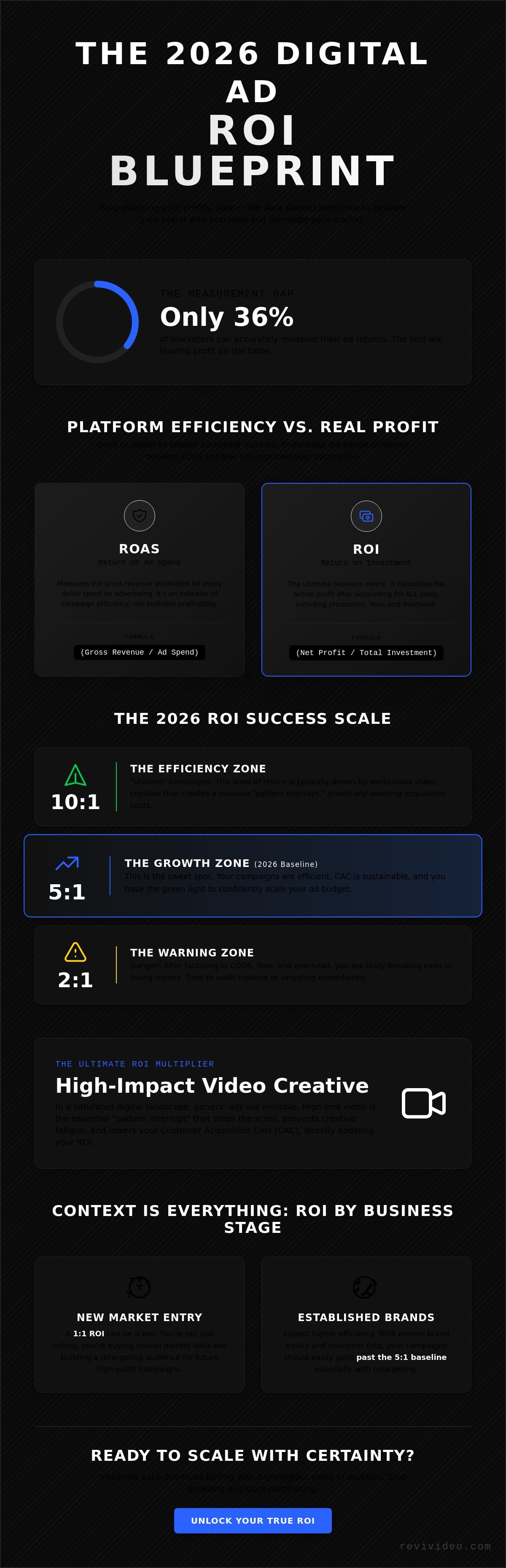
Only 36% of marketers can accurately measure their returns; the rest are essentially throwing budget into a black hole and hoping for the best. If you’re tired of watching your ad spend disappear without a clear profit trail, you’re likely asking: what is a good ROI for digital advertising in 2026? It’s frustrating to see high ROAS numbers on a dashboard while your bank account tells a different story. You know that true growth requires more than just vanity metrics. It requires a surgical understanding of your bottom line.
We’re here to bridge that gap. You’ll master the exact benchmarks needed to scale your brand and finally separate true profit from gross revenue. This guide reveals the latest 2026 industry standards and explains why high-impact video production is your secret weapon for lowering CAC. We’ll give you the data-backed confidence to double your ad budget and dominate your market with precision. It’s time to stop guessing and start winning.
Key Takeaways
- Identify the 5:1 ratio as the new 2026 baseline and learn why anything lower might leave your brand in the red.
- Stop chasing vanity metrics and learn how to calculate what is a good ROI for digital advertising using total overhead and production costs.
- Master platform-specific benchmarks for Meta and Google to ensure your campaigns dominate the competition.
- Discover why high-end video production is the essential “pattern interrupt” that prevents creative fatigue and doubles your impact.
- Scale faster by integrating production and ad buying into one seamless, data-driven engine.
Defining a “Good” ROI for Digital Advertising in 2026
Forget the outdated advice from five years ago. The digital landscape is faster, louder, and more expensive than ever before. When founders ask what is a good ROI for digital advertising in the current climate, they often expect a simple number. In 2026, the 5:1 ratio is your new baseline for survival. This means for every $1 you spend on ad buying and production, you must generate $5 in revenue. If you’re hitting this mark, you’ve found the “Growth Zone.” You can scale predictably because your margins cover your operational costs while leaving room for profit.
Don’t be fooled by a 2:1 return. It sounds like you’re doubling your money, but it’s often a trap. Calculating your true Return on investment (ROI) requires looking past the ad manager dashboard. Once you factor in COGS, agency fees, and high-end video production costs, a 2:1 ratio usually means you’re barely breaking even. Your dashboard might show a green arrow; however, if your bank account isn’t growing, that arrow is lying to you. Stop obsessing over vanity metrics like impressions and clicks. They don’t pay the bills. Focus on bottom-line revenue and actual cash in the bank.
The 2026 Success Scale: Where Does Your Brand Land?
- 2:1 ROI (The Warning Zone): You’re likely losing money after overhead. This is the danger zone for high-growth brands. It’s time to audit your creative or your targeting.
- 5:1 ROI (The Growth Zone): This is the 2026 sweet spot. Your campaigns are efficient, and your customer acquisition cost (CAC) is sustainable. You have the green light to increase your ad budget.
- 10:1 ROI (The Efficiency Zone): These are the “Unicorn” campaigns. In competitive markets like Phoenix, hitting a 10:1 ratio usually requires world-class video content that triggers a massive “pattern interrupt” in social feeds.
Why Benchmarks Vary by Business Stage
Context is everything. Your target ROI should shift based on your brand’s maturity and your specific market goals. A local Phoenix-based service provider has different math than a national e-commerce giant.
- New Market Entry: If you’re just launching, a 1:1 ROI can actually be a win. You’re essentially buying market data and brand awareness for free. You’re building an audience you can retarget later for much higher returns.
- Established Brands: You should expect higher efficiency. With a solid customer list and proven brand building, your retargeting campaigns should easily push past the 5:1 baseline.
- Local vs. National: Phoenix real estate or legal sectors often face higher lead costs, but the lifetime value (LTV) of a single client is massive. E-commerce brands need higher immediate ROI because their margins are usually thinner and shipping eats into the profit.
ROI vs. ROAS: Calculating the Real Impact of Your Ad Spend
Don’t confuse platform efficiency with business success. Many creators get blinded by a massive Return on Ad Spend (ROAS) in their Meta dashboard, thinking they’ve hit the jackpot. While ROAS tells you how much gross revenue you generated for every dollar spent on ads, it ignores the reality of your bank balance. When you ask what is a good ROI for digital advertising, you must look at the total picture. ROI is the ultimate business metric because it accounts for COGS, shipping, agency fees, and production costs. Understanding the nuance of ROAS vs ROI is the difference between a scaling brand and a bankrupt one.
Think of it this way: ROAS is the efficiency of the engine, but ROI is the actual profit in the tank. You can have a high-performing engine that still runs out of gas if your overhead is too high. Many Phoenix businesses forget to calculate “hidden costs” like credit card processing fees, agency management retainers, or the time spent on fulfillment. If those costs aren’t in your spreadsheet, your ROI is a fantasy. True success means your margins are fat enough to absorb these expenses while still funding your next big video production.
The ROAS Trap: Why High Numbers Can Be Deceiving
A 400% ROAS looks incredible on a slide deck. However, if your customer acquisition cost (CAC) is rising and your margins are thin, that 4:1 return might actually be a net loss. High return rates or complex fulfillment processes in the e-commerce space can quickly turn a profitable-looking campaign into a financial drain. You need to know your “break-even ROAS” to understand the minimum performance required to keep the lights on. Scaling your brand requires knowing what is a good ROI for digital advertising across every touchpoint of the funnel, not just the final sale.
Attribution in 2026: Tracking the Multi-Touch Journey
The days of simple last-click attribution are over. In a privacy-first world, your customers don’t just see an ad and buy immediately. They might watch a video on Instagram, see a retargeting ad on YouTube, and finally convert through a Google search. If you only credit the final click, you’ll kill your most effective awareness campaigns. This is why multi-touch attribution is non-negotiable for serious growth.
Modern Phoenix brands use data-driven models to see how high-end video views fuel search volume. This requires sophisticated ad buying and server-side tracking, such as Meta’s Conversions API (CAPI), to capture the full story. These tools bypass browser restrictions to give you a clear view of your customer’s journey. If you aren’t connecting these dots, you’re making budget decisions based on half-truths. Maximize your visibility by utilizing an integrated ad buying strategy that aligns your creative with your technical tracking. Stop guessing and start measuring the real impact of every dollar you deploy.
Industry Benchmarks and Platform-Specific ROI Expectations
Platforms aren’t created equal. To measure the ROI of paid advertising effectively, you have to understand the specific ecosystem of each channel. In 2026, Meta Ads continue to reward creative-heavy campaigns. If your brand is in the fitness or education space, you’re looking at average conversion rates of 14.29% and 13.58% respectively. These numbers aren’t accidental. They’re the result of high-energy video content that captures attention in less than three seconds. When you’re determining what is a good ROI for digital advertising, remember that platform-specific benchmarks are your primary compass.
Google Search tells a different story. High-intent keywords in the Scottsdale and Phoenix markets are more expensive than ever. With an average cost per lead (CPL) hitting $66.69 across the board in 2026, precision in ad buying is non-negotiable. If you’re in the legal or real estate sectors, you’re fighting for space in one of the most competitive regions in the country. Real estate ROAS currently averages around 1.8:1. This lower immediate return reflects a longer sales cycle; it’s a marathon that requires consistent brand building to win.
Sector-Specific ROI Averages
- Professional Services (Legal, Medical): These sectors often see lower lead frequency but massive high-value ROI per client. You’re playing for the long-term lifetime value.
- Lifestyle & Fashion: These brands thrive on high-volume, creative-dependent ROAS targets. The 2026 retail average is 6.4:1, but top performers push much higher with viral content.
- Local Services: The secret to market dominance isn’t just a bigger budget. It’s localized commercial video production that speaks directly to the Phoenix community.
The “Phoenix Premium”: Local Market Dynamics
Phoenix isn’t a monolith. Ad costs in Paradise Valley and Scottsdale carry a premium because the competition is fierce. You aren’t just competing with local rivals; you’re competing with national brands eyeing our high-income demographics. Seasonality also plays a massive role. During the tourist and “snowbird” seasons, search volume spikes along with ad costs. Leveraging a local brand identity is your best defense against these fluctuations. When you sound like a neighbor rather than a sterile corporation, your efficiency climbs. It’s about being an insider in the fast-moving world of social media trends. Stop guessing what is a good ROI for digital advertising and start localized campaigns that resonate with the Valley’s unique culture.
Why High-End Creative is the Ultimate ROI Multiplier
Most marketers treat ad units like sterile data points in an equation. They’re missing the “Creative Gap” that separates failing campaigns from market leaders. In 2026, the algorithm favors engagement above all else. If your creative is boring, your costs will skyrocket. Creative fatigue is a silent budget killer; running repetitive, uninspired ads can lead to a 50% drop in ROI over just a few weeks. When you’re analyzing what is a good ROI for digital advertising, you have to realize that the quality of your visual assets is the primary variable you can actually control.
Professional video production serves as the ultimate tool for “Pattern Interruption.” Social media feeds are a blur of generic content. To win, you must stop the scroll immediately. High-quality design reduces friction and builds instant authority, which directly increases your landing page conversion rates. Consider the data: a generic stock photo ad might get clicks, but a custom brand video typically drives deeper engagement and higher intent. Creative is the only lever left that can exponentially lower your CPC.
The Science of High-Impact Video
The “First 3 Seconds” rule is the law of the land in 2026. Professional editing hooks viewers instantly, saving your ad spend by qualifying leads before they ever cost you a full view. Storytelling is your secret weapon; it drives a 2x higher ROI than simple feature-dumping. People don’t buy features. They buy the transformation your brand promises. When your video resonates emotionally, your audience grows naturally, and your visibility becomes a benchmark for quality in your industry.
Professional Design and Brand Trust
A polished branding agency approach does more than just look good. It increases your Average Order Value (AOV) by establishing premium positioning. If your website development is clunky or your design feels amateur, your bounce rates will soar, and your ROI will plummet. A cohesive brand identity across all digital touchpoints ensures that every dollar spent on ad buying works harder. This consistency builds the trust necessary for high-ticket conversions in competitive markets. Stop settling for average assets and start scaling with intent. Partner with REVI to transform your creative into a high-performance revenue engine.
Maximizing Your Ad Performance with REVI’s Integrated Approach
Stop wasting your budget on fragmented strategies. The traditional model of hiring one agency for video production and another for ad buying is inefficient and slow. It creates a communication gap that kills your momentum. At REVI, we eliminate this friction by housing the entire lifecycle of your campaign under one roof. When your creative team talks directly to your media buyers, the result is a seamless revenue engine. We don’t just guess what is a good ROI for digital advertising; we build the infrastructure to guarantee it.
Scaling from a modest 3:1 to a dominant 7:1 ROI requires rapid iteration. Our team uses real-time data to identify which hooks are stopping the scroll and which headlines are driving the click. If a specific video segment underperforms, we don’t wait for a monthly report to fix it. We tweak the creative instantly. This agility gives Scottsdale and Gilbert businesses a massive competitive edge in the crowded Phoenix market. You get the speed of a startup with the precision of an elite marketing firm.
Our Data-Driven Ad Buying Strategy
Precision is our baseline. We utilize advanced targeting to ensure your message reaches high-intent customers in the Valley. Every dollar you deploy is backed by continuous A/B testing of hooks, headlines, and calls-to-action. We strip away the mystery of digital marketing through transparent, real-time reporting. You’ll see exactly which assets are winning and why your customer acquisition cost is dropping. It’s about total visibility and calculated success.
- Hyper-Local Targeting: Reach the right audience in high-competition zones like Paradise Valley and Scottsdale.
- Real-Time Optimization: Shift budget to winning creative within hours, not weeks.
- Holistic Visibility: Track the journey from the first video view to the final website conversion.
Get Started with a High-Performance Campaign
Your path to market dominance starts with a single high-energy concept. We handle everything from the initial strategy to the professional video shoot right here in the Phoenix area. Beyond just ads, we ensure your website development is optimized for maximum conversion efficiency. A great ad is useless if your landing page fails to close the deal. We build the entire funnel to ensure your brand growth is predictable and profitable. Stop settling for mediocre returns and start demanding impact. Scale your brand ROI with REVI’s expert ad buying and production.
Own the 2026 Digital Marketplace
The digital landscape doesn’t tolerate guesswork. You now know that hitting a 5:1 ratio is your baseline for survival; however, true market leaders push far beyond that. By distinguishing between vanity platform metrics and true business profit, you’ve taken the first step toward real growth. High-end video production isn’t just a luxury. It’s the engine that powers your conversion rates and lowers your acquisition costs. Creative is your only remaining lever for exponential efficiency.
Stop wondering what is a good ROI for digital advertising and start building the infrastructure to achieve it. Our local Phoenix-based team brings over 8 years of digital growth expertise to every campaign. We specialize in high-end video production for lifestyle brands, combining national reach with the precision of local market knowledge. We remove the tedious production barriers so you can focus on scaling your vision. It’s time to stop chasing clicks and start capturing market share with total confidence.
Ready to multiply your ROI? Partner with REVI for expert ad buying and video production.
Frequently Asked Questions
What is a good ROI for a small business in Phoenix?
A 5:1 ratio is the 2026 gold standard for Phoenix small businesses. This means every dollar spent returns five dollars in revenue. In competitive Valley hubs like Scottsdale or Gilbert, you need this margin to cover rising operational costs and maintain a healthy profit. Hitting this target allows you to scale your ad budget with confidence.
How do I calculate ROI vs ROAS for my digital ads?
ROAS measures gross revenue while ROI tracks your actual net profit. To find your ROAS, divide total ad revenue by your ad spend. To determine what is a good ROI for digital advertising, subtract your total costs; including COGS, agency fees, and production; from your revenue, then divide that number by your total costs. ROI is the only metric that tells you if you’re actually making money.
Why is my digital advertising ROI decreasing in 2026?
Rising ad inflation and strict privacy regulations like Apple’s App Tracking Transparency are the primary culprits. Additionally, 47% of marketers report difficulty with multi-channel attribution in 2026. If you don’t use server-side tracking solutions like Meta’s Conversions API, you’re likely losing track of your customers. Creative fatigue also plays a role; boring ads lose their effectiveness 50% faster than they did two years ago.
Can professional video production actually improve my ROI?
Yes, because high-quality creative is the strongest lever for lowering your customer acquisition cost. Short-form video content on Reels and TikTok currently delivers the highest ROI of any social media format. Professional production creates the “pattern interrupt” needed to stop the scroll and hook high-intent viewers instantly. This engagement signals to the algorithm that your ad is valuable, which can lower your overall CPC.
What is the average cost per lead for Scottsdale businesses?
The 2026 average cost per lead (CPL) is $66.69 across all digital platforms. In high-competition Scottsdale sectors like real estate or legal services, these costs can fluctuate based on local demand and search volume. Precision ad buying is essential in these areas to ensure you aren’t overpaying for low-intent traffic. Focus on lead quality over quantity to keep your backend ROI high.
How long does it take to see a positive ROI on a new ad campaign?
You can see initial results within 7 to 14 days, but full optimization usually takes 30 to 90 days. This window allows the platform’s AI to learn which creative versions resonate most with your audience. Digital ads offer much faster returns than long-term plays like SEO. Constant monitoring and rapid iteration during this period are vital to reaching a profitable 5:1 ratio quickly.
Which platform offers the highest ROI for local service brands?
Meta currently leads for local service brands, especially when using lead generation campaigns with high-impact video. Fitness brands, for example, see conversion rates as high as 14.29% on the platform in 2026. Google Search remains a powerhouse for capturing users with immediate, high-intent needs. Choosing the right platform depends on whether you’re trying to generate new demand or capture existing search volume.
What is a 5:1 ROI in percentage terms?
A 5:1 ROI translates to a 400% return on your investment. If you spend $100 and generate $500 in net profit after all your expenses are paid, you’ve achieved this benchmark. It’s a clear signal of a healthy, scalable revenue engine. Understanding what is a good ROI for digital advertising in percentage terms helps you compare your marketing performance against other business investments.