

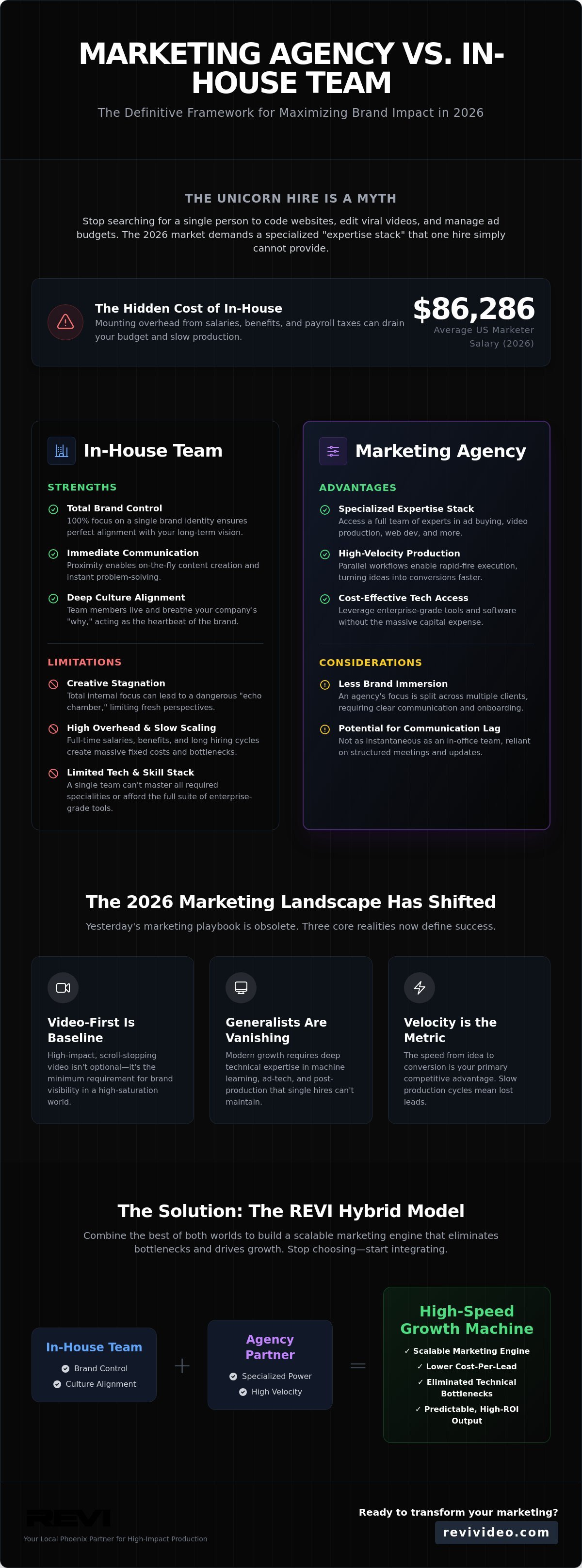
Why are you still searching for a “unicorn” hire who can code a high-performing website, edit viral videos, and manage six-figure ad budgets for the price of one salary? With the average US marketer earning over $86,286 in 2026, building a full team in-house often leads to massive overhead without the specialized velocity you actually need. You want results, not a mounting pile of payroll taxes and slow production cycles. It’s a common frustration; you need professional-grade content that converts but don’t have the time to micromanage every creative detail.
This article provides the definitive framework for the marketing agency vs in-house debate to help you maximize your brand’s impact this year. You’ll discover how to build a scalable marketing engine that lowers your cost per lead and eliminates technical bottlenecks. We are diving into the data on AI-driven cost reductions and the hybrid models that allow modern brands to outpace the competition. Stop settling for yesterday’s slow output and start leveraging the high-speed tools of tomorrow. Get ready to transform your marketing from a cost center into a high-speed growth machine.
Key Takeaways
- Stop hiring generalists for a specialist world. Learn why the 2026 market demands a technical and creative “expertise stack” that single hires can’t provide.
- Master the definitive framework for the marketing agency vs in-house decision to maximize your brand’s visibility without the burden of massive overhead.
- Discover how professional-grade video production and high-velocity content cycles drive conversions faster than traditional in-house workflows.
- Uncover the hidden costs of full-time salaries and benefits that drain your budget while slowing down your marketing engine.
- Explore the REVI Hybrid Model to combine internal brand control with the specialized power of a local Phoenix partner.
The 2026 Marketing Landscape: Why the Agency vs In-House Debate Has Changed
The 2026 market is a battlefield of noise. High-saturation isn’t just a buzzword; it’s your daily reality. Video-first content is now the baseline for any brand that wants to survive. If you aren’t producing high-impact video that stops the scroll, your brand is effectively invisible. This shift has fundamentally rewritten the rules of the marketing agency vs in-house debate. You no longer need someone to simply “do marketing.” You need a high-velocity engine that integrates expert ad buying, professional video production, and technical web development into a single, seamless workflow.
Generalist roles are vanishing. In the past, a single marketing manager could handle social posts, emails, and maybe a basic ad campaign. Today, that approach is a recipe for stagnation. Modern audience growth requires deep technical expertise in machine learning algorithms and automated ad-tech. Velocity is your new primary metric. Marketing velocity is the speed from idea to conversion. If your team takes weeks to move from a creative concept to a live, optimized ad, you’ve already lost the lead to faster, more agile competitors.
The Rise of the Specialized Content Creator
A single hire cannot master the technical demands of 2026. Professional video production requires more than a smartphone and a ring light. It demands high-end gear, specialized lighting, and advanced post-production skills that convert attention into revenue. When you look at the structure of a modern advertising agency, you see a team of specialists working in parallel. This allows for rapid-fire execution that an internal generalist simply can’t match. One person trying to manage your brand building, design, and video production will eventually hit a wall, resulting in slow production cycles and missed opportunities.
The Technology Gap
The cost of the “tech stack” has skyrocketed. High-end ad-tech, machine learning tools, and professional production software are massive investments for a single brand. Agencies solve this by amortizing these costs across dozens of clients. You get access to enterprise-grade tools without the enterprise-grade price tag. This efficiency is why many brands are moving away from heavy internal overhead. They want the power of a full production house and a data-driven ad team without the high cost of full-time salaries. By leveraging an agency’s tech stack, you turn a massive capital expense into a predictable, high-ROI investment.
The Case for In-House: Brand Proximity and Internal Control
Building an internal team is a strategic move toward total brand immersion. When you hire for a role, that person lives and breathes your company culture every single day. They don’t split their focus between multiple accounts or competing priorities. This 100% focus on a single brand identity is the strongest argument for an internal setup in the marketing agency vs in-house comparison. It ensures that every post, email, and update aligns perfectly with your long-term vision. You maintain complete control over the narrative without waiting for an external partner to catch up on your latest pivot.
Immediate communication is another massive win. You can walk across the office or jump on a quick Slack huddle to solve problems in seconds. This proximity enables “on-the-fly” content opportunities that agencies might miss. If something exciting happens at your headquarters, your team captures it instantly. For basic, repetitive tasks like community management or simple graphic updates, an in-house team can often lower long-term costs. They provide the institutional knowledge that keeps your brand equity stable over years of growth.
Culture and Brand Alignment
In-house teams excel when they act as the heartbeat of your brand. They understand the “why” behind your business better than any outsider. This makes them incredibly effective at day-to-day social media engagement. They aren’t just following a style guide; they are the style guide. The “sweet spot” for an internal team is managing the pulse of your community and ensuring that your core message remains consistent across every touchpoint. This deep alignment builds a foundation of trust that resonates with your audience.
The Limitations of the Internal Model
Total control can lead to a dangerous “echo chamber.” When your team only talks to each other, creative stagnation is inevitable. You lose the fresh perspective that an outside partner brings to the table. Scaling is also a significant barrier in the marketing agency vs in-house debate. If you need to launch a high-velocity campaign, your small internal team will likely hit a production bottleneck. They simply don’t have the specialized depth to handle advanced ad buying and technical web development simultaneously. When internal speed lacks technical precision, it becomes a liability rather than an asset. If your team is hitting a wall with creative output, integrating professional video production can help break through the noise and scale your impact quickly.
The Agency Advantage: Specialized Expertise and High-Impact Production
Hiring a single “rockstar” marketer is a 2015 strategy that fails in 2026. When you choose an agency, you unlock the “Expertise Stack.” You aren’t just paying for a person; you’re accessing a specialized department of media buyers, creative directors, and technical developers for the cost of one mid-level salary. This multi-layered approach is the core differentiator in the marketing agency vs in-house debate. It replaces the limitations of a single hire with the collective power of professionals who spend 40 hours a week mastering their specific craft.
Agencies also drive innovation through cross-industry experience. Because they manage diverse accounts, they spot platform shifts and audience trends months before they hit the mainstream. They bring a “lab-tested” perspective to your brand, applying winning strategies from other verticals to your specific market. This prevents creative stagnation and ensures your strategy remains at the cutting edge of digital performance. You gain the benefit of thousands of hours of testing without spending your own budget on the learning curve.
Professional Video Production vs. Internal Content
High-end video production is the primary differentiator for lifestyle brands in markets like Phoenix, Scottsdale, and Gilbert. While raw, smartphone-shot content has its place, it cannot build the deep customer trust required for high-ticket conversions. Professional storytelling requires cinematic equipment, controlled lighting, and advanced sound design that internal teams rarely possess. At REVI, we link professional filming directly to viral brand growth. We create assets that stop the scroll and command attention. This level of production quality signals authority and positions your brand as a leader rather than a follower in a saturated digital landscape.
Strategic Ad Buying and ROI Optimization
Media planning is no longer a part-time task for a social media manager. It’s a high-stakes science of optimization that requires dedicated specialists. Agencies maintain direct platform relationships and leverage advanced machine learning tools to ensure every dollar of ad spend works harder. They don’t just “buy ads”; they engineer high-performing funnels that adapt to real-time data. This specialized focus is often the deciding factor when comparing a marketing agency vs in-house setup. Ad buying is a science of optimization, not just a purchase. When you have experts managing your budgets, you move from “hoping for clicks” to “predicting revenue.”
To start building a more predictable growth engine, you can check out Exclusive Business Marketing and see how their specialized approach drives results.
Calculating the Real ROI: Comparing Costs and Performance
The sticker price of a salary is just the beginning. As of June 2026, the average salary for a marketer in the United States reached $86,286 per year. If you are looking for a mid-level individual contributor, that median jumps to $110,000. Once you add payroll taxes, health insurance, 401k matching, and office space, your “single hire” is costing you significantly more than their base pay. In the marketing agency vs in-house calculation, these hidden costs often drain budgets before a single ad even goes live. You are paying for presence, not just performance.
The “Tooling Tax” is another silent killer of internal margins. Professional creative suites, high-end ad-tech, and analytical software require thousands in annual licensing fees. Agencies amortize these costs across their entire client roster, giving you enterprise-grade power without the individual bill. Beyond the software, consider the cost of missed opportunities. If your internal team takes three weeks to produce one video while a competitor launches five, you are losing market share every day. Slow production cycles are a direct tax on your brand’s growth potential.
Talent Acquisition vs. Agency Retainers
Finding a top-tier video producer or ad buyer in the Phoenix, Scottsdale, and Gilbert markets is increasingly difficult. Competition for talent is fierce. While a senior-level marketer earns between $110,000 and $160,000, an agency provides an entire team of specialists for a fraction of that total overhead. You also avoid the “Turnover Risk.” When your only marketing hire leaves, your entire strategy grinds to a halt. An agency ensures continuity, keeping your marketing engine running regardless of individual staff changes. It’s about building a system that doesn’t break when one person walks out the door.
The Scalability Factor
Agencies offer the unique ability to turn the volume up or down based on your specific seasonality. You don’t need to fire people during slow months or scramble to hire during peak seasons. This financial flexibility is vital for high-velocity growth. Whether you need a massive push for a new website development project or a specialized brand building campaign, you can scale your resources instantly. If you are ready to stop managing people and start managing results, check out The Ultimate Guide to Choosing a Video Production Agency in Phoenix to see how a local partner can accelerate your timeline. You can optimize your marketing spend today by shifting from fixed overhead to a results-driven agency model.
The REVI Hybrid Model: Why a Local Phoenix Partner is the Ultimate Shortcut
Stop treating the marketing agency vs in-house decision like a zero-sum game. In 2026, the most successful lifestyle and tech brands don’t choose one over the other; they embrace the hybrid model. You keep your core strategy and brand vision internal while outsourcing the high-stakes execution to a specialized partner. This approach gives you the best of both worlds: total brand control and the technical velocity of a full production house. You move faster, spend smarter, and eliminate the production bottlenecks that stall growth.
REVI positions itself as the visionary partner for brands ready to scale. We provide a frictionless experience by integrating your three most critical growth pillars into one workflow. Instead of managing three different vendors for your website, your ads, and your creative, you get a single, high-energy engine. We remove the tedious barriers that keep your ideas from reaching your audience. When your strategy meets our execution, you create a scalable marketing system that doesn’t require constant hand-holding.
Local Expertise in the Phoenix Market
Local context is the secret weapon of high-converting content. In the 2026 digital space, generic stock footage and sterile studio shots don’t build trust. Your audience in Phoenix, Scottsdale, and Gilbert wants to see their world reflected in your brand. Using local landmarks and cultural cues in your Commercial Video Production in Phoenix creates an immediate emotional connection. It signals that your brand is a real, active part of the community.
Speed is the other major advantage of a local partner. We can be on-site in Scottsdale or Tempe in minutes to capture “on-the-fly” content that your competitors miss. This geographic proximity allows for a level of agility that national agencies can’t touch. We offer:
- Rapid-response filming for time-sensitive brand updates
- Authentic desert lighting and scenery that resonates with Valley residents
- Deep knowledge of the Phoenix consumer’s buying habits and preferences
Your Vision, Our Execution
We don’t replace your team; we empower them. REVI integrates directly with your existing staff to remove the technical hurdles of high-end video production and complex ad buying. You provide the brand soul, and we provide the technical muscle. This collaboration ensures that your marketing agency vs in-house strategy remains lean and focused on results. We take the guesswork out of your digital presence, turning complex backend technology into a simple, rewarding experience. It’s time to stop managing overhead and start hitting your KPIs. Ready to scale? Let’s build your brand today.
Build Your High-Velocity Marketing Engine
Success in 2026 depends on your ability to outpace the competition. You don’t need more overhead; you need more impact. The marketing agency vs in-house decision is now a question of velocity and technical precision. By leveraging a hybrid approach, you maintain your core brand soul while accessing the specialized talent stack required for modern visibility. You’ve seen how agencies amortize the costs of high-end tech and professional gear, giving you an immediate edge in production speed and ad optimization.
REVI is the visionary partner for Phoenix lifestyle brands that value time and results. We provide a frictionless experience by combining integrated ad buying with professional video production. Our results-driven content strategy removes the tedious barriers that stall most internal teams. Stop settling for slow output and start scaling your visibility today.
Stop wasting time on slow production. Partner with REVI today.
Your brand deserves a scalable engine that works as hard as you do. Let’s start building your future now.
Frequently Asked Questions
Is it cheaper to hire a marketing agency or an in-house team?
An agency is significantly more cost-effective for most businesses because you avoid the high overhead of full-time salaries. With the average US marketer earning over $86,286 in 2026, a single hire often costs more than an entire agency team. You gain access to a full stack of specialists in ad buying and video production without the burden of benefits, taxes, and office space. It’s about paying for results, not just a person in a chair.
What are the main disadvantages of hiring a marketing agency?
The primary trade-off is brand proximity. An agency won’t be in your office every day to catch “on-the-fly” moments or subtle internal culture shifts. Communication can sometimes feel less immediate than walking across the hall to a colleague’s desk. You must be intentional about sharing your internal vision to ensure the external team stays perfectly aligned with your evolving goals and brand identity.
Can a marketing agency work with my existing in-house team?
Absolutely, and this hybrid approach is the 2026 standard for high-velocity growth. Your internal lead manages the brand strategy while the agency handles the heavy lifting like technical website development and cinematic video production. This partnership removes production barriers and lets your team focus on high-level decision-making while we handle the specialized execution. It’s the most efficient way to scale without adding massive payroll debt.
How do I know if my business is ready for a full-service agency?
You’re ready when your growth hits a technical wall. If your current team can’t keep up with the demand for high-end video or if your ad buying isn’t hitting its KPIs, it’s time to scale. Businesses ready for an agency usually have a clear product-market fit but lack the specialized talent stack and advanced ad-tech required to dominate their digital landscape. When internal bottlenecks stall your revenue, an agency provides the necessary shortcut.
What marketing tasks should I keep in-house?
Keep the heartbeat of your brand internal. Daily community management, real-time social media engagement, and core company culture should stay in-house. These tasks require the deep brand immersion that only someone living the mission every day can provide. Use your internal team for the brand’s “what” and the agency for the high-impact “how.” This balance ensures your marketing agency vs in-house strategy remains lean and effective.
How does an agency handle brand voice better than an in-house hire?
Agencies refine your brand voice through a lens of data-driven performance. While an in-house hire knows the “vibe,” an agency knows what actually converts in the competitive 2026 market. We use professional storytelling and cross-industry experience to sharpen your message, ensuring it resonates with a wider audience while maintaining its authentic core. This objective perspective prevents the creative stagnation that often plagues internal teams after a few years.
What is the typical ROI when switching from in-house to an agency?
Switching to an agency typically results in a lower cost per lead and a massive jump in content velocity. Agencies leveraging AI tooling have seen content creation and reporting costs drop by 20-35 percent as of June 2026. You get a higher volume of professional-grade assets that drive conversions faster than a single internal hire ever could. The ROI comes from replacing slow, manual processes with a high-speed, automated engine.
Why should I choose a local Phoenix agency over a national firm?
Local relevance builds immediate trust. A Phoenix agency understands the specific culture, landmarks, and desert lighting that resonate with Valley residents. We can be on-site in Scottsdale or Gilbert in minutes to capture authentic content that national firms simply can’t replicate. It’s the ultimate shortcut to a professional-grade digital presence that feels like home. Plus, the marketing agency vs in-house debate is easier to solve when your partner is just a short drive away.