
Your production budget is gone, your content calendar is full, and your videos are still getting skipped. That’s the brutal reality of social media video production in 2026: making videos isn’t enough anymore. The platforms have changed the game. The algorithms don’t reward effort; they reward engineering.
You already know the frustration. You’ve paid the freelancers, briefed the editors, and approved the final cut, only to watch a polished corporate-looking Reel collect dust while a shaky 15-second clip from a competitor racks up a hundred thousand views. The gap between “we made a video” and “we built a high-performance asset” has never been wider, and most brands are still stuck on the wrong side of it.
This guide closes that gap. You’ll learn exactly how to engineer scroll-stopping social video content built for 2026’s algorithmic logic, from creative strategy to final ad placement, so every dollar you spend on production actually works harder. We’re covering the full picture: what the platforms are rewarding right now, how to streamline your content engine, and how integrated production and ad buying transforms raw footage into measurable audience growth.
Key Takeaways
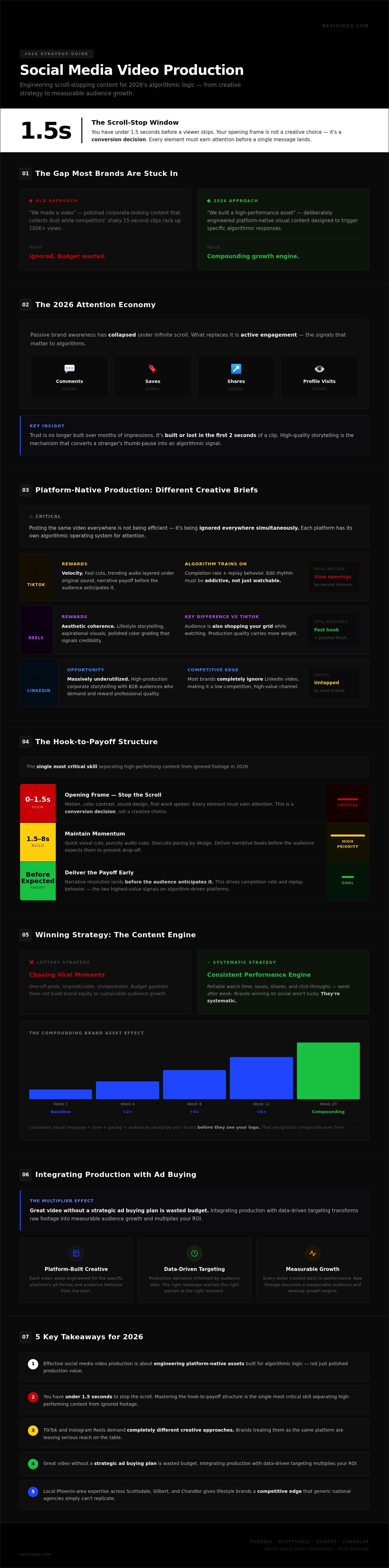
- Effective social media video production in 2026 is about engineering platform-native assets built for algorithmic logic, not just polished production value.
- You have under 1.5 seconds to stop the scroll — mastering the hook-to-payoff structure is the single most critical skill separating high-performing content from ignored footage.
- TikTok and Instagram Reels demand completely different creative approaches, and brands that treat them as the same platform are leaving serious reach on the table.
- Great video without a strategic ad buying plan is wasted budget — discover how integrating production with data-driven targeting multiplies your ROI.
- Local Phoenix-area expertise across Scottsdale, Gilbert, and Chandler gives lifestyle brands a competitive edge that generic national agencies simply can’t replicate.
Why Social Media Video Production is the Core of 2026 Growth
Social media video production isn’t just filming and editing anymore. In 2026, it’s the deliberate engineering of platform-native visual assets designed to trigger specific algorithmic responses and audience behaviors. The distinction matters enormously. Brands still treating video as a content checkbox are funding their own irrelevance.
The scroll-stop window is brutal: under 1.5 seconds. That’s the entire margin between a view and a skip. Your opening frame isn’t a creative choice; it’s a conversion decision. Every element, the motion, the color contrast, the sound design, the first word spoken, has to earn attention before a single message lands. Professional social media video production is built around this constraint from the very first brief.
The shift that defines 2026 isn’t about going viral. Chasing viral moments is a lottery strategy. What actually drives sustainable growth is consistent performance: a content engine that delivers reliable watch time, saves, shares, and click-throughs week after week. Brands winning on social right now aren’t lucky. They’re systematic.
The 2026 Attention Economy
Modern audiences don’t passively absorb brand content; they filter it at speed. Passive brand awareness, the idea that repeated exposure alone builds affinity, has collapsed under the weight of infinite scroll. What replaces it is active engagement: comments, saves, shares, and profile visits that signal genuine interest to platform algorithms. High-quality storytelling is the mechanism that converts a stranger’s thumb-pause into that signal. Trust isn’t built over months of impressions anymore. It’s built or lost in the first two seconds of a clip.
The content rhythm that performs in this environment is staccato by design: quick visual cuts, punchy audio cues, and narrative payoffs delivered before the audience expects them. This isn’t lo-fi content. It’s precision-engineered pacing that most in-house teams simply aren’t structured to produce consistently.
Video as a Strategic Brand Asset
One-off posts don’t build brands. A cohesive video content library does. When every asset shares consistent visual language, tone, and pacing, the cumulative effect compounds. Audiences start to recognize your brand before they see your logo. That recognition is worth more than any single viral moment.
Professional design elevates how your brand reads inside a crowded feed. The production quality signals credibility instantly, and for established brands, that signal directly influences purchase intent. This is why the smartest growth-oriented businesses treat video production as brand infrastructure, not a line item. If you’re building that foundation, understanding how it connects to your broader identity is essential. The Ultimate Guide to Choosing a Branding Agency in Phoenix (2026 Edition) breaks down exactly how to align your visual production strategy with long-term brand equity.
Lo-fi content has a place, but it’s not the whole strategy for brands with serious growth targets. When consistency, quality, and algorithmic intelligence work together, every video you publish becomes a compounding asset, not a one-time bet.
Platform-Native Production: TikTok, Reels, and Beyond
Every platform runs on a different operating system for attention. Post the same video everywhere and you’re not being efficient; you’re being ignored everywhere simultaneously. The brands pulling serious reach in 2026 treat each platform as its own creative brief, because algorithmically, that’s exactly what it is.
TikTok rewards velocity. Fast cuts, trending audio layered under original sound, and a narrative that delivers its payoff before the audience anticipates it. The platform’s For You Page is trained on completion rate and replay behavior, which means your edit rhythm has to be addictive, not just watchable. Slow openings don’t get second chances here.
Instagram Reels operates on a different frequency. Aesthetic coherence matters. Lifestyle storytelling, aspirational visuals, and a polished color grade signal credibility to an audience that’s also shopping your grid while they watch. The hook still needs to hit fast, but the overall production quality carries more weight than it does on TikTok.
LinkedIn Video is the underutilized asset most brands completely ignore. High-production corporate storytelling, thought leadership narratives, and behind-the-scenes brand authority content perform exceptionally well with a B2B audience that’s actively looking for reasons to trust you before they ever reach out.
YouTube Shorts is the bridge. A well-crafted Short drives profile visits, and profile visits convert into long-form subscribers. That long-form audience is your highest-intent, most loyal segment. Shorts aren’t a standalone play; they’re the top of a funnel that deepens brand authority over time.
Optimizing for the Feed
9:16 vertical video isn’t a preference in 2026; it’s the technical baseline for competitive social media video production. Beyond aspect ratio, safe zones matter enormously. Platform UI elements, captions, and interactive overlays eat into the bottom 20-30% of your frame on most apps. Shoot with that dead zone in mind, or your key visuals get buried under a like button. Sound-on production is equally non-negotiable for TikTok and Reels: audio design, voice pacing, and sound-reactive editing directly influence algorithmic push. A video that only works on mute is a video that underperforms.
Cross-Platform Strategy
One high-end shoot doesn’t have to produce one asset. Structured correctly, a single production day generates platform-specific cuts for TikTok, Reels, LinkedIn, and Shorts, each edited to match that platform’s native rhythm and audience expectation, while keeping visual language consistent across all of them. That’s the efficiency play serious brands are running right now. REVI’s end-to-end video production approach is built precisely for this: one cohesive creative strategy that multiplies into a full content ecosystem without the brand losing its identity in translation.
The REVI Production Blueprint: Strategy to Final Cut
Most production processes start with a camera. REVI’s starts with a question: what does this video need to make a viewer do? That distinction drives every decision that follows, from the first creative brief to the final export file. It’s a four-phase process built specifically for the performance demands of modern social media video production.
Phase 1: Creative Strategy. Before a single shot is planned, the hook and the payoff are locked. The hook is the specific visual or audio trigger engineered to stop the scroll in under 1.5 seconds. The payoff is the emotional or informational reward that makes the viewer glad they stayed. These two elements are defined explicitly in the brief, not discovered in the edit. That clarity is what separates intentional content from expensive guesswork.
Phase 2: High-Performance Filming. Professional gear creates the cinematic signal that tells an audience your brand is worth their attention. Sharp focus, controlled exposure, and deliberate depth of field don’t just look good; they communicate credibility instantly inside a crowded feed. The technical baseline matters.
Phase 3: Staccato Editing. The edit rhythm is where performance lives. Punchy cuts timed to audio cues, motion-driven transitions, and narrative payoffs delivered ahead of expectation keep completion rates high. Every second that doesn’t earn its place gets cut.
Phase 4: Optimization. Graphics, captions, and calls-to-action aren’t afterthoughts. They’re conversion infrastructure layered in with the same precision as everything else.
Pre-Production: Planning for Impact
Storyboarding for social means obsessing over the first three seconds before worrying about anything else. Location scouting across the Phoenix metro, including Scottsdale, Gilbert, and Chandler, gives lifestyle brands access to environments that match their visual identity without manufacturing atmosphere artificially. Crucially, KPIs are identified before cameras roll: watch time targets, click-through benchmarks, and save-rate goals that give the edit a measurable objective, not just an aesthetic one.
Post-Production: The Magic is in the Edit
Motion graphics reinforce brand identity at the frame level, making every asset instantly recognizable even before a logo appears. Color grading is calibrated for that high-end lifestyle feel that performs on Reels and elevates perceived brand value across every platform. The final polish, the layer that separates a competent video from a high-performance asset, comes from dedicated video editing services that treat the edit as a strategic tool, not a finishing step. That’s the difference between footage and a brand asset that actually compounds over time.
Maximizing ROI: Integrating Production with Ad Buying
Great video without a distribution strategy is an expensive hobby. You can engineer the perfect hook, nail the edit rhythm, and still watch your budget evaporate if the wrong audience sees it at the wrong time through the wrong placement. Most agencies treat production and ad buying as separate departments. That separation is where ROI goes to die.
ROI in social video ad spend means every dollar invested in production and placement generates measurable audience action, whether that’s a click, a conversion, or a loyal follower, at a cost that scales sustainably. That definition matters because it forces production decisions and media decisions into the same conversation from day one.
REVI’s integrated approach collapses that wall entirely. Creative strategy and ad buying logic inform each other before a single frame is shot. That’s not a workflow tweak; it’s a fundamentally different way to build a content engine.
Media Planning for Social Video
Budget allocation isn’t a 50/50 split. Top-of-funnel awareness content, the broad-reach video that introduces your brand to cold audiences, needs different creative logic than bottom-of-funnel conversion ads targeting warm leads who’ve already engaged. TOFU content prioritizes reach and watch time. BOFU content prioritizes click-through and purchase intent. Running the same video for both objectives is one of the most common and costly mistakes brands make.
Commercial video production built for Meta and TikTok ad campaigns requires this funnel-stage thinking baked into the brief. A 15-second hook-driven clip designed for cold TikTok traffic won’t perform the same job as a 30-second testimonial retargeting a warm Instagram audience. Each asset needs a defined role before it’s scripted.
A/B testing different video hooks is non-negotiable. Run two versions of the same ad with different opening three seconds and let the data decide. The winning hook informs the next production cycle. That’s not guesswork; that’s a system.
Scaling with Efficiency
The Creative Feedback Loop is where smart brands pull ahead. Ad performance data, specifically which hooks drive the highest completion rates, which CTAs generate the lowest cost per acquisition, and which audience segments respond to which visual styles, feeds directly back into the next production brief. Each shoot gets smarter. Each campaign gets cheaper to run at scale.
High-quality creative assets reduce CPA because platforms reward relevance. Meta and TikTok’s algorithms actively lower distribution costs for content that earns strong engagement signals. Better social media video production isn’t just a brand play; it’s a media efficiency play. The production investment pays back through reduced ad spend on every subsequent campaign.
For brands looking to pair high-performance creative with expert distribution, you can discover Millennium Marketing Agency to refine your targeting strategy across Meta and TikTok.
REVI’s model combines technical ad buying expertise with precision visual storytelling, so Phoenix-area lifestyle brands aren’t choosing between looking great and performing efficiently. They get both, engineered together from the first brief to the final placement. Talk to REVI about building a production and ad strategy that compounds.
Scaling Your Brand with Phoenix’s Top Production Agency
Generic national agencies don’t know what the light looks like in Paradise Valley at golden hour. They don’t know the visual language of Scottsdale’s luxury lifestyle market, or how Gilbert’s fast-growing consumer base responds differently to aspirational content than the established East Valley demographic in Chandler. That local intelligence isn’t a nice-to-have. For lifestyle brands competing in the Arizona market, it’s a measurable creative advantage.
Phoenix-area production isn’t just about geography. It’s about access. The Southwest offers a visual environment that no studio set can replicate: dramatic desert landscapes, architectural contrast, and year-round shoot-ready weather that keeps production timelines tight and location costs low. Brands that tap into that environment build a visual identity that’s genuinely distinctive inside a national feed full of generic backdrops.
Local Production, Global Reach
REVI operates across the full Phoenix metro, from Paradise Valley and Scottsdale to Mesa and Tempe, giving lifestyle brands access to the region’s best locations and a production team that understands the local talent pool. But the reach extends far beyond Arizona. The assets built here are engineered for national and international algorithmic performance. That’s the combination most agencies can’t offer: hyper-local creative intelligence paired with platform-native social media video production built to scale. As a full-service local video production company, REVI brings design, web, video, and ad buying under one roof, which means your brand’s visual identity stays consistent from the first creative brief to the final paid placement. No handoff friction. No message dilution. One team, one strategy, compounding results.
Ready to Dominate the Feed?
REVI’s commitment is straightforward: high-energy, results-driven content that earns its place in the feed every single time. Not polished for the sake of polish. Not creative for the sake of creativity. Every asset is built with a performance objective baked in from day one, because great-looking video that doesn’t move the needle isn’t an asset; it’s an expense.
Your 2026 content strategy doesn’t have to be a guessing game. The brands pulling ahead right now aren’t outspending their competitors. They’re out-engineering them, with smarter briefs, sharper edits, and integrated ad strategies that make every dollar compound.
That’s exactly what REVI builds. If your current social media video production isn’t generating the reach, engagement, and growth your brand deserves, the gap isn’t your budget. It’s your system.
Book a consultation with REVI and build the content engine your brand needs to own the feed in 2026. The scroll doesn’t wait. Neither should you.
Build the Content Engine That Owns 2026
The brands winning on social right now aren’t outspending their competitors. They’re out-engineering them. Every concept covered here points to the same truth: effective social media video production is a system, not a service. Platform-native creative strategy, precision editing, and integrated ad buying all have to work together, or none of them work at all.
Three things separate brands that compound from brands that stagnate: they build assets with algorithmic logic baked in from day one, they connect production decisions directly to media performance data, and they work with specialists who understand both sides of that equation.
REVI brings all three together. Expert ad buying integration, high-end lifestyle brand expertise, and a Phoenix-based production team that knows the local market and builds for global reach. That’s not a combination most agencies can offer.
Your next campaign doesn’t have to be a gamble. Scale your brand with high-performance video production and contact REVI today. The feed rewards the prepared. Start building your advantage now.
Frequently Asked Questions About Social Media Video Production
What is included in social media video production?
Professional social media video production covers the full pipeline from creative strategy through final delivery: concept development, scripting, location scouting, filming, editing, motion graphics, color grading, caption integration, and platform-specific formatting. It’s not just shooting footage. Every phase is engineered to serve a specific performance objective on a specific platform.
At REVI, the process also folds in ad buying strategy from the start, so the assets built during production are already optimized for paid placement. That integration is what separates a high-performance content engine from a collection of polished clips that don’t convert.
How much does professional social media video production cost in 2026?
Production costs vary significantly based on scope: number of assets, shoot days, talent, locations, and post-production complexity all factor in. A single-platform campaign looks very different from a full cross-platform content system built for TikTok, Reels, LinkedIn, and Shorts simultaneously. Rather than working from a generic price range, the smarter question is what return you need the investment to generate.
Contact REVI directly to discuss your brand’s specific goals and get a scoped proposal. Pricing tied to a clear performance objective is always a better investment than a flat production quote with no strategic context behind it.
How long does it take to produce a social media video campaign?
A focused single-platform campaign can move from brief to final delivery in two to three weeks when pre-production is tight and approvals move efficiently. Multi-platform campaigns with multiple asset variations typically require four to six weeks to execute properly, accounting for strategy, shoot days, editing, revisions, and platform optimization.
Rushing the pre-production phase almost always costs more time in the edit. Locking the hook, the payoff, and the platform-specific requirements before cameras roll is what keeps timelines clean and final assets performing at the level they were designed to hit.
Do I need different videos for TikTok and Instagram Reels?
Yes, and brands that skip this step consistently underperform on both platforms. TikTok rewards velocity: fast cuts, trending audio, and payoffs delivered before the audience expects them. Reels rewards aesthetic coherence and aspirational visual quality. The same clip optimized for one will feel off-rhythm on the other, and algorithms penalize content that doesn’t match native platform behavior.
The efficient solution isn’t shooting twice. A structured single production day can generate platform-specific cuts for both, edited to match each platform’s native rhythm while keeping your brand’s visual identity consistent across every asset. That’s the cross-platform strategy serious brands are running right now.
Why should I hire a video production agency instead of using an in-house team?
In-house teams are great for speed and brand familiarity, but they’re rarely structured to produce the volume, variety, and technical precision that consistent algorithmic performance demands. Professional gear, dedicated editors, motion graphics specialists, colorists, and strategic ad buying expertise don’t typically live under one roof inside a brand’s marketing department.
An agency like REVI also brings data from across multiple campaigns, so the creative decisions informing your brief aren’t based on internal assumptions. They’re based on what’s actually driving completion rates, saves, and conversions right now across real campaigns at scale.
How do you measure the success of a social media video?
Success metrics depend entirely on the funnel stage the asset is designed for. Top-of-funnel content is measured by watch time, reach, and completion rate. Mid-funnel content tracks saves, shares, and profile visits. Bottom-of-funnel conversion assets live and die by click-through rate and cost per acquisition. Running the same measurement framework across all three stages gives you misleading data.
KPIs should be defined before production begins, not after the video is live. When the edit knows what it’s optimizing for, every creative decision, pacing, CTA placement, caption structure, serves a measurable objective rather than an aesthetic preference.
Can REVI help with both the filming and the ad placement?
Yes. REVI’s model integrates video production and ad buying under one strategy, which means creative decisions and media decisions inform each other from the first brief. You’re not handing footage to a separate media buyer who had no input on how it was made. The whole system is built together, so assets are already optimized for their intended placements before they go live.
This integration directly impacts performance. Platforms like Meta and TikTok reward content that earns strong engagement signals with lower distribution costs, so better-engineered creative reduces your cost per acquisition over time. Production and ad buying working in isolation is one of the most expensive inefficiencies a brand can run.
What makes a social media video go viral in 2026?
Viral isn’t a strategy; it’s an outcome. What you can engineer is the conditions that make virality more likely: a hook that stops the scroll in under 1.5 seconds, a narrative payoff that rewards the viewer for staying, and edit pacing that drives completion and replay behavior. Those signals tell the algorithm your content is worth pushing to a wider audience.
Consistency compounds what luck can’t sustain. Brands that build a repeatable social media video production system, one where every asset has a defined hook, a clear payoff, and platform-native formatting, generate algorithmic momentum over time. That’s not a viral moment. It’s a growth engine, and it’s far more valuable.