

What good are thousands of ad impressions if they reach the wrong people or don’t lead to action? For Gilbert businesses, a programmatic display advertising agency Gilbert companies partner with should connect audience targeting to relevant creative and clear campaign goals. Reach matters, but it’s only the start.
It’s reasonable to want to know where your ads may appear, how campaigns reach local audiences, and what the results mean. Programmatic buying uses automated technology to place ads, but strategy still shapes who sees them, which creative they see, and how performance is measured. When those pieces work together, campaigns can build visibility with relevant audiences across Gilbert and the wider East Valley.
This article explains how programmatic display campaigns work, what to look for in an agency’s strategy and reporting, and how to connect impressions and clicks to meaningful business outcomes. You’ll also see how REVI brings strategic media planning and ad buying together with video production, design, brand building, and website development, helping campaigns move from audience insight to creative and landing-page experience with a clear purpose.
Key Takeaways
- See how programmatic display differs from search ads, organic results, and social feed placements.
- Follow the campaign process from setting an objective to reviewing performance, with each step shaped by business goals and audience needs.
- Use clear criteria to assess a programmatic display advertising agency Gilbert businesses can work with, including audience rationale, placement visibility, creative, and reporting.
- Map your actual service area before setting geographic targeting, and distinguish Gilbert audiences from nearby East Valley markets when it matters.
- Learn how REVI connects strategic media planning and ad buying with design, video, branding, and website development to support a coherent campaign.
What a Programmatic Display Advertising Agency in Gilbert Does
Programmatic display advertising uses automated technology to buy and deliver digital ad placements. Instead of manually negotiating every placement, advertisers set campaign parameters and automated systems help match ads with available opportunities. The technology handles the buying process; strategy determines who the campaign aims to reach, where it should run, and what outcome it should support.
For a neutral overview of the process and its terminology, Programmatic advertising explains concepts such as demand-side and supply-side platforms. The practical takeaway is straightforward: automation can make ad buying more responsive, but it can’t replace a clear plan.
How programmatic display differs from other digital advertising
Display ads are visual placements that can appear across digital environments such as websites and apps. Search ads respond to active queries: someone looks for a service, and an ad may appear alongside results. Organic results aren’t paid placements. Social feed ads appear within social platforms, while programmatic display refers to the automated buying of display inventory. These channels can complement one another, but they aren’t interchangeable.
Display campaigns can support different goals. A business might use them to introduce its brand, stay visible while potential customers compare options, or reconnect with people who previously interacted with its website. The objective shapes the audience plan and placement choices. Not every campaign uses the same inventory, platforms, or targeting signals.
What a Gilbert business gains from agency support
A programmatic display advertising agency Gilbert businesses engage can connect media planning, ad buying, and data-informed targeting to a defined campaign goal. That means deciding what the campaign needs to accomplish before choosing where to spend, then using relevant audience and geographic signals to guide delivery.
Local planning matters. A Gilbert business serving customers in a defined part of the East Valley needs a different geographic plan from one serving a wider area. Treating the whole Phoenix metro as one audience can blur differences in service coverage, customer needs, and offers. An agency can build those distinctions into the media plan instead of relying on broad reach alone.
Strong support also makes the campaign easier to understand. The agency should explain the audience rationale, how media decisions connect to the objective, and what the performance signals mean. Impressions and clicks show activity, but the strategy should connect that activity to the result the business wants. Automation can speed up buying; thoughtful planning gives it direction.
How Programmatic Display Campaigns Reach and Engage Audiences
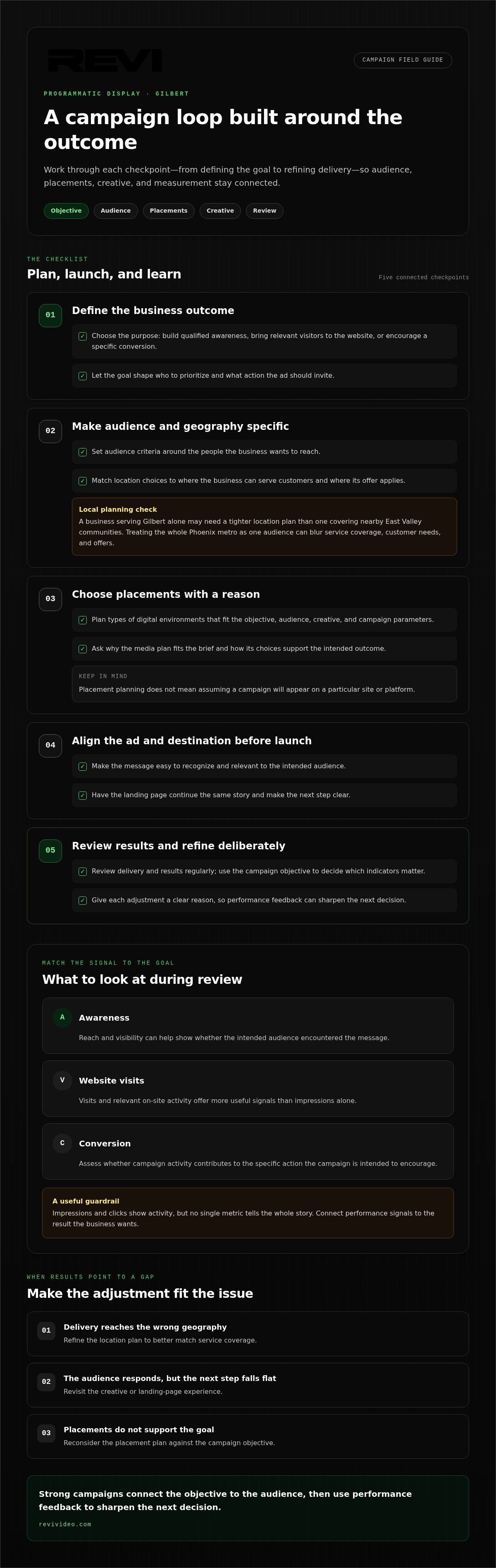
A programmatic campaign should follow a deliberate loop: define the objective, plan the audience, select suitable placements, launch the creative, and review the results. Each step shapes the next. Without a clear goal, even automated buying can deliver impressions that don’t help the business.
From campaign brief to audience and placement plan
Start with the business outcome. Is the campaign meant to build qualified awareness, bring relevant visitors to a website, or encourage a specific conversion? The answer helps determine which audience to prioritize and what action the ad should invite.
Next, make the audience and geography specific. A Gilbert business serving Gilbert alone may need a tighter location plan than one covering nearby East Valley communities. Audience criteria should reflect who the business wants to reach, while geographic choices should match where it can serve customers and where its offer applies.
Then plan placements that fit the objective, audience, creative, and campaign parameters. Placement planning means choosing appropriate types of digital environments, not assuming a campaign will appear on a particular site or platform. A programmatic display advertising agency Gilbert businesses work with should explain why the media plan fits the brief and how its choices support the intended outcome.
Launch, monitor, and refine the campaign
Before launch, align the ad creative with the audience and destination page. The message should be easy to recognize, and the landing page should continue the same story and make the next step clear. Once the campaign is running, review delivery and results regularly rather than waiting for a final summary.
Use the objective to decide which indicators matter. For an awareness campaign, reach and visibility can help show whether the intended audience encountered the message. For a campaign focused on website visits, visits and relevant on-site activity offer more useful signals than impressions alone. If the goal is a conversion, assess whether campaign activity contributes to that action. No single metric tells the whole story.
Use review findings to make practical adjustments. If delivery reaches the wrong geography, refine the location plan. If the audience responds but the next step falls flat, revisit the creative or landing-page experience. If placements don’t support the goal, reconsider the placement plan. Give each change a clear reason so the campaign can learn as it runs.
Strong campaigns connect the objective to the audience, then use performance feedback to sharpen the next decision. REVI brings strategic media planning and ad buying together with creative and web capabilities, helping businesses keep those pieces aligned. Explore REVI’s campaign strategy and ad buying as you consider how a focused local campaign could work for your business.
How to Evaluate a Programmatic Display Advertising Agency
Automated buying can make campaign delivery more efficient, but it shouldn’t make the decisions harder to understand. Start with a direct question: How will the agency make media spend, audience choices, placement decisions, and campaign changes clear? The answer should connect each decision to your business goal, not hide behind platform jargon or a dashboard full of unexplained numbers.
Use this framework to compare how an agency plans and manages campaigns:
| Area | What a clear approach explains |
|---|---|
| Strategy | How the objective shapes the media plan and what outcome the campaign is designed to support. |
| Audience rationale | Why the selected audience and geography fit your customers, service area, and offer. |
| Placement visibility | What types of digital environments are planned and how placement considerations are discussed. |
| Creative | How the ad message and design suit the audience and connect to the next step on your website. |
| Reporting | What results will be reviewed, how often the campaign will be discussed, and what decisions may follow. |
Look for transparent campaign management
A clear working relationship makes the logic visible: the goal informs audience choices, those choices guide media planning, and campaign results help shape the next decision. Placement visibility matters, too. The conversation should cover the kinds of environments being considered and how their suitability relates to your brand, without treating any specific site or placement as guaranteed.
REVI plans and purchases media, uses data-informed targeting, and connects campaign performance to the strategy. That keeps the conversation practical: what the campaign is trying to do, what the media plan is designed to support, and what the results suggest doing next.
Match measurement to the business goal
Impressions and reach can help assess whether an awareness campaign is delivering visibility. They don’t prove that people will buy. Clicks can show response, while site actions or conversions can help evaluate lower-funnel goals when tracking supports those measurements. Choose indicators that fit the objective, then interpret them in context instead of treating a large impression count as success on its own.
The journey doesn’t end at the ad. If someone clicks but lands on a slow, confusing, or mismatched page, the website experience can weaken the campaign. REVI’s website development and design capabilities can support a more consistent path from ad creative to landing page, helping each stage work toward the same business goal.
Planning a Local Display Campaign for a Gilbert Business
Local targeting works best when it starts with the business’s real service area, not an oversized map. A company serving Gilbert may also reach customers in nearby East Valley communities, but those locations shouldn’t automatically be grouped together. Differences in coverage, customer needs, or offers can call for separate audience plans and distinct campaign messages.
Set a useful geographic and audience focus
First, map where the business can actually serve customers. Then prioritize the areas that matter to the campaign. A Gilbert-only offer should focus on the relevant Gilbert audience; a service available across additional East Valley communities can have a broader plan that reflects that coverage. Avoid adding Phoenix-area locations simply to increase potential reach. If those areas aren’t relevant, broader targeting can dilute local focus.
Geography is only one part of relevance. Shape audience criteria and ad language around the intended customer and the offer that applies to them. If coverage or promotions differ between Gilbert and nearby communities, separate those audiences and make the distinction clear in the creative. A programmatic display advertising agency Gilbert businesses work with can translate service boundaries and campaign goals into a media plan that’s easier to understand and act on.
Connect display creative to the post-click experience
The ad and destination page should feel like one conversation. Keep the promise, location, and next step consistent: an ad aimed at Gilbert customers should lead to a page that speaks to the relevant service and audience, rather than a generic page with no clear connection. That continuity helps visitors understand what to do after a click.
Creative should earn attention quickly and make the offer easy to grasp. REVI’s commercial video production guide offers a starting point for thinking about video as part of a campaign’s creative mix. For related ideas on shaping a brand story through video, explore the Phoenix video production guide.
Before launch, check the full path: audience, geographic plan, ad message, destination page, and intended action. REVI brings ad buying together with design, video production, brand building, and website development, helping keep those campaign elements aligned. Explore REVI’s creative and campaign capabilities to plan a more consistent local display campaign.
How REVI Supports Programmatic Display Advertising in Gilbert
A local display campaign needs more than automated ad buying. It needs a clear objective, a relevant audience, creative that fits the message, and a useful destination after the click. REVI connects strategic media planning and purchasing with data-informed targeting, helping Gilbert businesses shape campaigns around their goals and the places they serve.
Bring ad buying, creative, and web experience together
When media planning, creative, and website experience work as separate pieces, a campaign can lose focus. An ad may catch someone’s attention, but a mismatched message or unclear landing page can make the next step harder. REVI’s connected capabilities help carry a consistent message from campaign planning through ad creative and onto the website.
Video production and design can help express a brand’s value in a way that suits the campaign’s audience and purpose. Brand building supports consistency, while website development helps shape the experience people encounter after they respond. The right creative choices depend on the campaign brief, so media decisions and assets should work together rather than rely on assumptions about a particular platform, placement, or format.
For a business serving Gilbert and nearby East Valley communities, that coordination can support more relevant messaging. If an offer or service area differs by location, campaign planning can reflect those distinctions instead of relying on one broad message for everyone.
Turn campaign goals into a practical next step
Start with four essentials: the business outcome, the audience you want to reach, the geography that matches your coverage, and the measures that will help assess progress. These choices give media planning a clear direction. They also keep campaign discussions focused on what the business needs, rather than activity that looks impressive but doesn’t serve the objective.
As a programmatic display advertising agency Gilbert businesses can work with, REVI connects ad buying with complementary creative and web capabilities. The approach is shaped around the campaign’s goals, audience, geography, and measurement priorities.
Ready to turn those priorities into a focused plan? Discuss your advertising goals and campaign needs with REVI, including the audiences you want to reach and the Gilbert-area locations that matter to your business.
Make Your Next Gilbert Campaign More Intentional
Programmatic display works best when automation follows a clear plan. Define the business goal, focus targeting on the audiences and locations that fit your service area, then use campaign feedback to guide the next decision. The right programmatic display advertising agency Gilbert businesses choose should make the strategy and its performance understandable, not bury them in ad metrics.
REVI connects strategic media planning and purchasing with data-driven audience targeting. Video production, design, brand building, and website development can support a consistent experience from the ad to the next step on your site. That alignment helps keep campaign messaging focused while you work toward meaningful business outcomes.
Start with the basics: what you want the campaign to accomplish, who you need to reach, which Gilbert-area locations matter, and how you’ll assess progress. Plan your next advertising campaign with REVI and turn those priorities into a practical direction for your business. A clearer plan is a stronger starting point for local growth.
Frequently Asked Questions
What does a programmatic display advertising agency do?
A programmatic display advertising agency Gilbert businesses work with helps plan and manage automated digital display campaigns. It clarifies the objective, identifies an intended audience, and shapes media choices around geography and campaign priorities. The agency handles strategic media planning and purchasing, applies data-informed targeting, and reviews campaign performance. Clear support also explains what the results show and which decisions may follow, rather than treating ad delivery as the whole job.
How does programmatic display advertising work?
Programmatic display ads are bought and delivered through automated systems that match campaign parameters with available digital placements. First, the business defines a goal, such as awareness, site visits, or conversions. Next, the plan sets audience and geographic criteria, selects suitable placement types, and prepares creative. After launch, the agency reviews delivery and indicators tied to the objective, then uses the findings to guide adjustments to audience, placement, or creative.
Can programmatic display ads target customers in Gilbert, Arizona?
Yes, a campaign can use geographic planning to focus on people in Gilbert and other areas the business serves. A local plan might distinguish Gilbert from Phoenix, Scottsdale, Mesa, Chandler, Paradise Valley, or Tempe when service coverage or offers differ. Geographic targeting uses defined criteria, but it shouldn’t be treated as pinpoint certainty about a person’s exact location or intent. Set boundaries around real service coverage, then monitor delivery and refine the plan.
How much should a small business spend on programmatic display advertising?
There isn’t one suitable budget for every small business. The amount depends on the campaign goal, intended audience, geographic scope, and overall campaign needs, including its duration and media plan. Start by deciding what you need the campaign to accomplish and which locations matter. Then plan spending around that scope and review whether delivery and performance indicators support continuing or adjusting the approach. A clear objective helps keep budget decisions connected to business priorities.
What metrics should I use to measure display advertising performance?
Choose metrics based on what the campaign is meant to achieve. For awareness, reach and impressions can indicate whether ads are being delivered to an audience, but they don’t prove sales. Clicks can help assess response, while site actions or conversions can measure next steps when tracking is in place and reliable. Review metrics together, compare them with the objective, and use the pattern to decide whether audience, creative, or placements need adjustment.
Is programmatic display advertising right for a local business?
Programmatic display can suit a local business that wants to build awareness, stay visible during consideration, or encourage a measurable next step. Fit depends on more than automated buying: the audience must match the business, geography must reflect where it serves customers, and creative must give people a relevant reason to respond. For businesses in Gilbert and nearby East Valley communities, align those choices with the campaign goal and review performance consistently.
How is programmatic display advertising different from Google Search ads?
Programmatic display and Google Search ads reach people differently. Search ads typically respond to a person’s active query, connecting with expressed intent in that moment. Display ads use visual placements to introduce a brand, support consideration, or re-engage an audience, depending on campaign setup. Neither channel replaces the other. A business can choose based on its goal, audience, and customer journey, or use them as complementary parts of a broader advertising plan.
How can a Gilbert business avoid wasted display ad spend?
Reduce wasted spend by defining a business outcome before choosing audiences or placements. Set geographic boundaries to match actual service coverage, rather than targeting the whole metro by default. Use creative that speaks to the intended customer and links to a relevant page with a clear next step. Review delivery and results regularly, then adjust audience criteria, placement choices, or messaging when evidence shows a mismatch. Don’t judge success by impressions alone.