

What good is a steady stream of PPC clicks if none of those visitors can approve a production run? For manufacturers, PPC management for manufacturing companies in Chandler needs to do more than drive traffic. Broad targeting can attract job seekers, consumers, and inquiries that don’t fit your capabilities, while the business buyers you want may take months to make a decision.
That longer sales cycle makes it harder to see which campaigns contribute to real opportunities. And when products are technical, a generic ad or landing page can leave qualified prospects unsure whether you’re the right fit. Clicks alone won’t tell you what’s working. Lead quality and pipeline signals matter.
This guide explains how to assess manufacturing PPC, connect campaign activity with qualified opportunities, and shape targeting and messaging around the business buyers you need to reach. You’ll also learn what to measure beyond clicks and how relevant creative and landing pages support a consistent buyer journey. REVI combines strategic media planning and ad buying with video production and website development to help align campaign touchpoints with your message.
Key Takeaways
- Set campaign goals around qualified inquiries, RFQs, sales conversations, and pipeline contribution, not just impressions and clicks.
- Build campaigns around the products, applications, and buyer problems reflected in relevant search intent.
- Use lead quality, sales acceptance, and opportunity progression to evaluate whether PPC is reaching the right prospects.
- Plan targeting, creative, landing pages, and review steps around your buyers and actual sales or delivery footprint.
- Effective PPC management for manufacturing companies in Chandler connects strategic media planning and data-driven optimization with clear reporting and relevant creative.
PPC management for manufacturing companies in Chandler: define results beyond clicks
Pay-per-click (PPC) is an advertising model where advertisers pay when someone clicks an ad. Managing manufacturing PPC takes more than setting bids. It involves planning campaigns, buying media, targeting business audiences, and optimizing performance as data comes in. The goal is to connect relevant buyer searches with inquiries your sales team can pursue, not simply generate activity.
Impressions show that an ad appeared, and clicks show that someone engaged. Neither confirms that a prospect needs your product or can buy it. More meaningful signals for a manufacturer may include a relevant inquiry, a request for quotation (RFQ), a sales-accepted lead, a sales conversation, or an opportunity that advances through the pipeline. Agree on these stages before launch so you can judge the campaign against business outcomes, not traffic alone.
Technical products often require research, internal discussions, and specification reviews before a purchase decision. A buyer might click an ad early in that process, then return through another channel before submitting an RFQ. Last-click reporting gives credit to only the final interaction, which can hide earlier ads that helped create demand. Review ad data alongside lead records and sales feedback for a fuller view of campaign contribution.
A qualified manufacturing PPC lead is an inquiry from a business buyer whose needs fit your capabilities, whose intent matches your offer, and whose details allow your sales team to take a relevant next step.
What should manufacturing PPC management achieve?
Start with your sales process and your team’s capacity to respond. If your sales team handles technical RFQs, define what makes a request actionable: the application, product requirements, company fit, and a reachable contact. Separate those inquiries from consumer questions, job applications, supplier pitches, and support requests. Then track whether sales accepts each lead and what happens next. With PPC management for manufacturing companies in Chandler, clear fit, intent, and follow-up criteria turn “more leads” into a measurable objective.
Why does Chandler location targeting need a business-first lens?
Choose geography based on where your buyers are and where your business can serve them. A Chandler manufacturer shipping nationally may need broader reach, while a company serving nearby facilities may prioritize a tighter area. Chandler-only targeting isn’t automatically the right fit. For businesses serving the Phoenix area, consider whether Phoenix, Scottsdale, Gilbert, Mesa, Chandler, Paradise Valley, or Tempe belong in the campaign based on actual buyer locations and sales or delivery coverage. Local landing-page details can establish relevance, but the offer, product information, and buyer intent should remain central. Location can refine a campaign; it can’t make an irrelevant query qualified.
How manufacturing PPC campaigns connect search intent to qualified inquiries
A campaign earns its value across a chain: a buyer searches for a specific capability, sees an ad that matches the query, lands on a relevant page, and decides whether to inquire. The sales team then follows up with context about the prospect’s needs. If any link breaks, even a strong click rate may not lead to a useful conversation. Content Marketing Institute’s research on paid advertising adoption by manufacturers highlights SEM/PPC as a channel manufacturers use. The opportunity is to structure it around buyer intent, not simply visibility.
How should campaigns reflect manufacturing search intent?
Separate searches that suggest supplier selection from broader research. A buyer searching for a specific component or production capability may be comparing vendors. A general manufacturing term could signal early research, a job search, or something unrelated. Organize campaigns by product line, application, or buyer problem when search demand supports those themes. Use terms buyers recognize, then match each ad to the most relevant product or capability information. Review search queries regularly and exclude irrelevant themes, such as recruiting or consumer searches, when they don’t fit your offer. Don’t make technical claims the business can’t substantiate.
For example, a search focused on a particular manufacturing process should lead to an ad that addresses that process, then to a page explaining the relevant capability and how to start a conversation. A broad educational search may call for a different message and a less sales-forward next step. Keep the search query, ad promise, and page content aligned. That consistency helps buyers understand the offer and helps your team identify what prompted an inquiry.
What makes a manufacturing PPC landing page more useful?
A useful landing page quickly answers three questions: what does the manufacturer provide, what application or production challenge does it address, and what should an interested buyer do next? Give technical visitors enough relevant detail to assess fit without burying the inquiry path in dense copy. Make the contact step easy to find, and ask for information that helps sales respond meaningfully, such as the company and the nature of the request.
A relevant landing page carries the buyer’s search intent into clear, specific information and a next step that fits their needs.
For PPC management for manufacturing companies in Chandler, connected campaign planning and page experience matter. REVI combines strategic media planning and ad buying with website development, design, and video production to help keep campaign messaging and creative aligned with the destination. Explore REVI’s website development and creative capabilities when planning a consistent journey from search to inquiry.
Will PPC generate qualified manufacturing leads? Evaluate measurement, not promises
PPC can attract interest from potential buyers, but a click alone can’t prove that a visitor is a good fit or will become a customer. Lead quality depends on the audience and search targeting, the offer, the landing page, and what happens after someone submits an inquiry. For manufacturers with long sales cycles, judge performance from ad interaction through sales opportunity, not by one early metric.
Clicks and conversion counts still matter. They help show whether ads reach people and whether those people take an action. Treat them as diagnostic signals, then check what the actions represent. A form submission could be an RFQ from a relevant business, a consumer question, or a request unrelated to your capabilities. Consistent definitions help marketing and sales tell the difference.
| Activity metrics | Lead and pipeline indicators |
|---|---|
| Impressions and clicks show ad visibility and engagement. | Inquiry relevance shows whether the request fits your products, capabilities, and target buyers. |
| Click-through and conversion rates help diagnose ad and page response. | Sales acceptance shows whether the sales team considers an inquiry worth pursuing. |
| Cost per click or conversion describes campaign activity, not revenue. | Opportunity progression and eventual business outcomes show what happens after initial contact. |
Which PPC metrics matter to a manufacturing sales team?
Agree on what counts as a conversion, a qualified inquiry, and a sales-accepted lead. Use those definitions consistently in campaign reports and sales records. Track impressions, clicks, and form submissions to spot delivery or messaging issues, then compare them with lead relevance, follow-up status, and opportunity progression. Where CRM data is available, connect campaign interactions with later sales stages. This adds useful context without assuming every outcome can be attributed to a single ad.
Manufacturing buyers may research, return later, and interact through several channels before speaking with sales. Last-click reporting credits only the final tracked interaction, so it can miss earlier campaign touchpoints that helped build consideration. Review attribution as an informed estimate, alongside sales feedback and platform data.
How can reporting make campaign performance easier to judge?
Set a reporting cadence that reflects how quickly your team can review inquiries and how long opportunities take to develop. Label each reported conversion plainly, such as “form submission” or “sales-accepted inquiry.” Separate observed data from modeled or estimated attribution, and explain tracking gaps. Transparent PPC management for manufacturing companies in Chandler makes the evidence and its limits easy to understand. It shouldn’t promise a fixed lead volume, sale, or return that the available data can’t support.
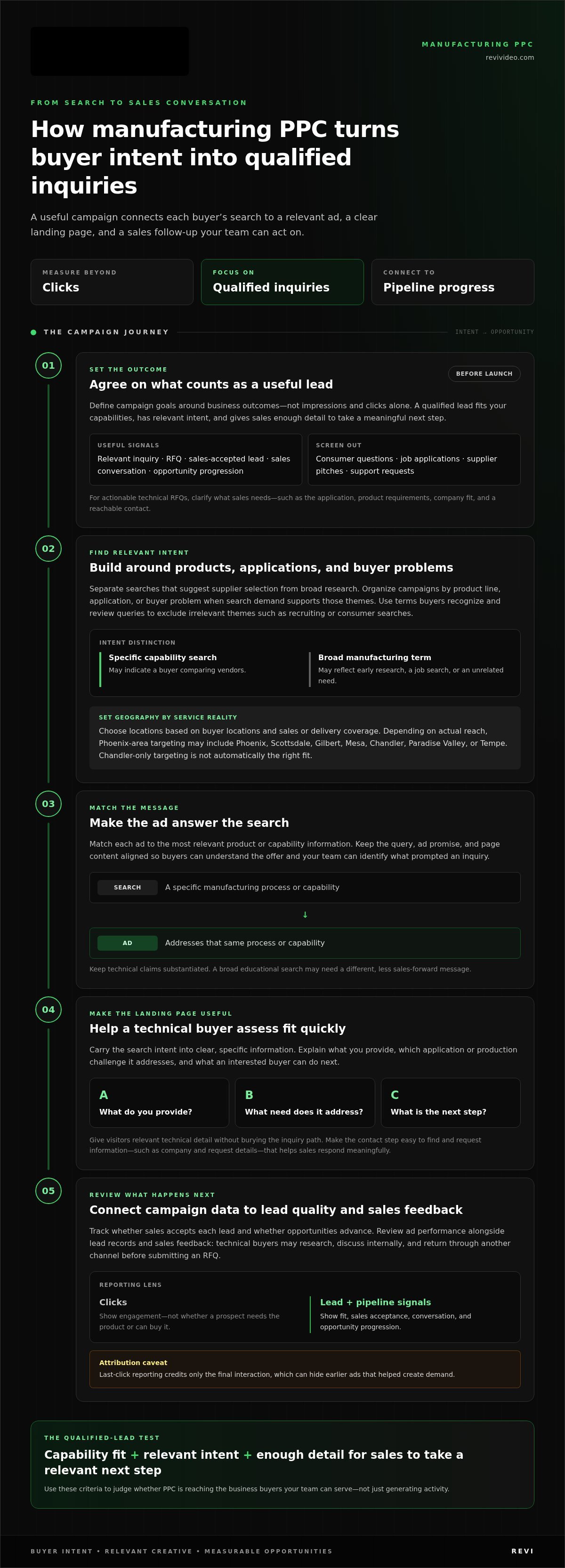
How to plan Chandler manufacturing PPC targeting, creative, and launch
A focused launch starts with your business, not a platform setting. Define which offerings matter, who needs them, what counts as a useful inquiry, and how your sales team will handle one. Then build the campaign around the buyers and locations that make commercial sense. This keeps targeting, ads, landing pages, and follow-up working toward the same goal.
What should a Chandler manufacturing PPC plan establish first?
Use this sequence to turn priorities into a launch plan:
- 1. Set the business objective. Choose a meaningful outcome, such as relevant RFQs or sales conversations, and define how the team will identify a qualified inquiry.
- 2. Select priority offerings and buyers. Focus on the products, capabilities, applications, and business roles that matter most. Use accurate terminology your buyers recognize.
- 3. Map search themes to coverage. Group relevant searches by product or application, then set geography based on actual buyer locations and your sales or delivery footprint. Chandler may be central to the plan, but it isn’t automatically the full market. Some manufacturers serve nearby businesses; others sell beyond the Phoenix area.
- 4. Review the website journey. Follow the path from ad landing page to inquiry. Decide which actions signal real interest, and make sure the page gives buyers a clear next step.
- 5. Align creative and follow-up. Match the ad’s promise to the landing-page content, then prepare the sales team to respond with relevant context about the inquiry.
- 6. Launch, review, and refine. Monitor search relevance, inquiry quality, and sales feedback. Use what you learn to adjust targeting, messaging, and pages.
How should creative and web experiences support paid campaigns?
Keep ad copy clear and technically accurate. Speak to a specific application or buyer need, and make the landing page explain how the relevant capability fits. Avoid broad claims the page can’t substantiate. A well-structured page, consistent design, and easy-to-find inquiry step help preserve the message from first click to sales conversation.
Video can support a campaign when seeing a process or product in context helps explain a complex offering. REVI’s guide to commercial video production in Phoenix explores how video can contribute to brand creative. For more on production considerations, see the Phoenix video production agency guide.
REVI connects strategic media planning and ad buying with website development and creative. Learn more about how to build a connected PPC campaign with REVI, aligning targeting, messaging, and the web experience.
Choose a measurable manufacturing PPC partner in Chandler with REVI
A strong PPC partnership starts with shared definitions of success. Before campaigns launch, clarify which offerings they’ll promote, which business buyers they should reach, what geographic area makes sense, and what counts as a qualified inquiry. Then agree on how reporting will distinguish ad activity from sales-relevant progress. Clear expectations make it easier to spot what needs attention and why.
What should a manufacturing PPC engagement make clear?
Look for a plan that connects media decisions to your sales process. It should explain campaign objectives, intended audiences, geographic scope, and how performance will be reported. Lead-quality criteria matter too: define what makes an inquiry a fit, how sales will record follow-up, and which outcomes signal that an opportunity is progressing. Use those definitions to guide optimization discussions, not clicks alone.
Creative and website support should fit the campaign rather than sit apart from it. A relevant landing page can explain a capability in language buyers understand and make the next step clear. Video or design can help communicate a technical offer when they add useful context. The key is consistency: the ad sets an expectation, and the page delivers on it.
How can Chandler manufacturers take the next step with REVI?
REVI provides strategic media planning and purchasing across digital platforms, with data-driven targeting and ongoing optimization. Campaign decisions can be aligned with business priorities, then refined using performance information without treating clicks as proof of revenue. Share your priority offerings, target buyers, sales or delivery footprint, and current marketing challenges to ground the campaign plan in your business.
REVI also combines ad buying with video production and website development. This integrated approach helps align campaign creative and web experiences, from the first ad impression to the inquiry path. Planning can focus on your goals, audience, measurement needs, and practical campaign direction, without assuming a predetermined outcome.
Talk with REVI about manufacturing PPC and define a campaign direction built around the buyers your business needs to reach.
Build your next manufacturing PPC campaign around qualified demand
Clicks can show that an ad attracts attention, but qualified inquiries and sales progression reveal whether it’s reaching the buyers your business needs. Strong campaigns connect specific search intent to clear, technically accurate messaging, relevant landing pages, and consistent follow-up. Measure each step, and use sales feedback to refine the plan over time.
That’s the focus of PPC management for manufacturing companies in Chandler: align targeting and campaign goals with your actual buyers, geographic reach, and sales process. REVI provides strategic media planning and digital ad buying, supported by data-driven targeting and optimization. Its video production and website development services can help connect campaign creative with the page experience buyers see after a click.
Ready to discuss your priority offerings, target buyers, and campaign needs? Talk with REVI about manufacturing PPC and start shaping a focused direction for your next campaign. A clearer plan can put your marketing team on stronger footing to reach relevant business buyers.
Frequently Asked Questions
What does PPC management for a manufacturing company include?
PPC management includes campaign planning, ad buying, audience and search targeting, and ongoing performance optimization. For a manufacturer, that means aligning campaign themes with actual products, applications, and buyer needs, then directing traffic to relevant pages. PPC management for manufacturing companies in Chandler should also define what qualifies as a useful inquiry and how reporting will track lead quality and sales follow-up, not just clicks and impressions.
Can PPC help a Chandler manufacturer reach buyers outside Chandler?
Yes. Campaign geography can reflect where your buyers are and where your company can sell or deliver, rather than stopping at Chandler city limits. A manufacturer serving a wider market can target relevant locations beyond Chandler; one focused on nearby accounts may choose tighter coverage. REVI serves businesses across the Phoenix-area communities of Phoenix, Scottsdale, Gilbert, Mesa, Chandler, Paradise Valley, and Tempe, while campaign targeting should follow your actual business goals.
How do you measure PPC success for manufacturing companies?
Measure both campaign activity and the quality of what follows. Impressions, clicks, and form submissions can help diagnose ad and landing-page performance, but they don’t confirm buyer fit. Define qualified inquiries with your sales team, track which leads sales accepts, and review opportunity progression and eventual business outcomes in CRM records where available. For long buying cycles, treat attribution as useful context, not automatic proof that one click caused a sale.
How much should a manufacturing company spend on PPC?
Set a budget around business priorities, relevant search demand, and your ability to respond to incoming inquiries. Start by identifying which offerings and buyer groups matter most, then decide what level of testing your team can support. Keep the advertising budget distinct from agency management fees, and agree on how performance will be reviewed before expanding. The right investment depends on your market, goals, campaign scope, and sales capacity.
How long does PPC take to generate manufacturing leads?
There’s no reliable fixed timeline for manufacturing leads. Search volume, targeting, offer, landing-page relevance, and sales follow-up all influence when inquiries arrive and whether they qualify. Early campaign data can show whether ads are attracting relevant searches and prompting inquiries, but it takes longer to assess opportunity progression when buyers research and decide over an extended period. Set review points that separate early indicators from later sales outcomes.
Is Google Ads a good fit for manufacturing companies?
Google Ads can fit manufacturers whose buyers actively search for specific products, processes, suppliers, or solutions. The key is matching campaign themes and landing pages to relevant queries while filtering out consumer, recruiting, and unrelated traffic. Before launch, identify the searches that reflect genuine buying intent and define what a qualified inquiry looks like. Review lead quality alongside click and conversion data to decide whether the channel supports your sales objectives.
Should manufacturing PPC campaigns use video ads?
Video can support manufacturing campaigns when seeing a process, facility, or product in use helps explain the offer. It isn’t essential for every campaign, so use it when visual detail answers buyer questions or strengthens the message. Keep the video consistent with the ad and landing page, and judge its contribution by the audience it engages and the next actions it supports. REVI combines video production with ad buying and website development.