

A polished product video can still miss the mark if it shows features without answering the questions buyers actually have. With product demonstration video services Scottsdale brands can turn a hard-to-explain product into a clear, useful story that helps customers understand what it does and why it matters.
It’s not always obvious which creative approach fits, what production involves, or how the finished video will support a marketing goal. Start with the buyer’s needs, not a checklist of features. Show the product in action, explain its value, and give viewers the information they need to take a relevant next step.
This guide explains how to plan a product demo around your audience, choose an approach that fits your product and distribution channels, and define a focused production plan. REVI’s video production brings the story to life while aligning the demo with your brand and wider marketing activity. The result is a video designed to clarify, connect, and move buyers closer to a decision.
Key Takeaways
- Choose a demo format based on your product’s complexity, your audience’s familiarity, and the action you want viewers to take.
- Build the story around buyer questions, then use clear demonstrations to show how the product meets a real need.
- When comparing product demonstration video services Scottsdale, look for a focused approach that makes product use, pacing, and messaging easy to follow.
- Set campaign goals, product access, shoot priorities, stakeholders, and placements before production begins.
- Align video production with brand, design, website, and ad planning to keep the product story consistent across channels.
Why Scottsdale businesses use product demonstration videos to explain value
A product can be valuable and still be difficult to explain with a paragraph or a static image. A product demonstration video makes the benefit visible: it shows someone using the product to solve a recognizable problem, step by step. That clarity helps prospective customers picture how it could fit their needs.
A product demo is visual storytelling focused on how a product works and what it helps a user do. Unlike a general brand video, it puts the product’s use and practical value at the center. This is the core idea behind a product demonstration: show the product in action so viewers can understand it, rather than only hear claims about it.
For Scottsdale businesses, a demonstration can make an unfamiliar or complex offering easier to grasp before a conversation with a sales team. Think of software with several workflow steps, or a physical product whose setup isn’t obvious from a photo. A focused sequence can show what happens first, how the product responds, and what changes for the user. Keep the explanation grounded in a real context instead of adding details simply because they’re available.
A strong demo also gives viewers a useful next step. That might be exploring a product page, starting a trial, requesting information, or speaking with a sales representative. Choose one action that fits the campaign, then shape the explanation around what someone needs to know before taking it. Product demonstration video services Scottsdale businesses use should connect the story, audience questions, and intended next step, not simply capture attractive footage.
What should a product demonstration video help a customer understand?
Start with the problem. Show the product being used in a relevant setting, then make its distinguishing benefits easy to recognize. For example, a demo of a multi-step digital tool might follow a user from a difficult task to a clearer, more organized workflow. Viewers should leave knowing what the product does, how it works, and why that matters to them.
When is a product demo more useful than a general promotional video?
Choose a demo when operation, setup, or functionality needs to be seen to make sense. A promotional video can build a broader impression of a brand through its values, people, and story; a demo focuses on product use. The formats can work together: brand storytelling can introduce the company, while a focused demonstration helps interested buyers evaluate a specific product.
That distinction keeps creative decisions tied to the buyer’s stage. Someone discovering a brand may need context and a reason to care. Someone comparing solutions may need to see the product handle a task or answer a practical concern. A clear production brief identifies the audience, the question the video must resolve, and the action that should follow. REVI’s video production can support a product-focused story as part of a wider brand and marketing plan.
Choose the right product demo format for your product and audience
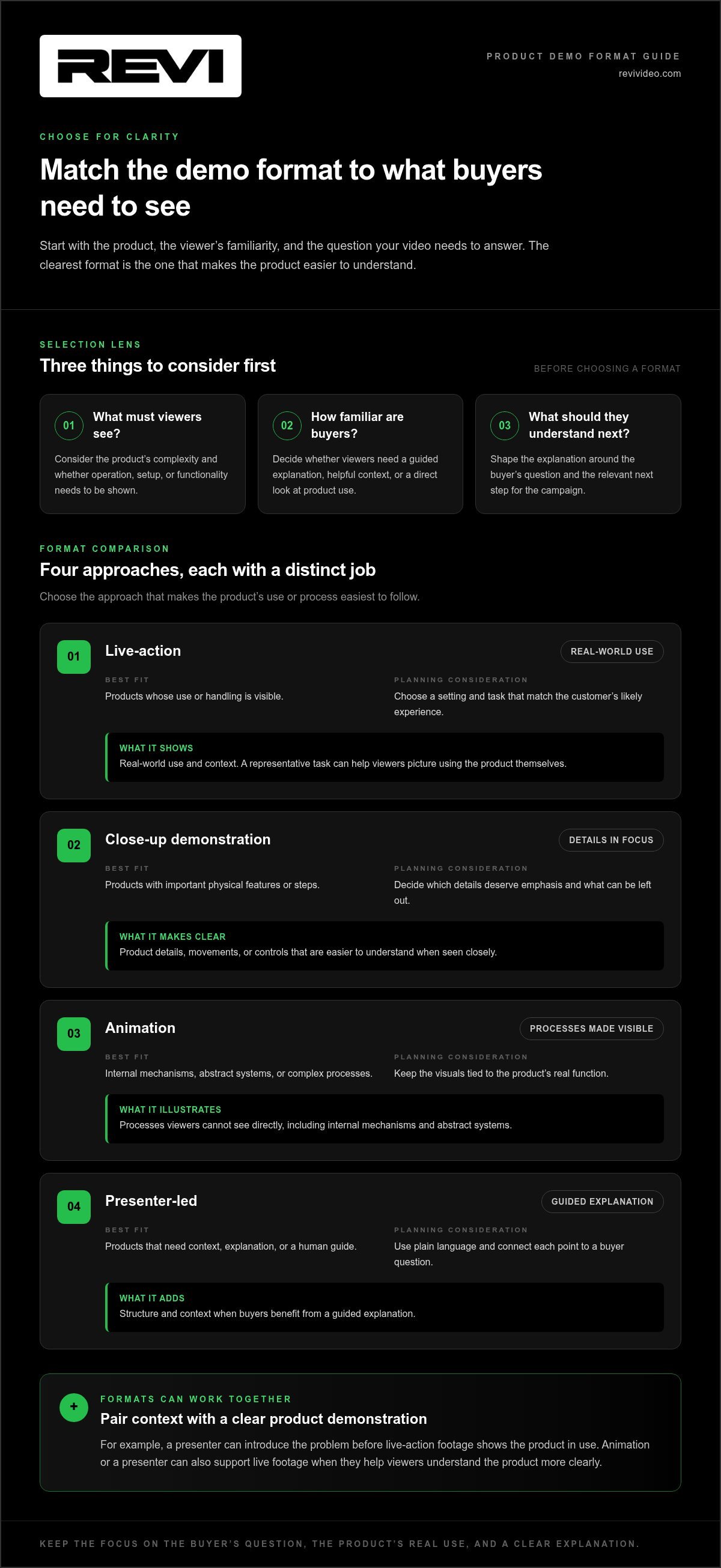
The strongest format isn’t automatically the trendiest one. Choose it based on what buyers need to see, how familiar they are with the product, and what you want them to do next. A simple object may need a close-up view; a multi-step process may need narration or visual explanation. The right format makes the message easier to follow.
Use this comparison to narrow your options. Formats can also work together: a presenter might introduce the problem before live-action footage shows the product in use. Guides to the types and importance of product demo videos offer additional context, but your audience and product should drive the final choice.
| Format | Strength | Best fit | Planning consideration |
|---|---|---|---|
| Live-action | Shows real-world use and context | Products whose use or handling is visible | Choose a setting and task that match the customer’s likely experience |
| Close-up demonstration | Makes details, movements, or controls easier to see | Products with important physical features or steps | Decide which details deserve emphasis and what can be left out |
| Animation | Illustrates processes viewers can’t see directly | Internal mechanisms, abstract systems, or complex processes | Keep visuals tied to the product’s real function |
| Presenter-led | Guides viewers through an explanation | Products that need context, explanation, or a human guide | Use plain language and connect each point to a buyer question |
When does live-action product video make the clearest demonstration?
Choose live-action when movement, scale, texture, or handling helps explain value. Show a user completing one representative task instead of staging a sequence that looks impressive but feels unrelated to daily use. For a product with a setup process, let viewers see the relevant steps in order. Keep the setting familiar to the intended audience so they can picture using the product themselves.
When can animation or a presenter-led demo improve understanding?
Animation can clarify what a camera can’t capture, such as an internal mechanism or an abstract process. A presenter can add structure when buyers need a guided explanation or context before seeing the product in action. Either format can stand alone or support live footage. Focus on clarity rather than assuming one format will perform better.
Before production, write down the viewer’s starting question and the action you want them to take. Then choose the simplest format that answers that question. REVI can align product demo production choices with the product story and wider brand needs for businesses in Scottsdale and nearby Phoenix-area communities, including Phoenix, Gilbert, Mesa, Chandler, Paradise Valley, and Tempe. Explore Scottsdale video production as you consider the right approach.
How to evaluate product demonstration video services in Scottsdale
A strong proposal starts with the audience, not a shot list. It should identify what prospective customers need to understand, which questions are slowing their decision, and how the video will answer them. Production style matters, but polished visuals can’t compensate for a concept that leaves the product’s purpose unclear.
When reviewing relevant work, look beyond the overall aesthetic. Check whether the product appears in use, whether each step is easy to follow, and whether the pacing gives viewers enough time to absorb important details. Visual consistency should support the brand while the message stays focused on one main idea. Ask yourself: could a viewer explain what the product does after watching?
Effective product demos make the product’s purpose clear early, show its use in a logical sequence, keep visuals and narration focused, and guide viewers toward a relevant next step. Use that as a practical checklist when comparing product demonstration video services Scottsdale businesses may consider.
How can you tell whether a product demo communicates clearly?
Look for an opening that identifies the product or the task it helps with. Then follow the story from the customer’s problem through the demonstration to the practical benefit. Narration, on-screen text, and visuals should reinforce the same central message. If an important step needs extra explanation, the concept may need tightening before the edit is finalized.
A useful review doesn’t depend on production jargon. Note where the product becomes understandable, where attention drifts, and whether any scene feels disconnected from the viewer’s question. This feedback helps distinguish a purposeful edit from one that simply moves quickly.
What should a useful product demo deliver across marketing channels?
Decide where the video will appear before locking its framing and edit structure. A website product page may give viewers time for a fuller explanation; a social post or paid campaign may need a faster introduction and a clear route to more information. Account for these placements from the start instead of treating distribution as an afterthought.
Review the plan for the primary placement first, then decide whether the same story can support other channels without losing clarity. Consider what viewers should do after watching, such as visiting a product page or taking another campaign-specific step. REVI’s guide to commercial video production in Phoenix can provide broader context for how a product demo fits within commercial content. For Scottsdale projects, aligning the concept, brand presentation, and intended placements helps keep production focused from the first discussion through the final edit.
Prioritize clear product use, purposeful pacing, consistent visuals, and a defined next action. These criteria make it easier to judge whether a proposed video serves the audience and campaign, not just whether it looks polished.
Plan a Scottsdale product demo: brief, shoot, and distribution
A focused plan keeps production moving and the product story clear. Start by defining the campaign goal and intended viewer action. Then gather the information, people, and product access needed to show the product accurately. Leave creative details, such as the exact shot sequence, open for development with the production team.
Use this ordered checklist to prepare:
- Set the campaign goal. Decide what the video should help viewers understand or do.
- Describe the audience and use case. Note who will watch, what they need, and the context in which they’ll use the product.
- Write the core message. Identify the product’s main value and the next action you want viewers to take.
- Share product facts. List essential features, steps the video must show, and claims that need substantiation.
- Gather references. Provide brand guidelines, product materials, existing messaging, and examples that clarify the desired feel.
- Identify placements. Name likely destinations, such as a website, social post, or paid campaign, so the concept can account for them.
- Prepare access and approvals. Arrange a working product, identify subject-matter experts, and clarify who approves factual and creative decisions.
What belongs in a product demonstration video brief?
Make the brief useful, not exhaustive. Include the target audience, product use case, primary message, and intended action, plus the features that must appear and any claims requiring support. Share brand guidelines, product references, and likely distribution channels. A production team can develop the visual treatment and shot list from this foundation; you don’t need to solve every creative detail before the first planning discussion.
How should you prepare a product and team for filming?
Before a shoot, confirm the product is ready to demonstrate and map the steps viewers need to see. Bring product experts into planning so they can explain essential facts, while decision-makers agree on approvals and priorities. For a Scottsdale-area shoot, consider access, location needs, and practical constraints early. Keep the focus on what the demonstration requires without assuming a particular venue or schedule.
Separate must-haves from open creative questions. Product accuracy, core message, access, and approval roles are essential preparation. Specific framing, transitions, and supporting visuals can take shape during creative development. That distinction helps teams move efficiently without locking the video into a rigid plan too soon.
For businesses in Scottsdale, Phoenix, Gilbert, Mesa, Chandler, Paradise Valley, and Tempe, keep the product demo brief connected to the brand and campaign placements. REVI’s video production supports that alignment alongside its broader marketing work. See how the planning process can take shape in a video production conversation with REVI.
Work with REVI on product demonstration video services in Scottsdale
A product demo works best when the video, brand, and campaign feel like parts of one story. REVI provides professional video production and connects product explanations with brand building, design, website development, and ad buying. That integrated perspective helps keep the same message recognizable, whether a prospective customer first sees the demo in an ad or watches it on a product page.
For businesses in Scottsdale and surrounding communities such as Phoenix, Gilbert, Mesa, Chandler, Paradise Valley, and Tempe, product demonstration video services can benefit from planning beyond the shoot itself. A strong concept begins with what the audience needs to understand. Then creative and campaign choices reinforce that purpose: the visual style reflects the brand, the website gives viewers a relevant place to go next, and advertising can help put the story in front of its intended audience. Each decision should serve clarity and a defined business goal, not add complexity for its own sake.
How can integrated creative support a product demonstration video?
Connect the demo to established brand messaging and visual design so the product feels consistent with the rest of the business. Plan its intended placements with the website and advertising strategy in mind. A product page might provide room for a fuller explanation, while an ad placement may need a more direct path into the story. Adapt the creative to its context without changing the product’s core message.
That coordination also helps teams avoid disconnected work. If the video introduces a benefit, the destination should continue that story. If a campaign uses a specific message, the demo’s language and visuals should support it. REVI’s video production fits into this broader creative and marketing picture, keeping the focus on audience understanding rather than production polish alone.
What happens when you start a product demo project with REVI?
Start by sharing what the product does, who needs to understand it, and what you want the video to help them do. From there, a project conversation can explore the clearest concept, relevant production needs, and where the finished story will appear. Bringing product knowledge, audience insight, and campaign context into that discussion gives the creative direction a practical foundation.
You don’t need every shot or visual detail settled before the conversation begins. A clear objective and the essential product facts are enough to start shaping the approach. As the idea develops, the team can connect the demonstration to the brand and intended placements, keeping the project centered on useful communication.
For businesses serving Scottsdale, Phoenix, Gilbert, Mesa, Chandler, Paradise Valley, and Tempe, product demos can make complex product stories easier to follow. Explore REVI’s video production as you shape a focused concept around the buyer’s question and the product’s clearest answer.
Turn your product story into a clear next step
Your next product demo can do more than explain how something works. It can become a useful bridge between a buyer’s question and the action that helps them learn more. Keep that goal in view as you develop the concept, and let each creative choice earn its place by making the product easier to understand.
REVI pairs professional video production with ad buying, website development, brand building, and design, helping businesses in Scottsdale, Phoenix, Gilbert, Mesa, Chandler, Paradise Valley, and Tempe connect a product story with the places customers encounter it. REVI can shape product demonstration video services Scottsdale businesses can build around a focused message and marketing purpose.
Bring your product, audience, and objective into the conversation to start planning a demo with a clear direction. Talk with REVI about your Scottsdale product demonstration video. A sharper product story starts with one focused idea.
Frequently Asked Questions
How long should a product demonstration video be?
A product demonstration video should last only as long as viewers need to understand its use and decide what to do next. For a short social placement, focus on one task and show the key point quickly. On a product page, a longer edit may leave room for setup or feature details. Review each scene for a clear purpose, and cut anything that doesn’t help viewers follow the explanation.
What should I prepare before filming a product demonstration video?
Prepare a working product, a clear use case, and a concise explanation of what viewers should learn. Note any steps that must appear in the demonstration, plus details that could be misunderstood if shown without context. Gather current product references and brand materials, and identify a knowledgeable person who can answer questions during planning. For a Scottsdale, Phoenix, or nearby Valley project, share any location considerations early.
Can one product demonstration video work across multiple platforms?
One core story can support multiple channels, but it may need different edits for each placement. A website version might include more context, while a social cut could focus on one product benefit. Before filming, map the video’s likely destinations and decide whether framing, pacing, captions, or opening moments need to adapt. This helps preserve the message while making each version feel suited to where viewers encounter it.
How do you measure whether a product demonstration video is effective?
Choose measures that match the video’s job. If the goal is awareness, views and watch time can show whether people start and continue watching. For a campaign meant to prompt action, examine clicks or relevant activity on the destination page. Compare performance with the placement and objective, then use what you learn to refine the message or distribution. No single metric tells the whole story.
How much do product demonstration video services in Scottsdale cost?
Cost depends on the project’s creative scope, filming needs, product access, and planned assets. A focused demonstration has different requirements from a campaign with several concepts or edits. To frame the project, outline the product, audience, goal, and intended placements. REVI can discuss product demonstration video services Scottsdale businesses need based on those project details, connecting production choices to the intended marketing use.
Can a product demo video explain a product that is difficult to show on camera?
Yes. A demo can combine real product footage with close-ups, narration, diagrams, or animation to explain details that a camera can’t show directly. For example, if a mechanism operates inside a sealed product, an illustrative graphic could clarify what happens while footage shows the product’s visible use. Choose each visual to answer a specific customer question, and keep technical explanations accurate and easy to follow.
Should a product demonstration video include a call to action?
Usually, a clear next step helps viewers know what to do after watching. Match the action to the video’s purpose: a viewer comparing options might explore a product page, while someone seeking more detail could request information. Make sure the destination follows through on the video’s message. A simple, relevant prompt feels connected to the demonstration, unlike a generic instruction that sends viewers somewhere unexpected.
Ready to make your product easier to understand? Talk with REVI about a product demonstration video for your Scottsdale-area business.