

A Scottsdale location pin can reach locals, commuters, and people who may never book a winter trip. The smarter question is how to target winter visitors in scottsdale with facebook ads by combining location signals with relevant offers and measurable actions. Broad targeting can use budget reaching people who are unlikely to book, reserve, or visit.
That challenge sharpens in winter, when demand shifts around holidays, events, and travel plans. Meta’s “People traveling in this location” and “interested in” location options can help you reach different stages of that journey, while Advantage+ Audience may expand beyond your suggestions. Treat these settings as signals, not proof of travel intent. Set a clear campaign goal, use creative that fits your offer, and measure what people actually do.
This guide lays out a practical seasonal plan: how to shape audiences, time campaigns around Scottsdale’s winter calendar, and match awareness, traffic, or sales objectives to your business goal. You’ll also see how video, design, and a focused landing page can create a consistent path from ad view to inquiry or visit. REVI brings paid campaign planning together with creative and website development, helping you make decisions based on measurable actions rather than guesswork.
Key Takeaways
- Winter visitors travel for different reasons. Shape your campaign around the people most likely to use your resort, restaurant, golf course, or attraction.
- Learn how to target winter visitors in scottsdale with facebook ads by choosing audience signals that fit your goal, data, and practical service area.
- Compare broad reach, interest signals, first-party audiences, and retargeting to identify useful tests for your business.
- Build seasonal creative around your actual offer, capacity, and booking window, then assess campaign activity against meaningful business actions.
Why Scottsdale winter visitor campaigns need more than a city-radius audience
Winter visitors aren’t one uniform audience. Some are still planning a trip, some have arrived for a short stay, and others return to Scottsdale seasonally. A city-radius audience can include all three, along with local residents who may have no need for a visitor-focused offer. Build your campaign around a likely customer and a meaningful next step, rather than relying on a map pin alone.
Scottsdale’s identity as a destination can help you make an ad relevant. Its resorts, dining, golf, arts, and outdoor experiences appeal to different kinds of visitors. A Scottsdale, Arizona Wikipedia page offers general context on the city and its status as a tourist destination, but your ad still needs to connect that context to what your business actually offers.
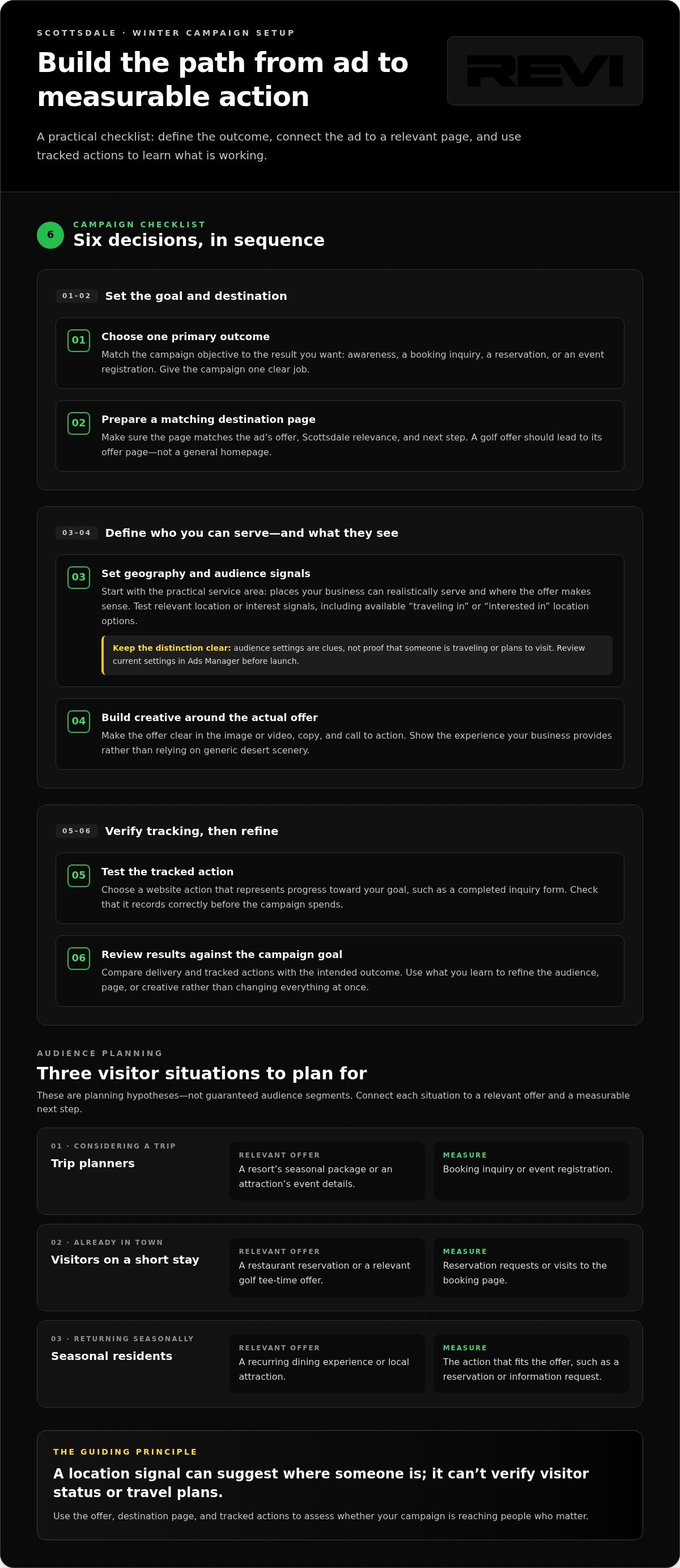
A location signal can suggest where someone is; it can’t verify that person’s visitor status or travel plans. Treat audience settings as clues, then use the offer, destination page, and tracked actions to assess whether your campaign is reaching people who matter.
Which Scottsdale winter visitors could your business serve?
Start with three planning hypotheses. They aren’t guaranteed audience segments, but they help connect a potential visitor’s situation to a relevant offer and an action you can measure.
- Trip planners: Someone considering Scottsdale may respond to a resort’s seasonal package or an attraction’s event details. Measure actions such as a booking inquiry or event registration.
- People already in town: A restaurant can promote a reservation, while a golf business can feature a relevant tee-time offer. Track reservation requests or visits to the booking page.
- Seasonal residents: A returning resident may be more interested in a recurring dining experience or local attraction than trip-planning content. Measure the action that fits the offer, such as a reservation or information request.
Use a landmark or event only when it helps explain the offer. A nearby attraction could make sense in a restaurant ad if it gives visitors a clear reason to dine there. Unrelated Scottsdale imagery may earn attention without helping someone decide what to do next.
Set a campaign goal before choosing an audience
Choose one primary outcome first, such as a booking inquiry, reservation, or event registration. Then select a campaign objective and destination that support it. Awareness can introduce your business to potential visitors, while a website action gives you a more direct signal to track. Keep those purposes distinct so you can evaluate the campaign against its intended job.
For example, a resort might use awareness activity to build recognition before a booking-focused campaign directs people to a relevant offer page. That doesn’t prove every person reached is a winter visitor. It does give you a practical framework for how to target winter visitors in scottsdale with facebook ads: define who you hope to serve, provide a relevant next step, and measure the response.
How to set up Facebook Ads for Scottsdale winter visitors
A reliable setup starts with the business outcome, then creates a clear path from ad to action. If you’re learning how to target winter visitors in scottsdale with facebook ads, treat each campaign setting as a decision to test, not a shortcut to identifying every traveler.
Use this sequence: Set the objective, match the page, define the audience, build the creative, test tracking, and review results.
- Choose the objective. Match it to the result you want, such as awareness, a booking inquiry, a reservation, or an event registration. Pick one primary outcome so the campaign has a clear job.
- Prepare the destination page. Send people to a page that matches the ad’s offer, Scottsdale relevance, and call to action. A golf offer should lead to a page about that offer, not a general homepage.
- Define the audience. Set geography around where your business can serve customers and where the offer makes sense. Then test relevant location or interest signals without treating them as proof of travel.
- Build the creative. Make the offer clear in the image or video, copy, and call to action. Show the experience your business actually provides instead of relying on generic desert scenery.
- Test tracking. Choose the website action that represents progress toward your goal, such as a completed inquiry form. Check that the action records correctly before the campaign spends.
- Review and adjust. Compare delivery and tracked actions with the campaign goal. Use what you learn to refine the audience, page, or creative rather than changing everything at once.
Choose campaign geography and audience signals carefully
Start with a practical service area: the places your business can realistically serve and the locations that make sense for its visitor offer. Meta Ads Manager may provide options such as reaching people traveling in or interested in a location, alongside audience suggestions that its system can expand. These controls can change, so review the current location and audience settings in Ads Manager before launch. Treat event or travel-related interests as testable signals, not confirmation that someone plans to visit Scottsdale.
Prepare the destination and tracking before launch
Make the next step easy to understand. The landing page should repeat the offer, explain what happens next, and give visitors a clear action. Define the conversion event before publishing, then test the full path from ad click through completion. Also review applicable consent and privacy requirements and Meta’s current advertising policies for your campaign. Good measurement starts before spend, not after the first report arrives.
Keep the workflow connected, from media planning to creative and destination page. REVI’s campaign planning and creative support can help align those pieces around your business objective and the actions you want to measure.
Compare audience approaches for reaching Scottsdale winter visitors
No audience setting confirms that someone is traveling to Scottsdale. Broad geography, interests, customer data, and retargeting provide different signals, each with strengths and limits. Performance can depend on available data, current Meta controls, creative, and how relevant the offer feels to the people who see it.
Use these approaches to choose a practical test for how to target winter visitors in scottsdale with facebook ads. Meta may expand beyond audience suggestions, so review the current controls in Ads Manager and treat each audience as a hypothesis, not a guarantee.
- Broad local reach: Use it to build awareness across a practical service area. The audience may include locals and people who aren’t visitors. Test an offer with broad appeal, supported by local creative and a matching landing page.
- Interest-based signals: Test relevant available interests, such as golf or a local event, to explore potential alignment. These signals don’t prove travel intent, and Meta may expand beyond suggestions. Compare an interest signal with a broader audience.
- First-party audiences: Use eligible customer or prospect data to reconnect with people who already know your business. Data quality, audience size, consent, and platform permissions affect whether this approach is useful. Where eligible, test it against prospecting.
- Retargeting: Reach eligible people who previously engaged with your site or content. Engagement doesn’t confirm that someone is a winter visitor, and the available audience may be limited. Compare retargeting with prospecting while keeping their results separate.
When does broad Scottsdale-area reach make sense?
Broad reach can suit an awareness campaign when an offer serves several kinds of visitor, such as a restaurant experience or attraction with wide appeal. Geography provides local context, not certainty about who is in town. Use creative that explains the experience and a landing page with relevant details. Before expanding reach or budget, look beyond clicks: check whether people engage with the page or take actions that fit your business goal.
When can first-party audiences or retargeting help?
These approaches can help reconnect with people familiar with your business, provided the data and audience use meet applicable consent and platform requirements. Keep prospecting and retargeting distinct: one seeks new interest, the other serves prior engagers. Neither automatically represents confirmed winter visitors.
For a fair comparison, use the same campaign objective and conversion definition across audience tests. Change one audience approach at a time, then compare the same tracked action, such as a completed inquiry or reservation request. This makes it easier to understand what the test suggests without confusing audience differences with changes to the campaign goal.
Plan seasonal creative and measure what your Scottsdale Facebook campaign delivers
Winter creative needs a real reason to act. Start with the offer your business can fulfill, the capacity you can support, and the booking window that makes sense. A restaurant promoting a seasonal menu, for example, can focus on reservations. An attraction can spotlight a specific experience and direct people to event details. Plan when each message should appear, then update it as the offer or available capacity changes.
Keep the campaign promise consistent from ad to action. Someone who sees an offer in a Facebook ad should find the same details and next step on the destination page. A mismatch can turn interest into confusion.
Create ads that connect Scottsdale context to a clear offer
Lead with the benefit, not a generic desert backdrop. Use Scottsdale in the copy when it helps visitors recognize the location or understand why the offer fits their trip. A short video could show the actual dining experience, golf setting, or attraction, while a still image can feature the offer and a clear call to action. Keep the details accurate, and make sure the landing page reflects the same terms and booking steps.
Creative should answer three quick questions: What can I do? Why is this relevant to my Scottsdale visit? What should I do next? A specific message gives the audience more context than sunshine imagery alone. It also gives you a clearer way to judge whether the ad attracts people who respond to the offer.
Use a simple review cycle to improve the campaign
Set a consistent schedule for reviewing results, then check the same stages each time: ad delivery, landing-page engagement, and completed actions. If people click but leave before reaching the offer details, examine the connection between the ad promise and page experience. If the page gets attention but few people complete the intended action, review the offer and booking steps before changing the audience.
Clicks show attention, not whether a campaign achieved its business goal. Measure the action tied to your objective, such as a completed reservation request or booking inquiry, and interpret it alongside delivery and page engagement. Use campaign tracking consistently so you can connect activity to the right creative and audience.
For a useful test, change one major variable at a time. Compare two creative concepts with the same audience and objective, or compare audience approaches while keeping the creative and conversion definition steady. Avoid changing the offer, audience, and ad at once; you won’t know which adjustment shaped the result. Keep what supports meaningful actions, refine what creates friction, and pause what isn’t helping.
Strong seasonal campaigns connect strategy, creative, and measurement. Work with REVI on seasonal video and design to bring your Scottsdale offer to life with creative that supports a clear campaign goal.
How REVI can help businesses advertise to Scottsdale winter visitors
A seasonal Facebook campaign works best when its pieces support the same goal. The audience, offer, ad creative, landing page, and measurement plan should feel connected, not like separate tasks. REVI brings strategic media planning and ad buying together with video production, design, and website development to help businesses build that connection around their objectives.
That coordination matters for visitor-facing businesses with a limited booking window or a specific winter offer. A resort, restaurant, golf business, or attraction can start by defining the action it wants people to take. From there, the campaign can test audience approaches and creative while keeping the destination and measurement plan tied to that action. This is a practical way to apply how to target winter visitors in scottsdale with facebook ads without treating location settings as proof of visitor status.
Bring media planning and campaign creative together
REVI’s ad buying and media planning can align the campaign objective with audience tests and a seasonal schedule. That gives each ad a clear role, whether it introduces an offer or supports a more direct response. The plan can account for the business’s actual offer and capacity, keeping the campaign message grounded in what it can deliver.
Professional video and design add options for showing the experience behind the offer. A restaurant might feature a seasonal dining experience; an attraction could highlight what visitors can do there. Each concept should communicate one relevant benefit and one clear next step. Creative shouldn’t promise more than the offer provides, and the call to action should lead directly toward an appropriate inquiry, reservation, or registration.
REVI produces professional video content for commercials and social media, and design can help keep the campaign’s look and message consistent. Together, the media plan and creative provide a structured way to test what earns meaningful engagement, then refine the campaign based on actions that matter to your business.
Make the ad-to-website journey easier to measure
A click is only the beginning of the journey. REVI develops responsive websites aligned with business objectives, giving campaigns a destination page that can support a selected action. Keep the offer, location details, and call to action consistent from ad to page. That continuity helps visitors understand what to do next and gives the business a clearer path for measuring relevant actions.
Measurement should connect back to the original objective. Decide which action indicates progress, make sure the page supports it, and review campaign activity against that definition. No single audience setting or creative choice guarantees a particular result. A connected system makes it easier to see what you tested and what response followed.
Scottsdale-area businesses can discuss a winter visitor advertising campaign with REVI by starting with the offer, the audience they hope to reach, and the action they want visitors to take.
Turn your winter campaign plan into your next growth move
The next season is an opportunity to build a clearer connection between your offer and the visitors you want to reach. Put your campaign objective first, then let it guide decisions about timing, creative, and what you’ll measure. A focused plan gives each test a purpose and helps you learn what deserves more attention as the season unfolds.
For businesses weighing how to target winter visitors in scottsdale with facebook ads, REVI brings strategic ad buying and media planning together with professional video production and responsive website development. Your campaign can connect its message to a relevant online destination, with decisions shaped around business goals rather than assumptions about guaranteed results.
Plan a Scottsdale winter visitor campaign with REVI and take the next step toward a more intentional seasonal strategy. Your offer has a story to tell. Build a campaign that puts it in front of potential visitors and gives you useful signals to act on.
Frequently Asked Questions
Can Facebook Ads target people who are visiting Scottsdale right now?
Yes, Meta Ads Manager may offer a “People traveling in this location” setting for reaching users whose recent location is Scottsdale and whose home is more than 100 miles away. This is a location signal, not confirmation of someone’s itinerary or visitor status. Options can change, so check the current controls in Ads Manager. For a same-day offer, make the ad’s location, availability, and next step especially clear.
When should a Scottsdale business start advertising to winter visitors?
Start when potential customers begin making the decision your offer depends on. A resort may need to reach trip planners earlier than a restaurant promoting a meal for visitors already in town. Use your own booking window and seasonal capacity to set the schedule, then allow time to learn from initial campaign activity before demand peaks. If you serve Scottsdale as well as Phoenix, Gilbert, Mesa, Chandler, Paradise Valley, or Tempe, define where each offer applies.
What should a Facebook ad for Scottsdale winter visitors say?
Lead with a specific reason to act, not just “Visit Scottsdale.” For example, a restaurant can highlight a seasonal menu and invite people to view details or reserve; an attraction can describe a real experience and direct visitors to event information. Include useful context, such as where the offer is available and any relevant dates or booking steps. Keep the wording aligned with the destination page so visitors know what to expect after clicking.
Should I target Scottsdale residents or people interested in travel?
Choose based on who can use the offer. If your service is designed for visitors, test location and travel-related signals separately from a resident-focused audience instead of assuming one group represents the other. “Interested in” a location or travel topic indicates possible relevance, not a confirmed trip. A Scottsdale business that also serves nearby Phoenix, Gilbert, Mesa, Chandler, Paradise Valley, or Tempe customers can test local messaging when residents are a genuine market.
How can I tell whether Facebook Ads brought in winter visitors?
Track an action tied to the campaign, then compare ad reporting with your own inquiry or booking records. Use a distinct landing page or campaign-tagged URL where practical, and include a source field in a reservation or inquiry form if it fits your process. These signals help connect campaign activity to business responses, but may not identify every visitor or prove that an ad caused a booking. Review attribution alongside customer feedback.
Do I need video ads to reach winter visitors in Scottsdale?
No. A clear image and focused copy can communicate an offer effectively; video is an option, not a requirement. Use video when movement or a short walkthrough helps people understand the experience, such as the atmosphere of a venue or what an attraction includes. Keep the call to action visible and consistent with the landing page. To compare formats, hold the audience and objective steady so the test gives you a useful signal.