

What if your ad budget isn’t the problem, but the path from impression to conversion? If you’re thinking, “I’m spending a lot on ads but not seeing results,” you’re not alone: spend keeps climbing while leads or sales lag behind. Reports full of clicks and impressions rarely show where potential customers drop off or what to fix next.
The answer isn’t always to spend more or switch platforms. First, find the weakest link between your audience, message, measurement, and website. This guide shows you how to spot where campaigns lose momentum, prioritize fixes based on business outcomes, and decide whether ad buying, stronger creative, or website improvements may help. You’ll learn to look beyond vanity metrics and trace the customer journey from first impression to conversion. When those pieces work together, you can better understand what your ad spend is doing and where to focus next.
Key Takeaways
- Define campaign success by meaningful business outcomes, such as qualified leads or sales, not activity alone.
- If you’re thinking, “I’m spending a lot on ads but not seeing results,” verify tracking before changing your campaigns.
- Use audience, creative, offer, landing page, and follow-up clues to pinpoint where potential customers drop off.
- Test one meaningful change at a time, and address measurement or conversion friction before increasing spend.
- Match your next step to the bottleneck: coordinated ad buying, video production, or website development can address different parts of the conversion path.
Spending a Lot on Ads but Not Seeing Results? Start by Defining the Problem
Watching ad spend rise while the business impact stays unclear is frustrating. But a large budget alone doesn’t prove a campaign is failing. The key question is whether the campaign is producing enough of the outcome it was designed to support, and whether that outcome is being measured reliably. If you’re thinking, “I’m spending a lot on ads but not seeing results,” start by defining what “results” means for your business.
Choose one primary objective for each campaign. A campaign built to generate awareness has a different job from one designed to bring in qualified inquiries or online purchases. If you judge an awareness campaign only by immediate sales, you may miss its purpose. If you judge a lead campaign by clicks alone, you may mistake activity for progress. Set the goal first, then evaluate the metrics that connect to it.
Which ad results matter more than clicks?
Match the campaign objective to a specific conversion: a qualified lead, a purchase, a booked appointment, or another action that matters to your business. Reach and engagement indicators, such as impressions, video views, and clicks, can show whether people notice or interact with an ad. They don’t confirm that someone became a customer.
- Awareness: Review reach and engagement as signs that the message is getting attention.
- Lead generation: Look beyond form submissions to whether inquiries fit your business and can move forward.
- Sales or bookings: Connect the completed purchase or appointment to the campaign where possible.
A click is useful when it moves someone into a measurable customer journey. One person might click, explore an offer, and submit a form. Another might tap the ad accidentally and leave. Treating those actions as equally valuable can obscure campaign quality. Return on Marketing Investment (ROMI) offers a framework for considering marketing’s contribution in relation to its investment, rather than relying on attention metrics alone.
Where can an advertising campaign lose momentum?
Trace the path in order: audience exposure, the ad itself, the landing page, the conversion action, and any follow-up needed to turn an inquiry into business. Each stage has a different job. The audience must be relevant, the message must give people a reason to act, and the page must make the next step clear and easy to complete.
For example, a local service business might show an ad for a specific service to people in its intended market. If the ad promises details about that service but sends visitors to a broad homepage, they may not find the information or action they expected. The audience may be suitable and the ad may earn attention, yet the landing-page mismatch can weaken the journey. Name the intended conversion and follow the customer’s route to it. That gives you a practical basis for diagnosis instead of reacting to spend or clicks in isolation.
Check Ad Tracking Before Deciding Your Campaign Is Failing
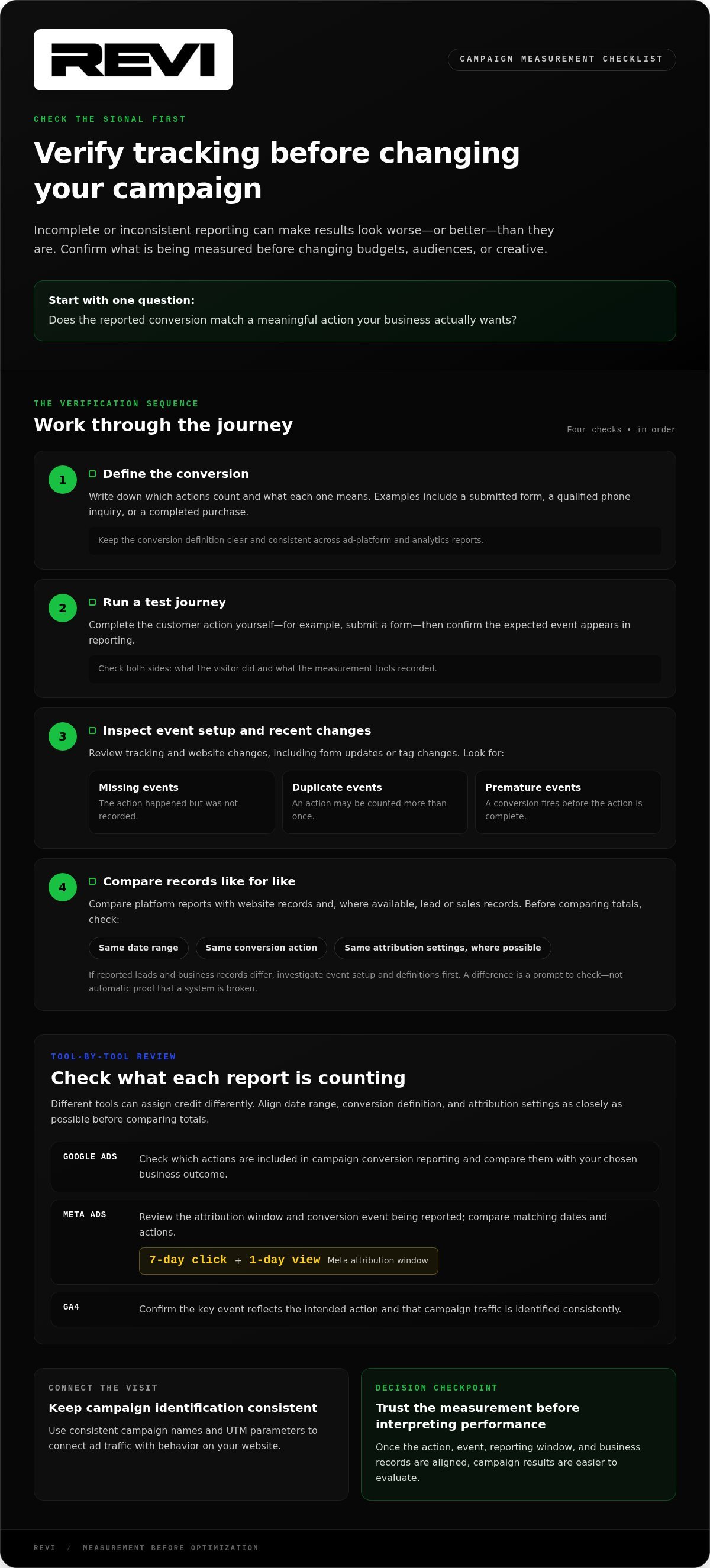
If you’re thinking, “I’m spending a lot on ads but not seeing results,” first check whether your reporting captures the results you care about. A campaign may generate leads that tracking misses, or count an action more than once. Verify measurement before changing budgets, audiences, or creative. Otherwise, you could make a costly decision based on incomplete or inconsistent data.
Start with a short list of meaningful actions. For a lead campaign, that might be a submitted form or a qualified phone inquiry. For an online store, it could be a completed purchase. Make sure your ad platform and analytics reports use a clear, consistent definition of each action.
How to verify that conversion tracking works
Walk through the customer journey yourself, then confirm that the action appears in the right reports. A test is useful only if you check both what the visitor did and what the measurement tools recorded.
- Write down which actions count as conversions and how each one is defined.
- Complete a test journey, such as submitting a form, and confirm the expected event appears in reporting.
- Review recent tracking or website changes for missing events, duplicate events, or conversions that fire before the action is complete.
- Compare platform reports with website records and, where available, your lead or sales records.
If an ad platform reports several leads but your business records show fewer inquiries, don’t immediately assume either the platform or your records are wrong. Check the event setup, date range, and whether the reports count the same action. Keep access and recent changes in view, too, since a form update or tag change can affect what gets recorded.
What to review in Google Ads, Meta Ads, and GA4
Different tools can assign credit differently. Before comparing totals, align the date range, conversion definition, and attribution settings as closely as possible. Meta’s attribution model uses a 7-day click and 1-day view window, which can produce a different count from a report using another window or attribution method. A difference is a prompt to investigate, not automatic proof that one system is broken.
- Google Ads: Check which actions are included in the campaign’s conversion reporting and compare them with your chosen business outcome.
- Meta Ads: Review the attribution window and conversion event being reported, then compare like-for-like dates and actions.
- GA4: Confirm that the key event reflects the intended action and that campaign traffic is identified consistently.
Use consistent campaign names and UTM parameters to connect ad traffic with behavior on your website. Then compare those insights with actual inquiries or sales. If measurement, ad buying, and website behavior need to be assessed together, explore REVI’s advertising and digital services to see how these parts of the customer journey can work together.
Diagnose the Ad Campaign: Audience, Creative, Offer, and Landing Page
If your first thought is, “I’m spending a lot on ads but not seeing results,” trace the campaign one step at a time. The weak link may be the audience, the message, the offer, the landing page, or what happens after someone responds. Strong click activity with few conversions can point to post-click friction, but it doesn’t identify the cause on its own. Look for observable clues, then ask a focused question before making changes.
Use this quick comparison to narrow the investigation:
| Potential bottleneck | Observable symptom | Question to investigate |
|---|---|---|
| Audience | Engagement comes from people outside your likely customer base. | Do location, audience signals, and campaign intent match the customers the business serves? |
| Creative | The ad gets limited attention or doesn’t make the offer clear. | Does the opening message quickly show who the offer is for and why it matters? |
| Offer | People respond to the ad but don’t take the next step. | Is the value clear, relevant, and easy to act on? |
| Landing page | People click through but leave without completing the intended action. | Does the page deliver the ad’s promise and make the next step obvious? |
| Follow-up | Inquiries arrive, but few progress toward a sale or appointment. | Is there a clear, timely process for responding to each inquiry? |
Is the audience right for the offer?
Check whether the campaign’s location settings and audience signals reflect the people you want to reach. For a Phoenix-area business, compare the targeting with the intended service area, which may include Phoenix, Scottsdale, Gilbert, Mesa, Chandler, Paradise Valley, or Tempe. Broad or overlapping audiences are worth reviewing, but neither is automatically a problem. Ask whether the people reached are relevant to this specific offer.
Do the ad and landing page make the same promise?
Compare the ad’s main claim with the landing-page headline, offer, and call to action. If an ad promotes a specific service but sends visitors to a general page, the mismatch can make the next step harder to understand. Check the page on mobile, too: look for a confusing form, distracting navigation, or a journey that feels slow or cumbersome. When the ad needs a clearer story or stronger visual hook, commercial video production in Phoenix can help shape creative around the offer. Brand-focused messaging may also benefit from brand video production in Phoenix.
Follow the journey as a real prospect would: see the ad, understand the offer, reach the page, take the action, and receive a response. A breakdown at any point can reduce the value of otherwise relevant traffic. Fix the stage the evidence points to, rather than changing the audience, creative, and website all at once.
How to Fix Underperforming Ads Without Changing Everything at Once
If you’re thinking, “I’m spending a lot on ads but not seeing results,” resist the urge to overhaul everything at once. First, fix broken measurement and obvious friction in the path to conversion. Then test changes in a way that helps you learn what matters. If you change the audience, creative, offer, and landing page together, you may not know which adjustment affected performance.
When campaign volume allows a useful comparison, change one meaningful variable at a time. Give the test enough time to account for how quickly people convert and how much relevant activity the campaign receives. There’s no universal review schedule: a campaign with quick responses needs a different cadence from one where prospects take longer to decide.
Build a focused ad improvement plan
Rank potential fixes by likely business impact, strength of evidence, and effort. A tracking issue with clear signs deserves attention before a speculative redesign. A confusing landing-page action may be a more direct fix than expanding the audience. Choose a test that addresses the strongest evidence without introducing several new variables.
- State the hypothesis. For example, “A more specific landing-page headline will better match the ad’s promise and help visitors understand the next step.”
- Choose one change. Update the headline, for instance, without also changing audience targeting and the offer.
- Set the measures. Pick a primary business outcome, such as qualified inquiries, and supporting indicators that help explain the result.
- Record the test. Note the hypothesis, adjustment, launch date, review conditions, and outcome in a change log.
Keep the log simple and consistent. It makes it easier to see what changed and when, especially when several people manage campaigns or website content. Record business outcomes, not just shifts in clicks or engagement.
Know when to adjust, pause, or keep testing
Don’t react to every short-term fluctuation. Check whether tracking works and whether prospects typically convert after a delay before deciding a test has failed. Review results at a cadence that fits campaign activity and the evidence available. If there isn’t enough activity to compare options meaningfully, don’t treat a small swing as a definitive answer.
Adjust or pause an element when evidence points to a clear mismatch or operational problem, such as an offer that doesn’t match the landing page or a conversion action that no longer works. If the setup is sound but evidence remains limited, keep gathering observations rather than layering on changes. That disciplined approach protects what’s working and makes each adjustment more informative.
For businesses that need ad buying, creative, and website work to align around a focused improvement plan, see how REVI brings advertising, creative, and web services together.
When Expert Ad Buying, Video, or Website Support Can Help
Once you’ve identified the likely bottleneck, choose support that fits the problem. If you’re still thinking, “I’m spending a lot on ads but not seeing results,” broad changes may not be the answer. The issue could sit in campaign decisions, the creative that earns attention, or the website experience after someone clicks. Pinpointing the gap helps you focus the work.
These pieces influence one another. A strong ad can still lead to a confusing page. A clear website can’t make an offer relevant to the wrong audience. Coordinating media decisions, creative, and the destination helps each part of the customer journey support the same business goal.
Match the campaign problem to the right support
Choose expertise based on the evidence. If campaign structure, media planning, purchasing, or targeting needs attention, strategic ad buying can help shape decisions around the objective. If the message needs stronger visual storytelling or professional assets for advertising, video production can support the creative. If visitors reach the site but struggle to understand the offer or take the next step, website development can improve the experience they encounter there.
Some bottlenecks overlap. An ad may need a clearer message and a landing page that delivers on it. REVI brings ad buying, video production, and website development together, so businesses can address connected improvements across the campaign path rather than treating each piece as unrelated.
Prepare for a useful advertising strategy conversation
Bring a clear picture of what the campaign should accomplish and what you’ve observed so far. You don’t need to arrive with a perfect diagnosis. Concrete examples help make the discussion more useful and keep the focus on the business outcome.
- Campaign goals: Identify the desired action, such as a qualified inquiry, sale, or booked appointment.
- Current reporting: Gather available campaign and analytics reports, along with relevant account access.
- Conversion definitions: Explain what your business counts as a qualified lead or successful sale.
- Campaign examples: Share current ads, landing pages, and any known friction points in the customer journey.
Note what you’ve already changed and what happened afterward. That context helps distinguish a measurement question from a creative, media, or website challenge. REVI serves businesses in Phoenix and nearby communities, including Scottsdale, Gilbert, Mesa, Chandler, Paradise Valley, and Tempe. If you’re ready to discuss your goals and campaign obstacles, talk with REVI about your advertising goals.
Turn Your Next Ad Decision Into a Clear Step Forward
The next move doesn’t have to be a full campaign reset. Choose the most important unanswered question, gather the evidence you have, and make a focused decision. That shift can turn “I’m spending a lot on ads but not seeing results” from a frustrating stalemate into a practical starting point for better-informed marketing.
Sometimes the next step is improving media decisions. Other times, the opportunity lies in sharper creative or a website experience that better supports the action you want visitors to take. REVI brings ad buying, professional video production, and website development together for businesses in Phoenix and nearby communities, helping align those parts of the customer journey.
Bring your goals, campaign reporting, and known friction points into the conversation. Talk with REVI about your advertising goals and identify a focused next step for your campaigns. You don’t need every answer before you begin. Start with the clearest opportunity, then build momentum from there.
Frequently Asked Questions
Why am I getting clicks on my ads but no leads?
Clicks show that someone interacted with an ad, not that they’re ready or able to become a customer. The gap may come from a mismatch between what the person expected and what they found, or from practical barriers such as a form that requests too much information. Review the searches or placements generating visits, then compare them with the questions and needs expressed by actual prospects. If you’re saying, “I’m spending a lot on ads but not seeing results,” check lead quality as well as lead count.
Should I stop running ads if they are not producing results?
Not necessarily. First decide whether the campaign is simply inefficient or has a problem that makes continued spend unwise. A broken destination, incorrect offer, or campaign reaching the wrong market may call for a pause while you address the issue. If the campaign is functioning and still producing useful information, consider a narrower adjustment instead of shutting down every ad. Keep a record of what you pause and why, so you can make a deliberate restart decision.
How long should I run an ad campaign before judging its results?
There’s no fixed number of days that fits every campaign. Consider how often the intended conversion happens, how long customers usually take to decide, and whether enough relevant activity has accumulated to make a comparison useful. A quick appointment request may show a pattern sooner than a considered purchase. Before launch, set a review point based on those factors and your business objective. Avoid declaring success or failure based on an arbitrary calendar date or a brief fluctuation.
How much should a small business spend on advertising?
Set a budget your business can sustain, then connect it to customer economics and capacity. Estimate what a new customer is worth to your business, how many leads typically become customers, and how many new inquiries your team can handle. Use those inputs to decide what you can responsibly test, rather than copying another company’s budget or choosing a figure based only on platform recommendations. Keep room to evaluate results without putting essential operating cash at risk.
Can a better website improve my ad results?
Yes, a website can support stronger campaign performance if it helps visitors understand your business and take the intended next step. For a local company, useful details may include services, contact options, and the communities served. A Phoenix business reaching customers in Scottsdale, Gilbert, Mesa, Chandler, Paradise Valley, or Tempe can make its local relevance clear on the page. REVI’s website development work can align a site with business objectives and the experience advertising sends visitors to.
What should I check first when my advertising reports show different conversion totals?
First confirm that you’re comparing the same dates, time zones, conversion actions, and reporting status. A form submission recorded on one date may appear under a different date in another report, and a platform may count an action differently from your sales system. Then inspect a small sample of recorded inquiries or transactions to see which events represent real business activity. Document the remaining difference before changing campaign settings, so you can investigate one cause at a time.
Do I need new ad creative if my current campaigns are underperforming?
Not automatically. If the right people see the ad but don’t understand the offer, a clearer message or visual may help. If prospects engage and then abandon the process, new creative may not address the real obstacle. Look for signs such as repeated questions about what the ad promotes or a noticeable shift in audience response, then decide whether to refresh the concept, format, or opening message. Professional video production can create new visual assets when the existing creative no longer communicates the offer effectively.