

Marketing activity isn’t growth until you can connect it to revenue. The ROI of hiring a marketing agency in Scottsdale depends on more than leads or clicks: it comes from linking strategy, creative, media buying, and conversion data to business outcomes.
It’s reasonable to question whether an agency’s fee, ad budget, and the time your team invests will pay off. A campaign can attract attention without producing sales, so measure the full path from first interaction to customer. Tracking won’t capture every interaction: 40 % of the population opts out of tracking.
This guide gives you a practical framework for estimating and evaluating agency ROI without treating imperfect attribution as a reason to guess. You’ll learn which costs to include, how to compare agency support with internal effort, and how to weigh revenue alongside lead quality and conversion performance. Then you can assess whether an integrated approach to creative, web, media, and reporting fits your Scottsdale-area growth goals, including customers in Phoenix, Scottsdale, Gilbert, Mesa, Chandler, Paradise Valley, and Tempe.
Key Takeaways
- Measure the ROI of hiring a marketing agency in Scottsdale by connecting attributable business returns to the full marketing investment, not by counting activity alone.
- Use a consistent formula and include agency fees, media spend, production, website work, and relevant internal time to make comparisons fair.
- Compare agency, in-house, and DIY models across strategy, execution, creative production, and measurement to see where your business needs support.
- Check your audience, offer, conversion path, tracking, and baseline data before committing so you can judge progress with clearer context.
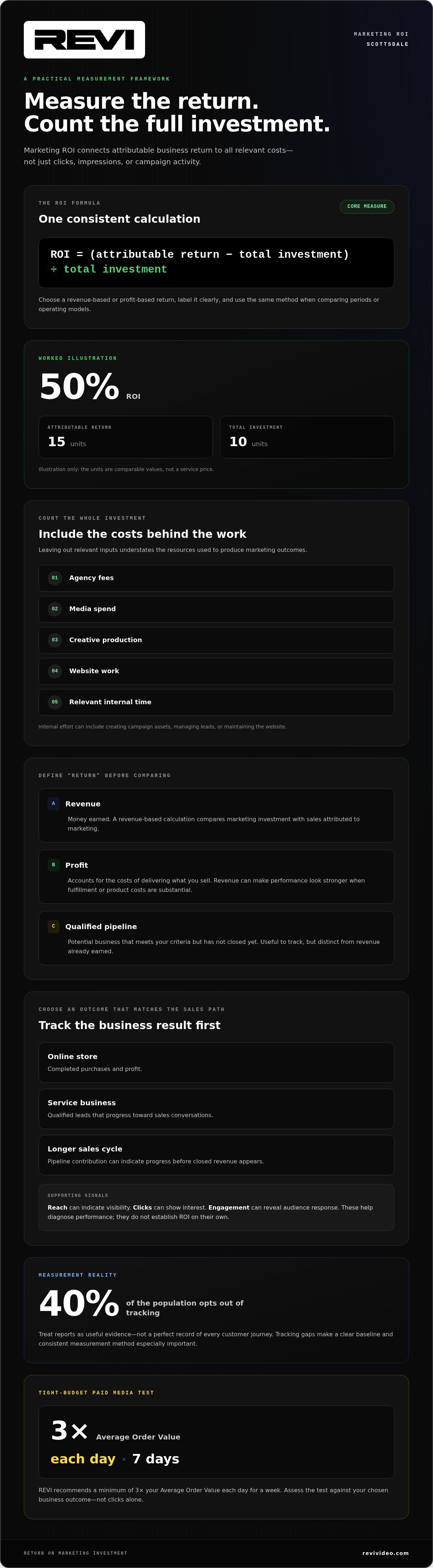
- Account for attribution limits: 40 % of the population opts out of tracking. For tight budgets, REVI recommends a minimum of 3 × your Average Order Value each day for a week (7 days).
What ROI Means When You Hire a Marketing Agency in Scottsdale
Judge an agency by the business outcome its work helps influence, not by activity alone. Impressions, clicks, and content output show that a campaign is running, but they don’t prove it’s creating value. The ROI of hiring a marketing agency in Scottsdale is best understood by comparing attributable business return with the full investment behind the marketing effort.
That idea is often discussed as Return on Marketing Investment (ROMI), which focuses on the return generated by marketing relative to its cost. The right measure depends on your business model. An online store may track purchases and profit; a service business may prioritize qualified leads; a company with a longer sales cycle may measure pipeline contribution before closed revenue appears.
Keep the measures distinct. Revenue is money earned, while profit accounts for the costs of delivering what you sell. Qualified pipeline represents potential business that meets your criteria but hasn’t closed yet. Leading indicators, such as landing-page conversion or booked consultations, can signal progress, but they aren’t substitutes for financial outcomes. Results also depend on your offer, execution, measurement, and market conditions. No agency can guarantee a return.
Which business outcome should your agency work influence?
Choose one primary outcome that fits how customers buy from you. A business that sells directly online might focus on completed purchases, while a professional service might track qualified inquiries that progress to sales conversations. A B2B company could monitor how marketing contributes to suitable opportunities entering its pipeline.
Map that outcome to your actual sales path: what action counts, who follows up, and how your business records a lead becoming a customer. Then use supporting metrics to diagnose performance. Reach can indicate visibility, clicks can show interest, and engagement can reveal audience response. These signals help explain results; they don’t establish ROI on their own.
Why Scottsdale context matters to your marketing baseline
Set a baseline around the customers you can realistically serve, not the assumption that every Scottsdale resident is part of your market. Define your service area, audience, offer, and conversion action. A business serving Scottsdale and nearby communities such as Phoenix, Gilbert, Mesa, Chandler, Paradise Valley, or Tempe may need a different baseline from one that sells online across multiple markets.
Use your own historical results as the starting point. Review lead quality, sales outcomes, conversion paths, and the time prospects typically take to decide. Note major changes to your offer or sales process so you don’t mistake them for agency impact. Tracking also has limits: 40 % of the population opts out of tracking. Treat reports as useful evidence, not a perfect record of every customer journey.
For a tight-budget paid media test, REVI recommends a minimum of 3 × your Average Order Value each day for a week (7 days). Use that guidance as a testing input, then assess performance against your chosen business outcome, not clicks alone.
How to Calculate Marketing Agency ROI Without Hiding the Inputs
A useful ROI calculation puts every major input on the table. Start with this formula:
ROI = (attributable return − total investment) ÷ total investment
A fair marketing ROI calculation compares attributable return with all relevant investment, including agency fees, media spend, production, website work, and internal time. Keep the method clear: a revenue-based calculation shows the return against sales attributed to marketing, while a profit-based calculation accounts for the costs of delivering those sales. They answer different questions, so label which one you use and apply it consistently.
For a simple illustration, if attributable return is 15 units and total investment is 10 units, the formula gives 50% ROI. The units represent comparable values, not a service price. Be precise about what “return” means in your report. Using revenue can make performance look stronger than using contribution profit, especially when fulfillment or product costs are substantial.
Include relevant internal effort, too. If your team spends time creating campaign assets, managing leads, or maintaining the website, leaving that work out understates the resources involved. For the ROI of hiring a marketing agency in Scottsdale, consistency matters: use the same cost categories and outcome definitions when comparing periods or operating models.
Set a baseline and measurement window before launch
Before a campaign starts, record comparable outcomes and inputs: sales or qualified leads, marketing spend, conversion rates, and typical sales-cycle timing. Choose a measurement window that gives prospects time to move through your actual buying process. A short window may miss later conversions; an overly broad one can make campaign effects harder to isolate.
Where your data allows, separate existing demand from incremental outcomes. Compare against a relevant pre-campaign period and note changes to the offer, season, or sales process. This won’t remove every influence, but it gives you a more useful reference than crediting every sale during a campaign to marketing.
Account for attribution gaps in paid marketing
40 % of the population opts out of tracking. As a result, ad platforms may not capture every interaction or conversion, especially when a customer discovers a brand in one place and converts somewhere else. Treat platform attribution as one view of performance, then compare it with business records such as lead status and completed sales.
REVI’s reporting can use automated dashboards and attribution platforms such as Triple Whale or Northbeam to organize performance data. The goal is to make assumptions visible, not to suggest tracking is perfect. Agree on which data sources inform the calculation, how conversions are counted, and when the report is reviewed.
For a connected view of creative, web, media, and measurement, explore REVI’s integrated marketing approach. A shared framework makes it easier to see what the numbers include, what they miss, and whether the campaign is moving toward the outcome that matters.
Agency, In-House, or DIY: Which Model Can Support Better ROI?
No operating model automatically delivers better returns. An agency is worthwhile when its work connects to a measurable business need, such as improving qualified lead flow, supporting sales with stronger creative, or coordinating campaign execution. The right choice depends on the skills and time your business can commit, the work that needs to happen, and how clearly you can measure its contribution.
Use this comparison to identify where ownership should sit. “Agency can manage” describes potential areas of support, not a promise that every engagement includes every task.
| Area | Business owns | Agency can manage |
|---|---|---|
| Strategy | Priorities, customer knowledge, approvals | Campaign planning and creative strategy |
| Execution | Sales follow-up and internal coordination | Production, website work, and ad management |
| Measurement | Business goals and sales records | Tracking setup, optimization, and reporting |
DIY keeps execution close to the business, but the same person may need to cover planning, production, media, and analysis. That can suit a focused project when the required skills and time are available. An in-house team can provide continuity and customer context. An agency can add coordinated capacity across disciplines. Compare the complete effort and capabilities, not just the visible output or fee.
When an in-house team may fit the work
An internal team can be a strong fit when marketing priorities shift with customer feedback, product updates, or sales conversations. Staff who understand the offer can guide messaging and approvals. Still, ownership alone doesn’t create capacity: the team also needs suitable tools, creative resources, clear processes, and reliable measurement. Assess what it can consistently deliver before assigning goals.
What an integrated agency model can coordinate
REVI connects creative strategy and production with web, media management, data analysis, and reporting. Shared goals can help align an ad’s promise with its landing-page experience and the conversion signals used to assess performance. Production can also create campaign assets shaped by paid media strategy, rather than treating creative as a separate task. A Phoenix video production agency guide offers useful context on how production partners fit into campaign work.
Measurement still has limits: 40 % of the population opts out of tracking. REVI can use reporting dashboards and attribution platforms such as Triple Whale or Northbeam to bring performance data together, while business records provide another view. For tight budgets, REVI recommends a minimum of 3 × your Average Order Value each day for a week (7 days). Use the test to inform decisions, not as a promise of return.
The ROI of hiring a marketing agency in Scottsdale depends on how well the chosen model supports your actual growth priorities. Keep strategic ownership close to the business, assign execution where the needed capacity exists, and agree on how results will be evaluated.
A Scottsdale Marketing ROI Readiness Checklist Before You Commit
Before investing in a campaign, make sure your business can define success and follow the customer journey to that result. This readiness check helps expose gaps early, so marketing activity has a clear path to a business outcome. It doesn’t predict performance or guarantee a return. It gives you a stronger starting point for evaluating the ROI of hiring a marketing agency in Scottsdale.
Start with these essentials:
- Audience: Identify the customers you want to reach and the area you can serve.
- Offer: State what you’re promoting and why it matters to that audience.
- Conversion action: Define the meaningful next step, such as a purchase, qualified inquiry, or booked appointment.
- Sales owner: Assign who follows up, records outcomes, and connects leads to sales.
- Baseline: Gather current performance data, noting gaps or changes that could affect comparisons.
Then review the website path from first visit to conversion. Can a prospect understand the offer, find the next step, and complete it without confusion? Check whether tracking records the actions you care about, whether your creative matches the offer, and whether the sales team can report what happened after an inquiry. A weak link in this chain can make results harder to interpret, even when a campaign attracts attention.
Questions to answer before measuring campaign performance
Decide which lead or purchase events count as meaningful outcomes, and who records offline conversions such as calls that later become sales. Set a reporting cadence that gives the team time to review results and act. Agree in advance how you’ll interpret incomplete attribution: 40 % of the population opts out of tracking, so reports may not show every influence or conversion.
Make the Scottsdale customer journey measurable
Map the journey from local discovery to website action and sales follow-up. For customers in Phoenix, Scottsdale, Gilbert, Mesa, Chandler, Paradise Valley, or Tempe, identify where a prospect may need more context, such as a video that explains the offer, brand content that builds clarity, or a more direct website experience. If production is part of the plan, this commercial video production guide for Phoenix provides relevant campaign context.
For paid media tests with tight budgets, REVI recommends a minimum of 3 × your Average Order Value each day for a week (7 days). Treat this as a testing recommendation, not a universal budget rule or a promise of results. The right readiness decision also depends on the offer, measurement setup, and your ability to act on the leads or sales generated.
Use the checklist to turn unknowns into clear next steps. If you’re ready to align the customer journey with creative, web, and paid media, explore REVI’s integrated marketing support.
How REVI Connects Strategy, Creative, Media, and Reporting
REVI’s principle, Production That Produces, starts with the action a campaign needs to support. Creative should do more than look polished. It should fit the offer, speak to the intended audience, and guide people toward a conversion goal the business can track.
That connection matters to the ROI of hiring a marketing agency in Scottsdale. REVI uses custom brand architecture to align creative, website experience, media strategy, and campaign measurement around shared goals. When those parts work together, teams can trace how an ad’s message carries through to a landing page and how the response is assessed. This structure supports clearer evaluation, but it doesn’t guarantee a particular return.
From creative strategy to campaign execution
Campaign content moves through coordinated Pre-Production, Production, and Post-Production. Planning defines the message and assets needed; production creates them; post-production prepares the content for campaign use. Creative Strategy uses data-backed decisions to shape full-funnel creative, with different content supporting discovery, consideration, and conversion rather than treating every audience interaction the same way.
Web work supports the next step. A conversion-focused page should make the campaign offer clear and the intended action easy to find. REVI’s Ad Buying & Management includes tracking implementation, budget allocation, daily optimizations, and A/B testing. Together, these activities connect campaign assets and media decisions to the experience prospects encounter after clicking.
Reporting that keeps business outcomes in view
Data Analysis collects and interprets advertising spend data so the team can assess campaign activity against agreed goals. REVI offers automated dashboards and daily, weekly, or monthly reporting. This cadence can help teams spot what needs attention, review patterns over time, and ground decisions in reported performance rather than isolated metrics.
Attribution still has limits: 40 % of the population opts out of tracking. Reports may not capture every touchpoint, so interpret dashboard data alongside the business outcomes being measured. For paid media tests with tight budgets, REVI recommends a minimum of 3 × your Average Order Value each day for a week (7 days). Treat this as a testing recommendation, not a universal budget rule or a promise of results.
The value of an integrated model comes from connecting the work, then using measurement to inform what happens next. Creative, website experience, media management, and reporting each have a role, but they need a shared conversion goal to support a coherent growth plan.
Ready to connect your campaign goals with a practical measurement approach? Explore REVI’s integrated marketing approach and start a conversation about the outcomes your business wants to track.
Turn Your Growth Goals Into a Measurable Plan
The next step is to turn your growth target into a shared working plan: define the business outcome, agree how you’ll assess progress, and decide what needs to happen across the customer journey. That gives your team and agency a clear direction, while leaving room to adjust as real campaign data comes in.
The ROI of hiring a marketing agency in Scottsdale depends on how well the work supports your business goals and how clearly you can evaluate its contribution. REVI connects creative strategy, video production, conversion-focused Web, and Ad Buying & Management, with reporting that can include automated dashboards and attribution options such as Triple Whale or Northbeam. These capabilities help organize the work and evidence; they don’t guarantee a particular return.
Bring your priorities, current measurement challenges, and growth questions into the conversation. Discuss a strategic, data-backed growth plan with REVI and take the next step with a clearer view of what you want marketing to achieve. Your growth plan can start with one focused decision.
Frequently Asked Questions
How do you calculate the ROI of hiring a marketing agency?
Calculate it by comparing attributable return with total investment over the same measurement period. A common formula is (attributable return minus total investment) divided by total investment. For a retail campaign, report realized sales separately from qualified pipeline; for a B2B campaign, track pipeline until opportunities close. If you use revenue, label it as revenue-based and assess profit separately. The ROI of hiring a marketing agency in Scottsdale is easier to interpret when the return definition and period stay consistent.
What costs should I include when measuring agency ROI?
Include costs tied to the campaign, and organize them so you can trace them back to the work. Along with agency services and media spend, account for production, website work, and internal time spent on approvals or lead follow-up. Separate one-time work from ongoing costs, and avoid counting the same expense twice. For shared resources, document the portion assigned to the campaign so comparisons across reporting periods remain meaningful.
How long does it take to see ROI from a marketing agency?
There’s no universal timeline because results depend on your offer, campaign setup, data quality, sales cycle, and lead follow-up. Set review points before launch: first verify that key actions are being recorded, then monitor early signals such as inquiries or completed forms, and finally assess sales outcomes after prospects have had time to decide. If leads remain uncontacted, campaign performance alone won’t explain the outcome. Record those delays as part of the evaluation.
Can a small business in Scottsdale afford an agency?
Affordability depends on your goals, available resources, and the scope of work, not a generic price benchmark. A smaller business can clarify priorities by choosing a focused campaign objective and understanding the associated investment before committing. For tight budgets, REVI recommends a minimum of 3 × your Average Order Value each day for a week (7 days). Treat this as a campaign-testing guideline, not a service price, universal budget rule, or guarantee of return.
Is hiring a marketing agency better than building an in-house team?
Neither option is automatically better; the right fit depends on the work and ownership your business needs. Consider a hybrid arrangement: an internal team member brings customer feedback and handles sales follow-up, while an agency coordinates specialized campaign execution. Before choosing, map who makes decisions, produces assets, monitors campaigns, and reports outcomes. This can reveal whether your main constraint is expertise, execution time, or coordination, and where outside support could add value.
How does privacy affect marketing attribution?
Privacy-related tracking limits mean advertising reports may not show every interaction in a customer’s journey. REVI states that 40 % of the population opts out of tracking. To add context, compare platform reports with CRM records, sales notes, and customer-reported sources where available. For example, a prospect may click an ad on one device and later call from another. Treat attribution as evidence for decisions, not a complete record of every influence.
What should a Scottsdale business ask before hiring a marketing agency?
Ask how the proposed work connects to a specific business outcome, what your team must provide, and how progress will be reported. Request clarity on deliverables, approval responsibilities, tracking ownership, and the measurement period. If your customers come from Phoenix, Scottsdale, Gilbert, Mesa, Chandler, Paradise Valley, or Tempe, discuss how the campaign’s geographic focus aligns with where you can serve customers. Agreeing on these details creates a practical basis for evaluating the work without assuming guaranteed results.