

A polished video can still miss the mark if it doesn’t give your audience a reason to watch, respond, or take action. If you’re searching for social media video content creation phoenix, you’re likely looking for more than a camera crew. You want a partner who can translate a business goal into a creative plan, then produce content that fits your brand and campaign.
That takes more than choosing a format or chasing a trend. The strongest approach connects strategy, production, and media decisions from the start. REVI brings those elements together, from discovery, storyboarding, and scripting to production, editing, campaign packaging, and paid media support.
This guide will help you plan social-first video for your goals and Phoenix-area audiences. You’ll learn how to build a stronger brief, decide what kind of creative support your campaign needs, and make polished content work harder across social channels. Use it to map a clear path from idea to video assets shaped around your brand and marketing objectives.
Key Takeaways
- Start with a specific campaign objective so your brief, creative direction, and audience action work together.
- Shape the concept around Phoenix-area audiences, then tailor pacing, aspect ratio, and edits to each platform and placement.
- Compare production-only support with an integrated approach to understand how creative, paid media, and performance learning can connect.
- Prepare for a smoother Phoenix-area shoot by approving the brief early and identifying location needs and local context.
- Connect social media video content creation phoenix with end-to-end production, creative strategy, and campaign goals.
Why Phoenix Businesses Need Social Media Video Content Built Around a Goal
A camera-ready concept is only a starting point. Effective social video begins with a clear decision about what the audience should understand, feel, or do. Social media video content creation combines strategy, filming, and editing to produce content for audience-facing campaigns. The objective guides each choice, from the opening hook and visual style to the message and next step.
Social-first video is made for a specific social audience, placement, and action; a general brand film expresses the broader identity of a business. A brand film can support social campaigns, but social-first creative is planned around how people encounter and engage with content in a feed. That distinction helps businesses brief a shoot with more purpose than simply asking for something polished.
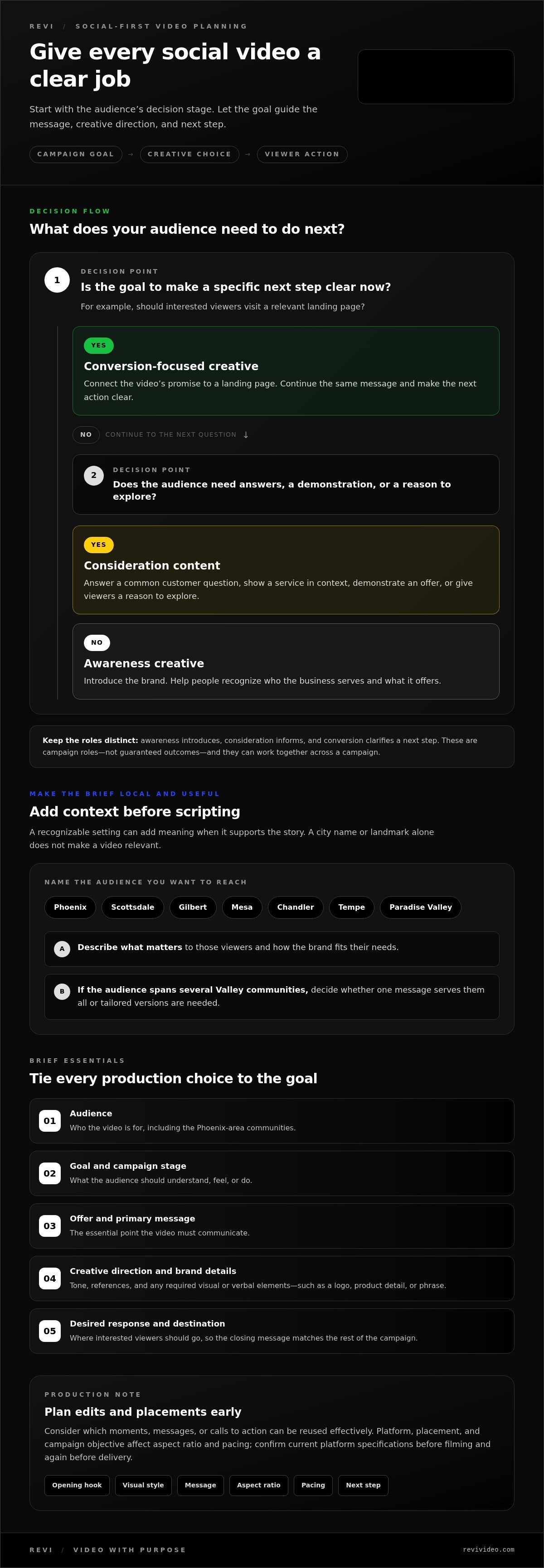
Start by identifying the audience’s stage of decision-making. Awareness creative introduces a brand or helps people recognize what it offers. Consideration content answers questions, demonstrates an offer, or gives viewers a reason to explore. Conversion-focused creative makes the next step clear, such as visiting a relevant landing page. These goals can work together across a campaign, but no single video can guarantee a particular response.
This planning connects video to the wider discipline of Social Media Marketing: a platform helps reach people, while the message and objective give each asset its job. For example, a neighborhood fitness studio might introduce its approach in an awareness video, explain what a first visit involves in a consideration video, and direct interested viewers to a page with class details. Each asset serves a distinct purpose.
Which business goals can social-first video support?
Match the creative to the goal before writing a script. For awareness, establish who the business serves and what it offers. To support consideration, show a service in context or answer a common customer question. For conversion, connect the video’s promise to a landing page that continues the same message and makes the next action clear. Treat these as campaign roles, not guaranteed outcomes.
What makes local Phoenix context useful in a video brief?
Name the audience you want to reach: Phoenix, Scottsdale, Gilbert, Mesa, Chandler, Tempe, Paradise Valley, or a combination. Then describe what matters to those viewers and how your brand fits their needs. A recognizable local setting can add meaning when it supports the story, but a city name or landmark alone won’t make a video feel relevant.
For a useful brief, record the audience, goal, key message, creative direction, and intended next action. If your audience spans several Valley communities, decide whether one message serves them all or whether the creative needs tailored versions. That clarity gives the production team a stronger foundation for scripting and editing, with each decision tied to the campaign rather than added as decoration.
How to Shape Social Media Video Creative for Phoenix Audiences
Give the creative team a useful brief before asking for concepts. A strong brief clarifies four things: who the video is for, what it needs to communicate, how it should feel, and what viewers should do next. This structure makes production choices purposeful, whether the campaign calls for a direct-to-camera explanation, a product demonstration, or a story-led edit.
For social media video content creation phoenix businesses should connect the brief to the campaign’s audience and objective, rather than simply request a few social clips. The SBA Marketing and Sales Guide offers broader small-business marketing and sales guidance. Apply the same disciplined thinking to clarify how video fits your campaign.
How should a social video brief define its creative direction?
Capture the audience, offer, primary message, tone, and desired response. Add brand references and any essential visual or verbal elements, such as a logo, product detail, or phrase. Then note the campaign stage and where interested viewers should go. A clear destination helps the creative team shape the closing message and keeps the next step consistent with the rest of the campaign.
Make the brief practical. Instead of writing “make it energetic,” explain what that means for your brand, such as a confident presenter, quick demonstrations, and concise on-screen text. Specify what the video must communicate and what it should avoid. The clearer these choices are, the easier it is to review a concept against the goal instead of relying on personal taste alone.
How can short-form cuts serve a wider campaign?
Plan useful edits during pre-production, not as an afterthought. REVI’s Post-Production service can shape campaign footage into short-form cuts that emphasize different messages, audiences, or placements. Give each edit a clear purpose. A product detail may suit an explanatory cut, while a concise opening and direct next step may better support a paid placement.
Platform, placement, and campaign objective all affect format. A vertical edit may suit a full-screen mobile placement, while another aspect ratio may fit a different feed or destination. Pacing matters too: some edits need a fast opening, while others need room to demonstrate a service or explain an offer. Confirm current platform specifications before filming and again before delivery. Requirements can change, and checking early helps avoid framing or export issues.
Think in terms of a family of assets, not a fixed number of clips. Identify which moments, messages, or calls to action can be reused effectively, then plan footage and editing priorities around them. Each cut should feel made for its placement, not simply trimmed from a longer video. For broader production considerations, explore this Phoenix commercial video production guide.
When your brief needs to connect creative direction with production and campaign planning, REVI’s video production and strategy brings those decisions into one custom plan.
Social Video Production vs. Integrated Creative and Paid Media in Phoenix
Production and campaign support solve different problems. A production-only scope turns an approved concept into finished footage and edits. An integrated approach connects creative with audience research, distribution decisions, and performance analysis. The right fit depends on what your business has already planned and where the biggest gaps remain.
| Campaign area | Production-only support | Integrated creative and paid media |
|---|---|---|
| Planning | Works from your existing strategy, brief, and media plan. | Connects creative planning with campaign objectives, competitor research, and audience personas. |
| Asset creation | Focuses on filming and agreed post-production deliverables. | Shapes video assets and edits around the creative plan and intended placements. |
| Distribution decisions | Uses the distribution plan your business has already established. | Connects paid media strategy with ad buying, budget allocation, and campaign optimization. |
| Performance learning | Delivers the agreed assets, while your team manages campaign analysis. | Uses data analysis and reporting to inform future creative and media decisions. |
Creative and campaign data should inform one another: audience response can guide the next creative decision, while fresh creative gives the campaign new material to evaluate. That feedback loop helps Phoenix businesses connect social media video content creation phoenix with campaign goals, rather than treating production and distribution as separate tasks.
When is production-only support the right fit?
Production-only support makes sense when your business already has a defined strategy, approved concept, and media plan. You know the audience, message, and where the video will run. The scope can then focus on filming and post-production deliverables, such as campaign footage and edited assets. This approach handles execution, but production alone can’t ensure reach, engagement, or revenue.
When does integrated campaign support add value?
Integrated support can help when strategy, creative, and media decisions need to be developed together. REVI’s Paid Media Strategy includes competitor research and audience personas. Ad Buying & Management covers tracking implementation, budget allocation, and optimization. Connecting these services to video production helps align what you produce with where and how you distribute it, then gives the team information to refine future decisions.
Measurement still has limits: 40 % of the population opts out of tracking. Reporting can help assess campaign activity, but it may not show every viewer’s path or capture every influence on a decision. Treat performance data as a useful signal, not a complete account of cause and effect.
For Phoenix businesses choosing between approaches, consider what your team can already own. If strategy and media are set, production can focus on execution. If research, distribution, and learning also need alignment, an integrated plan can bring those decisions into one campaign architecture without promising a particular outcome.
How to Prepare for a Phoenix-Area Social Video Shoot
A focused shoot starts before the crew arrives. Set the objective, approve the creative brief, plan the logistics, then prepare people and materials for filming. This sequence keeps the shoot aligned with the campaign and helps the team use production time on the footage the project needs.
- Set the objective. Decide what the video should communicate and what response it should support.
- Approve the brief. Align on the audience, key message, tone, creative direction, and planned placements.
- Plan the logistics. Confirm locations, schedules, participants, featured products, and the assets needed on set.
- Prepare for filming. Finalize scripts, storyboards, brand materials, and any necessary on-camera preparation.
For social media video content creation phoenix businesses should identify location needs and local context early. Location affects the visual story, schedule, and what the crew needs to capture. Discussing those details during planning helps prevent last-minute creative changes and keeps production focused.
What should a business prepare before filming?
Bring together brand guidelines, product or service details, approved messaging, and campaign objectives. Identify who will appear on camera, which products or services the video will feature, and any required visual elements, such as signage or branded materials. Share these with the production team alongside the approved brief. That gives scripting and storyboarding a clear reference point and helps everyone prepare for the same creative direction.
Align stakeholders before the shoot, too. Decide who can approve creative choices and make sure the people involved understand the message. If a spokesperson needs to explain a service, clarify the main points in advance rather than relying on improvised answers. Scripts and storyboards can guide delivery without making the finished video feel overly rehearsed.
How should Phoenix-area locations shape production planning?
Choose a setting because it supports the brand story, not simply because it looks recognizable. A service business might film in a space that shows its work in context; a local brand might use a community setting that feels familiar to its intended audience. Consider whether the campaign is speaking to people in Phoenix, Scottsdale, Gilbert, Mesa, Chandler, Tempe, or Paradise Valley, and let that audience guide the location choice.
Once you’ve selected a setting, build the schedule around its practical needs. Consider travel between locations, setup time, access to the space, and how the setting affects sound, lighting, or product demonstrations. Share location details early so the shot plan accounts for what the crew can realistically capture. Local relevance works best when it supports the message, rather than serving as decoration.
For a deeper look at each stage, from planning through post-production, explore REVI’s video production process guide. Ready to turn your campaign brief into a shoot plan? Plan your Phoenix video production with REVI.
How REVI Connects Phoenix Social Video Production to Campaign Goals
Strong social video needs more than a polished final edit. It needs creative choices that serve a business purpose, production built around those choices, and campaign learning that can shape what comes next. REVI provides end-to-end video services for Phoenix-area businesses, from Pre-Production through Production and Post-Production, alongside Creative Strategy and Paid Media Strategy.
This joined-up approach gives every stage a shared direction. Audience research and campaign objectives inform the creative plan; production turns that plan into footage and edits; paid media and reporting help the team understand campaign performance. The aim is not to promise a particular result, but to make decisions with the brand, audience, and campaign goals in view.
What does REVI bring to social media video production?
Pre-Production begins with discovery and planning. REVI develops storyboards and scripts, considers location needs, and shapes the creative direction before filming. This groundwork helps the production team capture footage with the campaign’s intended use in mind, including opportunities for short-form edits and campaign packaging.
During Production, a high-performance crew brings cinematic precision and top-tier gear to the shoot. Post-Production carries the footage through editing, motion design, sound engineering, and color grading, then packages the finished creative for its planned campaign use. Each craft decision supports the story and the brand, while the deliverables stay connected to the original brief.
For social media video content creation phoenix brands can use across a campaign, this end-to-end structure connects the creative concept to how the assets will be delivered and used. It also brings practical questions into the plan early: what footage supports the core story, what can become shorter edits, and how should each asset fit the campaign?
How can creative and campaign learning work together?
Creative Strategy and Paid Media Strategy align video planning with campaign objectives. Data-backed creative decisions and audience research inform full-funnel planning, from content that introduces a brand to creative that supports deeper consideration or a next step. Ad Buying & Management, Data Analysis, and Reporting connect campaign delivery with ongoing evaluation and optimization.
Reporting can include automated dashboards and daily, weekly, or monthly reports. These views give the team structured information to assess campaign activity and consider what to adjust in future creative or media decisions. Data doesn’t replace creative judgment; it adds context. The most useful learning comes from reading performance signals alongside the campaign objective, audience, placement, and message.
If you’re assessing how a production partner fits your campaign needs, REVI’s Phoenix video production agency guide offers further selection context. For a custom, business-minded social video project, Build a high-performance video campaign with REVI.
Make Your Next Video Idea a Campaign Starting Point
Your next social video doesn’t need to answer every marketing question at once. Choose one audience insight to explore, then give the creative a clear role in the campaign. After launch, use what you learn to shape the next brief. That steady cycle makes social media video content creation phoenix an evolving part of your marketing, not a one-off project.
REVI connects end-to-end production, from pre-production through post-production, with data-backed creative strategy, ad management, and reporting. This integrated work moves an idea toward campaign-ready assets while keeping business priorities in view. Each project starts with the needs of your brand and audience, then takes shape around your goals.
Ready to plan a social video project with a clear campaign purpose? Build a high-performance video campaign with REVI. Start with the goal you want your next creative to support.
Frequently Asked Questions
How much does social media video content creation cost in Phoenix?
The cost of social media video content creation phoenix projects depends on scope, not runtime alone. A concept with several locations, specialized visuals, or multiple deliverables calls for different production planning than a straightforward interview. When planning a project, clarify what the scope includes: pre-production, filming, editing, and campaign-ready assets. This makes it easier to align the creative and production plan with your needs.
How much should a business spend on social media video advertising?
Set an ad budget that fits your business economics and campaign objective. For a tight budget, REVI recommends a minimum of 3 × your Average Order Value each day for a week (7 days). Treat this as a testing guideline, not a promise of performance. Before launching, decide what you’ll evaluate, such as qualified site visits or purchase activity, and make sure your landing page is ready to support the campaign.
Is professional video production worth it for social media?
Professional production can be worthwhile when video plays an important role in your marketing and the project needs thoughtful storytelling, reliable execution, or a cohesive brand look. For example, a Phoenix-area business introducing a new service may need footage that explains the offer clearly and can be adapted for its campaign. Weigh the production scope against the usefulness of the planned assets, not polish alone. No production approach guarantees engagement or sales.
What should a social media video brief include?
A useful brief gives the team enough context to make decisions without guessing. Include the audience, campaign objective, offer, main message, desired tone, placement, and destination for viewers. Add approved brand references, required claims or visuals, and the names of decision-makers who will review the work. For example, if a video promotes a service, provide the details customers need to understand what it is and what step to take next.
Can one video shoot create content for multiple social placements?
Yes, one shoot can capture footage for different placements if the production plan accounts for them from the start. Tell the team where you intend to use the content, then plan framing, key moments, and supporting footage accordingly. A customer testimonial, for instance, might yield a longer edit and shorter excerpts, provided each version makes sense on its own. Check current platform specifications before finalizing framing and delivery formats.
How do video production and paid social advertising work together?
Video production creates campaign assets; paid social advertising puts selected assets in front of intended audiences through media buying. The campaign objective can guide which messages and edits the team prepares, while tracking and performance analysis can inform later adjustments. For example, if an ad earns attention but few landing-page visits, the team can review the creative, audience, and destination together rather than assuming the footage alone explains the result.
How can Phoenix businesses measure social media video performance?
Choose measures that fit the goal, then compare campaign activity with the intended next step. For awareness, review available reach and viewing data; for traffic, examine clicks and relevant site visits; for sales, consider tracked purchases alongside ad reports. Businesses in Phoenix, Scottsdale, Gilbert, Mesa, Chandler, Tempe, and Paradise Valley can use reporting to spot patterns and guide future creative decisions. Treat attribution as directional, since reports may not capture every influence on a customer.