

What if the best way to trust a new marketing agency isn’t to take its promises at face value, but to make the work visible from day one? If you’ve been burned by vague deliverables, slow communication, or reports that don’t explain where your budget went, asking how to trust a new marketing agency after being burned is a smart first step, not a sign you’re difficult.
You’re right to want more than a polished pitch. You need clear ownership of ad accounts, creative, and performance data, plus a direct line between strategy, spend, and business goals. Attribution can’t be perfect. 40 % of the population opts out of tracking. That makes transparent methods and honest reporting even more important.
This guide gives you a practical way to assess accountability before you commit. You’ll learn what to look for in communication and reporting, how to shape a focused first engagement with clear deliverables and review points, and how connected creative, media buying, and analysis can make decisions easier to trace. Trust doesn’t have to be an all-or-nothing leap. Build it through visible work, shared data, and commitments you can review.
Key Takeaways
- Learn how to trust a new marketing agency after being burned by looking for observable accountability, clear ownership, and follow-through.
- Use a practical checklist to assess whether an agency connects your goals, audience, creative, channels, and reporting.
- Start with a focused project that has a defined deliverable and review point before making a broader commitment.
- Judge performance with context: imperfect attribution can limit certainty, but transparent reporting can still guide decisions.
- See how connected strategy, production, web, ad management, and analysis can make marketing decisions easier to trace.
How to Trust a New Marketing Agency After a Bad Experience
A disappointing campaign can make it hard to hand over another budget, login, or major business goal. That caution makes sense. But one poor outcome doesn’t prove every agency works the same way. Separate the result from the process: a campaign can miss its target despite thoughtful work, while missing account access, shifting scope, or unexplained decisions point to accountability problems that deserve attention.
The practical answer to how to trust a new marketing agency after being burned isn’t to rely on a confident pitch. Look for evidence you can observe: clear responsibilities, access to relevant accounts and reporting, reliable follow-through, and decisions explained in terms you understand. An agency’s role can vary by its services and scope; Understanding the role of a marketing agency offers useful background. The working agreement should still spell out what the agency will do for your business.
This approach can’t guarantee campaign results. It helps you evaluate the relationship before you rely on it. Use the signals below to distinguish persuasive language from a transparent working process.
What does a trustworthy agency relationship look like?
Start with a plain-language account of the work. Who owns strategy, creative, approvals, and campaign decisions? What deliverables will you receive, when should you expect them, and who handles questions or delays? These details turn a broad promise like “grow your audience” into work you can review, such as a campaign plan, approved creative, and a scheduled performance update.
Access matters, too. Your business should be able to view relevant ad accounts and reporting, rather than depend on occasional screenshots. Shared visibility lets you see what’s running and what the numbers show. Confidence is welcome, but it should come with reasoning: the agency can explain why it chose an audience, channel, or creative direction and what evidence will inform the next decision.
Which warning signs deserve a closer look?
Pause when the scope relies on phrases like “ongoing optimization” without clarifying what work that includes. Ask for reporting that explains results, not just a collection of metrics. Ownership should also be plain: know who controls the accounts, creative files, and performance data, and how you’ll access them during the engagement.
- Vague deliverables: Request specific outputs and a schedule before work begins.
- Unexplained reporting: Ask what each key metric means and how it connects to your business objective.
- Unclear ownership: Write down who controls accounts, assets, approvals, and decisions.
- Guaranteed outcomes or pressure to commit: Slow the conversation down and get the assumptions, risks, and proposed scope in writing.
Before signing, keep a short record of what you expect, what the agency has agreed to provide, and which questions remain unanswered. For example, note the campaign objective, agreed creative deliverables, account access, update cadence, and the date you’ll review progress. That record gives both sides a shared reference point. A trustworthy partnership isn’t defined by perfect predictions. It’s built through clear commitments, visible work, and honest explanations when plans need to change.
How to Evaluate a Marketing Agency’s Transparency Before You Commit
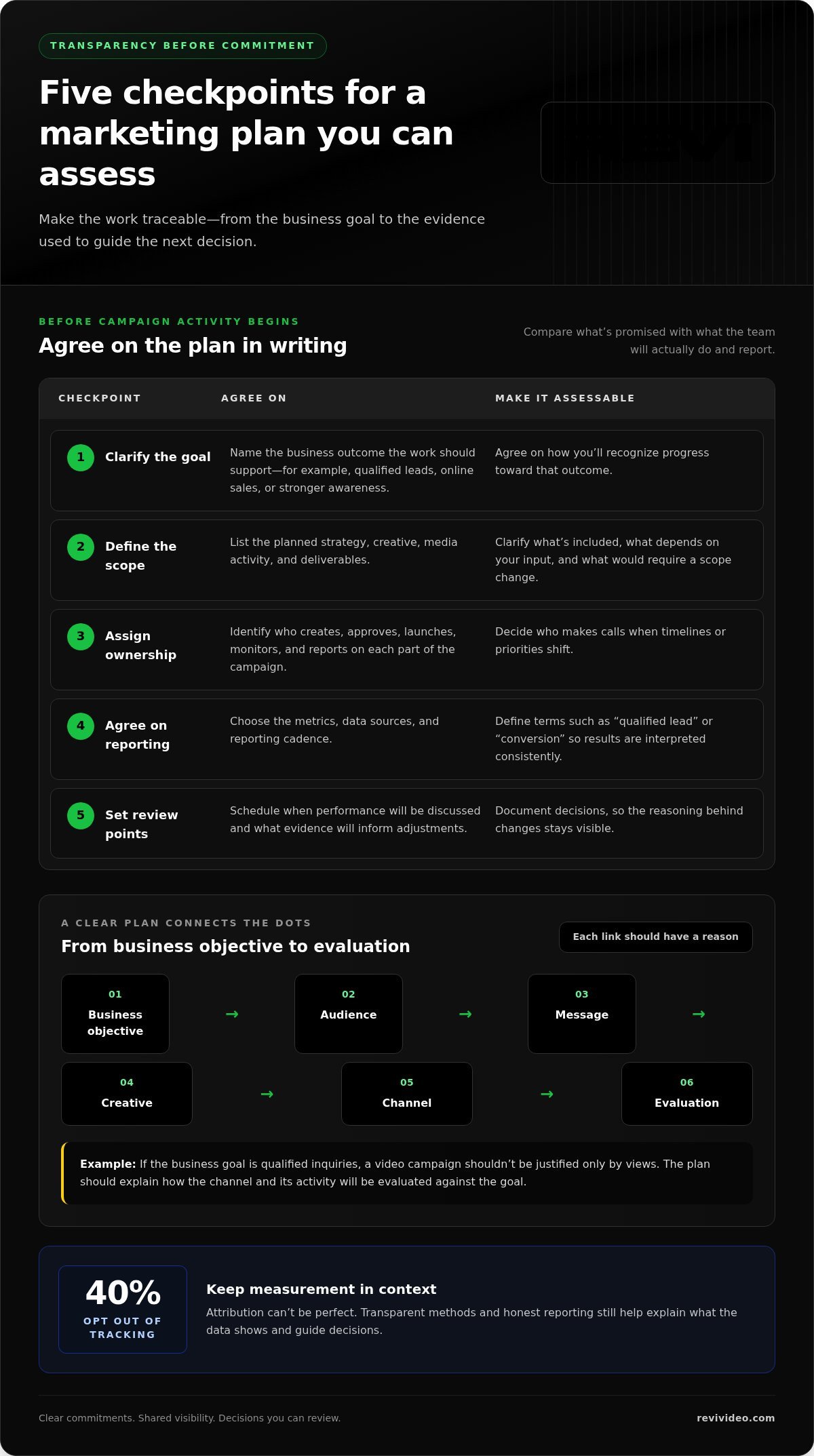
A polished proposal can describe a direction. A transparent plan shows how the work will move from your business goal to a decision you can assess. Before campaign activity begins, walk through the sequence below and get the answers in writing. This gives you a consistent way to compare promises with the working plan, whether you’re reviewing an agency in Phoenix, Scottsdale, Gilbert, Mesa, Chandler, Paradise Valley, or Tempe, or considering a partner elsewhere.
- Clarify the goal. Define the business outcome the work should support, such as qualified leads, online sales, or stronger awareness. Agree on how you’ll recognize progress.
- Define the scope. List the planned strategy, creative, media activity, and deliverables. Note what’s included, what depends on your input, and what would require a scope change.
- Assign ownership. Identify who creates, approves, launches, monitors, and reports on each part of the campaign. Clarify who makes decisions when timelines or priorities shift.
- Agree on reporting. Choose the metrics, data sources, and reporting cadence. Define terms such as a qualified lead or conversion so both sides interpret results consistently.
- Set review points. Decide when you’ll discuss performance, what evidence will inform adjustments, and how the team will document those decisions.
What should a clear marketing plan explain?
A useful plan connects the dots: business objective to audience, audience to message, message to creative, and creative to channel. It should explain why each channel fits the intended audience and how its activity will be evaluated against the objective. For example, a video campaign shouldn’t be justified only by views if the business goal is to generate qualified inquiries.
Look for assumptions, too. A plan might depend on an existing landing page, timely approvals, or enough campaign data to compare creative. The team should explain how it will respond if early evidence challenges those assumptions. For a project involving video, REVI’s Phoenix video production agency selection guide can help you think through scope and partner evaluation.
How can you assess access and reporting?
Confirm that you can access the relevant advertising accounts and see the data behind reported results. A dashboard is a starting point, not an explanation. Useful reporting interprets what happened, connects spend and campaign activity to outcomes, and identifies the next decision. Ask the agency to define the metrics it uses and show how it will distinguish a useful signal from a short-term fluctuation.
Write down the agreed definitions, account ownership, responsibilities, and review cadence before launch. This simple record helps prevent misunderstandings and gives every meeting a clear reference point. If you’re assessing how an integrated creative and advertising partner could fit your goals, explore REVI’s marketing approach as one example of connected strategy, production, and campaign analysis.
How to Start Small and Reduce Risk With a New Marketing Agency
A first project can give you evidence about the working relationship before you consider a broader commitment. Keep the scope focused enough to understand what the agency will deliver, how decisions will happen, and whether communication matches expectations. Treat it as a structured test of the process, not a promise that a campaign will produce a particular result.
Choose a real business priority, not a project selected only because it seems easy to hand off. That could mean developing one campaign, producing a defined creative asset, or improving a specific part of your website. The right starting point has a clear business purpose and a result you can review, even if performance data takes longer to mature.
How do you scope a first project?
Write a short project brief before work begins. Name the objective, deliverables, decision owners, dependencies, and review date. For example, a campaign brief might specify the audience and goal, the creative assets to be produced, who supplies product details, who approves the work, and who manages launch. This makes responsibilities visible and reduces the risk of discovering conflicting assumptions halfway through.
Set success criteria that match the objective and the available measurement. For a website improvement, that might include a completed page and agreed usability or conversion indicators. For an ad campaign, distinguish launch and delivery checks from business outcomes such as qualified leads or sales. If the project includes paid media, budget enough to gather useful evidence. REVI recommends a minimum of 3 × your Average Order Value each day for a week (7 days). Treat this as a testing guideline, not a prediction of results.
Also define the boundaries: what the agency controls, what your team must provide, and which actions need your approval. Identify dependencies such as access, existing brand assets, product information, or timely feedback. If one of these is delayed, agree on how the schedule or scope will be handled.
What should a useful review point cover?
Use the review to assess both the work and the way the team worked. Compare completed deliverables with the agreed scope. Discuss key decisions, observed results, and what the available evidence can’t yet tell you. Then ask whether the agency followed the documented strategy, communicated changes clearly, and raised issues early.
Keep the conversation specific. If a creative asset changed, review what prompted the change. If a result missed expectations, ask what the data shows and what other factors may have affected it. A thoughtful explanation is more useful than a quick excuse or an unsupported claim that success is just around the corner.
End by choosing among three clear paths: expand the work, adjust the approach, or pause. Base that call on delivery, communication, decision quality, and evidence relevant to the project goal. This is a practical way to approach how to trust a new marketing agency after being burned: create a bounded opportunity to observe how the partnership operates, then decide what the evidence supports.
How to Judge Agency Performance When Marketing Attribution Is Imperfect
Marketing reports can’t always connect every sale or lead to one specific ad. Tracking gaps make attribution imperfect, but they don’t make performance impossible to assess. The useful question isn’t whether every conversion can be traced with certainty. It’s whether the agency can explain what the available evidence shows, what it can’t show, and how that affects the next decision.
Keep the scale of the challenge in view: 40 % of the population opts out of tracking. A platform may therefore report only part of the customer journey. Different tools can also assign credit differently. Treat a reported conversion as one signal, then compare it with campaign activity, your own business measures, and the goal you agreed on before launch.
Which reporting signals help rebuild confidence?
A dashboard is useful when it helps you see what happened and decide what to do next. Look for reporting that brings spend and campaign activity together with interpretation. If an ad generated clicks but few qualified inquiries, the report should explain what the team thinks may be happening and what it plans to test or adjust. A list of metrics without context leaves you with numbers, not a clear performance picture.
Automated dashboards can make campaign information easier to review, while daily, weekly, or monthly reports create a regular rhythm for discussion. The right cadence depends on the work and the decisions that need attention. Attribution platforms such as Triple Whale or Northbeam may help organize available signals, but no platform can promise perfect measurement. Ask which data sources inform the report and how the team accounts for gaps or conflicting readings.
For paid media, REVI recommends a minimum of 3 × your Average Order Value each day for a week (7 days). Treat this as a testing guideline for generating evidence, not as a guarantee of sales or a definitive verdict on campaign success. Interpret the results alongside the campaign’s objective and context.
How should you respond when results are unclear?
Separate measurement limits from execution issues. A tracking gap may make a conversion hard to attribute; it doesn’t explain whether the campaign launched as planned, reached the intended audience, or used the approved creative. Record what’s known, what remains uncertain, and which data source supports each conclusion.
Then ask the agency to walk through its assumptions, tests, and planned optimizations. Was the intended audience reached? Did the team test creative or adjust budget allocation? What evidence would support keeping the current approach, changing it, or running another test? A clear answer identifies both the reasoning and the next step.
Compare observations with the agreed business goal instead of letting one platform metric decide the story. This makes reporting more useful even when attribution is incomplete. For a marketing partnership grounded in connected analysis and campaign decisions, explore REVI’s marketing services.
How REVI Builds a More Transparent Marketing Partnership
Trust grows when the parts of marketing work together and you can see how decisions connect. REVI creates custom architecture for each brand’s goals and context, then connects strategy, creative, media, web, and analysis where they support the work. That structure gives a campaign a clear throughline: what the business wants to achieve, who it needs to reach, what message it presents, and how the team will evaluate its activity.
This matters because disconnected work can make it harder to understand what’s driving a result. If the ad, landing page, and audience strategy don’t align, a campaign may generate activity without helping you see what to improve. A connected approach makes the pieces easier to assess. It doesn’t guarantee performance, but it gives decisions a more visible rationale.
How does REVI connect strategy, creative, and media?
Paid Media Strategy sets the campaign direction; Creative Strategy shapes the message and assets; Ad Buying & Management puts the plan into market and informs ongoing decisions. Video production can support that strategy across Pre-Production, Production, and Post-Production, so creative development and campaign needs stay connected. REVI’s guide to the video production process from pre-production to final cut explores how those stages coordinate.
Web development also has a role. If a campaign sends people to a website, the landing experience should support the same audience and objective as the ad. Data Analysis and Reporting then help the team review campaign activity, explain what it sees, and document optimization decisions. Automated dashboards and daily, weekly, or monthly reports can make that work visible over time. The point isn’t to flood you with metrics. It’s to connect creative, media choices, and results to the business goal.
For a Phoenix-area brand in Phoenix, Scottsdale, Gilbert, Mesa, Chandler, Paradise Valley, or Tempe, this connected model can make collaboration more straightforward: the people shaping the message, producing assets, managing ads, and reviewing data can work from a shared direction. REVI’s custom approach accounts for each brand’s context rather than forcing every business into the same plan.
What can a first conversation help clarify?
Bring the details that will shape a useful discussion: what went wrong in a previous partnership, what your business wants to accomplish now, and where you want greater visibility. You can also outline what’s already working, which assets or channels are in play, and what you want to understand more clearly. These details help surface practical questions about scope, access, responsibilities, measurement, and how connected strategy and execution could fit your needs.
If you’re considering how to trust a new marketing agency after being burned, start with a conversation focused on clarity, not pressure. A thoughtful discussion can help identify a sensible scope and the questions that need answers before work begins. Discuss your marketing goals with REVI and explore a strategic path for your brand.
Make Your Next Marketing Partnership a Deliberate Choice
Trust doesn’t have to arrive before the work begins. It can grow as you see how a partner handles decisions, communicates uncertainty, and adapts when the evidence points in a new direction. That shift matters if you’re asking how to trust a new marketing agency after being burned: you’re not being asked to ignore what happened. You’re using what you learned to set a clearer standard for what comes next.
Take that standard into your next conversation. Be direct about what didn’t work before, what your business needs now, and what you’ll need to see to feel confident moving forward. A strong partnership should make it easier to understand the plan and your role in it, not harder to ask questions.
REVI brings strategy and execution into a shared conversation, with Data Analysis and Reporting helping teams examine the work and make informed decisions. Start by exploring whether that approach fits your goals and the kind of visibility you want from a partner.
Talk with REVI about a strategic, data-backed marketing partnership. A thoughtful next step can put you back in control, one clear decision at a time.
Frequently Asked Questions
Can you trust a marketing agency after a bad experience with another one?
Yes, a disappointing experience with one agency doesn’t determine how another partnership will work. To decide how to trust a new marketing agency after being burned, pay attention to how the team handles your questions before work starts: do they listen, explain their recommendations, and document what they’ve agreed to? Begin with a defined scope and use your first review to assess the collaboration. Trust can build gradually, without an all-at-once commitment.
What should a marketing agency proposal include?
A useful proposal should connect your business objective to the recommended work. Look for the proposed scope, deliverables, responsibilities, assumptions, measurement approach, and how you’ll review progress. For example, if the goal is more qualified inquiries, the proposal should show how the planned creative and campaign activity support that goal, rather than focusing only on reach. It should also identify what decisions or materials the agency needs from your team.
How can you tell if a marketing agency’s reports are transparent?
Transparent reports let you trace the source of key numbers and understand what they mean for your business. Check whether the report identifies its data sources, defines important metrics, and distinguishes observed results from estimates or interpretation. A useful discussion should also explain why the team recommends a particular next step. If a number changes between platforms, the agency should be able to explain the difference rather than presenting one figure as the complete story.
What happens if a marketing agency does not meet agreed expectations?
Start by comparing the work delivered with the written scope and noting the specific gap. Share the concern with the agency and ask for an explanation, a proposed correction, and a clear owner for the next action. For example, if an agreed asset hasn’t been delivered, clarify its revised status and any effect on launch plans. Then use the agreement’s review or change process to decide whether to adjust, continue, or pause the work.
How long should you test a new marketing agency before expanding the work?
There’s no universal test period. Set a review date that gives the agency enough time to complete the agreed work and gives your team a fair chance to assess its quality, communication, and decision-making. For advertising, also consider whether enough relevant activity has accumulated to inform a useful review. If the evidence is still limited, agree on what needs to happen next before deciding to expand, rather than extending the engagement without a clear reason.
Can a marketing agency guarantee results?
No agency can responsibly guarantee a specific marketing outcome, because results depend on factors beyond its direct control, including audience response, competition, and the customer journey. A credible agency can explain its strategy, the assumptions behind it, how it will monitor activity, and what it may adjust as evidence comes in. Focus on whether those commitments are clear and reviewable. Treat confident forecasts as projections, not promises of sales, leads, or growth.
How much should a business spend on advertising with an agency?
Set an ad budget based on your business goals, Average Order Value, and ability to fund a test without relying on a guaranteed return. REVI’s recommendation for a tight budget is a minimum of 3 × your Average Order Value each day for a week (7 days). Businesses in Phoenix, Scottsdale, Gilbert, Mesa, Chandler, Paradise Valley, and Tempe can use that as a planning reference, then assess the test against agreed objectives and available data.