

The right seller target is defined by fit, not a broad industry list. Private equity firms should focus on companies that match their investment thesis, preferred sectors, size criteria, and growth plans. Effective marketing for private equity firms in Phoenix starts by identifying owners whose businesses align with those criteria and reaching them with relevant, credible messages.
That focus matters. Owners are more likely to engage when a firm understands their business and explains why a conversation is relevant, rather than sending a generic pitch. A clear target profile also helps teams prioritize prospects with a stronger strategic fit.
This article shows how to build a practical target profile, find and organize prospects, and use paid search, SEO, email, and other channels to reach them. It also explains how useful content and coordinated sales support can keep conversations moving through a long decision process.
Key Takeaways
- Define seller prospects by investment thesis, sector, company size, and growth potential before choosing outreach channels.
- Use paid search to meet prospects who are actively seeking relevant investment partners, then make the next step clear.
- Build trust with useful, current content that helps business owners understand the firm’s approach and evaluate fit.
- Organize prospect lists around decision-makers and meaningful qualification details, not just company names.
- Coordinate marketing with sales follow-up and email nurturing to keep relevant conversations moving over time.
1. Search engine marketing and paid search
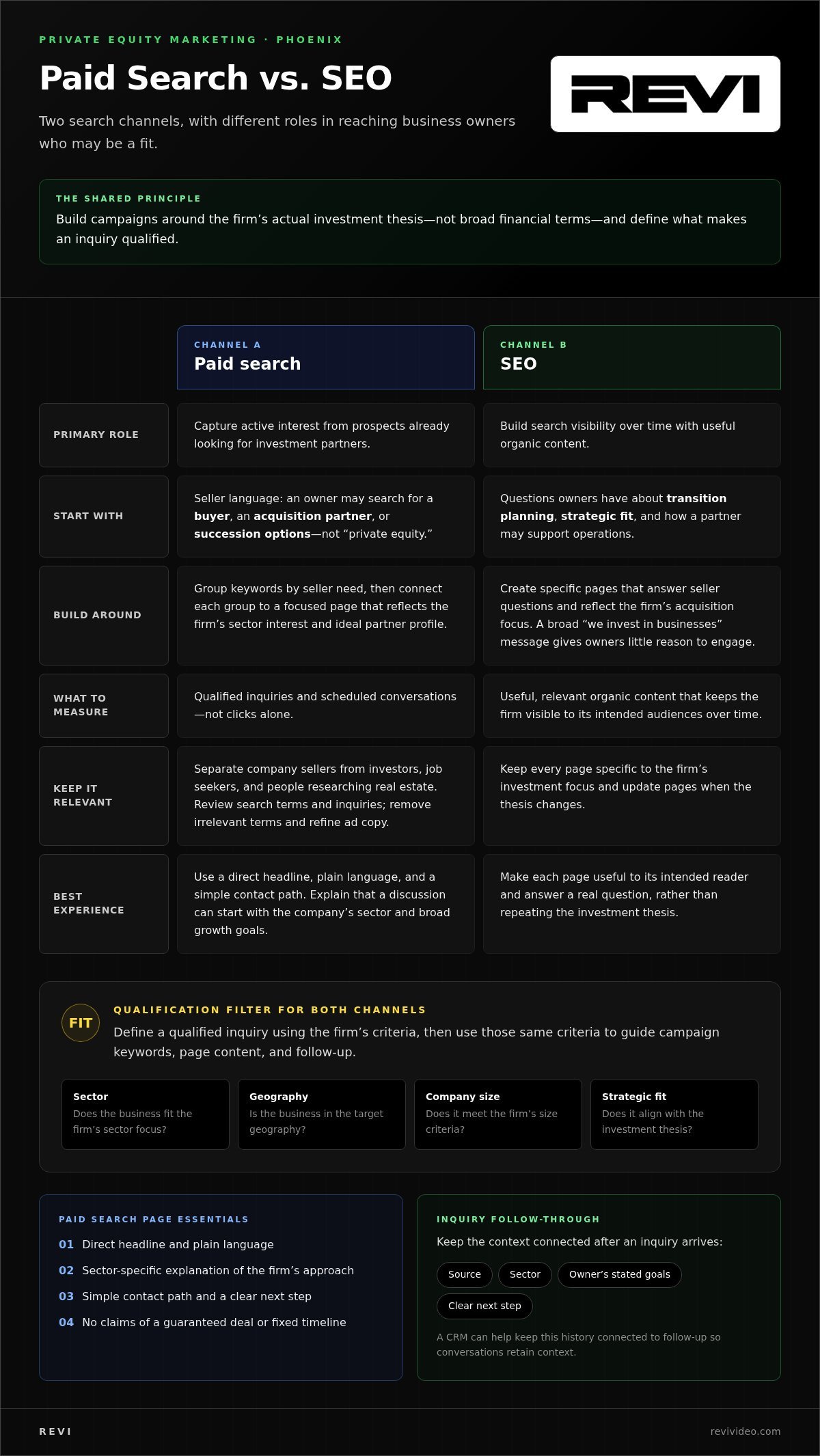
Search engine marketing helps private equity firms reach prospects already looking for investment partners. For Phoenix firms, paid search can capture active interest while search engine optimization builds visibility over time. Both work best when campaigns reflect the firm’s actual investment thesis, rather than broad financial terms.
Start with the seller’s language. A business owner may search for a buyer, an acquisition partner, or succession options, not “private equity.” Build keyword groups around those needs, then connect each group to a focused page. For example, a firm pursuing business services companies can explain its sector interest and what an initial conversation covers.
Before launching ads, define a qualified inquiry. Set criteria around sector, geography, company size, and strategic fit, then use them to guide campaign keywords, page content, and follow-up. This keeps the campaign focused on sellers the firm can realistically serve, rather than maximizing clicks regardless of fit.
- Match intent: Separate searches about selling a company from searches by investors, job seekers, or people researching real estate.
- Build relevant pages: Give each priority sector a page that describes the firm’s approach, operating interests, and ideal partner profile.
- Track meaningful actions: Measure qualified inquiries and scheduled conversations, not clicks alone.
Paid search can reach an owner at the moment of interest, but the landing page must make the next step clear. Use a direct headline, plain language, and a simple contact path. Explain what information can start a discussion, such as the company’s sector and broad growth goals. Avoid claims that suggest a guaranteed deal or fixed timeline.
Search visibility also depends on useful organic content. Create pages that answer seller questions about transition planning, strategic fit, and how an investment partner may support operations. Keep each page specific to the firm’s acquisition focus. A broad “we invest in businesses” message gives owners little reason to start a conversation.
Review search terms and inquiries regularly. Remove irrelevant terms, refine ad copy, and update pages when the firm’s thesis changes. In Phoenix, marketing for private equity firms should connect every search touchpoint to a consistent seller experience, from the first query to the first conversation. That makes paid search a practical part of a wider outreach system, not a shortcut to deal flow.
Operational discipline matters after an inquiry arrives: record its source and sector, note the owner’s stated goals, and assign a clear next step. A CRM can help keep that history connected to follow-up, so conversations do not lose context between the first response and later review. Phoenix law firms can use targeted paid search and a CRM to track prospective clients from initial inquiry through signed retainer.
A firm can also use relevant investment history to make its acquisition focus more concrete, while avoiding promises about outcomes or timing. Phoenix Partners invested in Shorewood Engineering Inc. in 2024. Shorewood Engineering Inc. was founded in 1988. The example can sit alongside clear explanations of sector interest and the kinds of businesses the firm seeks to meet.
2. Content marketing and authority building
Private equity decisions can take years, so useful content gives prospective sellers and investors reasons to stay engaged between conversations. A focused content plan can explain how a firm evaluates opportunities, works with portfolio companies, and approaches long-term growth. Each piece should answer a real question, not simply repeat the firm’s investment thesis. Effective marketing for private equity firms in Phoenix makes those answers relevant to the audiences the firm wants to reach.
Start with the audiences you need to reach. A founder considering a transition needs different information from an investor comparing opportunities or a portfolio company seeking operating insight. Map each audience to a practical topic, such as preparing for an ownership discussion, understanding a firm’s sector focus, or reviewing a case study. This makes every article, interview, or video more useful to its intended reader.
Case studies can help prospective investors evaluate an opportunity by showing the context, strategy, and outcomes of a specific investment. Keep the story clear: explain the business challenge, the firm’s role, and the decisions that shaped its approach. Use details the firm can share, and distinguish documented results from broader lessons. A well-structured case study demonstrates how the firm thinks without suggesting every investment follows the same path.
Educational content also supports relationships with current and prospective investors. A market update, for example, can explain changes in a target sector, while an interview with an operating leader can offer practical insight into growth priorities. Use each format to answer a different question. Avoid generic commentary that gives founders and investors no clear reason to return. Effective marketing for private equity firms in Phoenix connects each topic to the firm’s audience and investment focus.
- Choose a clear audience: Write for founders, investors, or portfolio company groups, rather than trying to address everyone in one piece.
- Connect content to evidence: Use relevant examples and explain the firm’s role accurately.
- Give each asset a next step: Invite readers to explore a related insight or begin a conversation.
Build a simple editorial process: collect recurring questions from deal and operations teams, choose topics that match the investment strategy, and ask a subject expert to review each draft. Then adapt strong ideas to different channels, such as a detailed article, short video, or investor email. Consistent themes make the firm’s voice easier to recognize.
Keep the material current. Private equity marketing content may become outdated or useless within a year or two years, especially when market conditions or the firm’s priorities shift. Review key pages and case studies, update changed details, and retire content that no longer reflects the firm’s approach. Intentional brand building can help keep those messages consistent across the firm’s content.
3. Ideal customer profiles and prospect lists
A useful prospect list starts with an investment thesis, not a directory of Phoenix businesses. Define the sectors, company characteristics, ownership situations, and growth potential that fit the fund. Then turn those criteria into an ideal customer profile that deal teams can use consistently. For example, Cave Creek Capital Management focuses on companies with annual revenues between $25 million and $150 million. That specific range shows how a firm can translate its investment focus into a practical screening criterion.
Build the profile around factors that signal strategic fit. Consider whether a company operates in a priority sector, whether its leaders may be planning a transition, and whether its growth needs match the firm’s approach. Separate essential criteria from useful context. A strong profile helps teams distinguish promising prospects from businesses that only share a broad industry label.
The Phoenix matched dataset dated September 29, 2026, included 26 companies with 1-10 employees and 11 companies with 11-50 employees. The median employee size of companies on the Phoenix list was 1-10 employees. These figures describe that matched dataset, not every potential seller in the region. Use them to sharpen questions about company size, then qualify individual prospects against the fund’s actual thesis.
Contact coverage matters, too. The Phoenix list averaged 4.6 contacts per company, which can help teams see whether a prospect record reaches beyond a single person. A founder may lead ownership discussions, while another executive understands operations or growth plans. Map relevant leaders and their roles, then record how each contact connects to the company’s decision-making.
- Set fit criteria: Define priority sectors, company profile, ownership context, and growth alignment.
- Organize contact roles: Record founders, executives, and other relevant decision-makers by their relationship to the business.
- Qualify before outreach: Check each prospect against the investment thesis and note the reason for including them.
Keep the list useful by recording the source and date of each key detail. Track company name, sector, location, employee range, relevant contacts, and the reason for fit. Add a clear status for research, outreach, response, or follow-up. This structure helps deal teams coordinate activity without treating every name as an equally strong opportunity.
Use feedback from conversations to refine the profile. If Phoenix business leaders respond to a particular investment angle, capture the language and needs they raise. If prospects repeatedly fall outside the firm’s criteria, update the screening process. A well-maintained list connects the firm’s vision to real companies and supports focused outreach as target businesses grow.
4. Marketing and sales support
Phoenix firms should look for marketing support that connects campaigns with sales follow-up and speaks to private equity audiences. The right strategy can turn investor and seller interest into organized conversations, with messaging tailored to relevant sectors such as Arizona manufacturing.
Marketing creates the first touchpoint; sales support gives that interest a clear next step. If a manufacturing owner downloads a sector briefing, for example, the team can record the inquiry, note the topic, and follow up with a relevant conversation. A shared process helps keep useful signals from getting lost between marketing and deal teams.
Start by agreeing on what counts as a qualified lead. Define the sectors, ownership situations, and strategic needs that align with the firm’s investment thesis. Then record each inquiry’s source, interest, and status in a shared tracking system. A prospect seeking general information needs different follow-up from an owner actively exploring a transition.
- Set a handoff: Specify who reviews incoming inquiries and who owns the next response.
- Capture context: Record the content, campaign, or event that prompted each investor or seller to engage.
- Track progress: Use clear stages, such as new inquiry, qualified conversation, and active follow-up.
- Close the feedback loop: Let deal teams flag irrelevant leads so marketing can refine its audience and message.
Search engine optimization can attract leads and support sustainable lead generation. Pair useful pages with a clear way to contact the firm, then track which topics prompt meaningful inquiries. A page about manufacturing succession, for instance, should lead to a relevant next step rather than a generic contact experience.
Response coordination matters because private equity decisions may take years. Build a follow-up sequence that adds value instead of repeating the same pitch. After an initial conversation, the team might share a relevant case study, then send a thoughtful check-in tied to the prospect’s stated priorities. Record each interaction so colleagues can continue the discussion with context.
Review the handoff process with marketing and deal teams. Compare inquiries with the firm’s target profile, identify where suitable prospects disengage, and adjust the message or follow-up. For Arizona firms pursuing investors and sellers across sectors, including manufacturing, this shared view keeps outreach aligned with actual deal priorities.
5. Private equity marketing channels
A private equity firm should choose channels based on its audience, objective, and desired next action. Email can keep institutional investors and family offices engaged with tailored updates, while professional introductions can provide a direct route to discussion. Effective marketing for private equity firms in Phoenix connects each channel to a specific audience and purpose.
SEC requirements depend on the fund offering, audience, and firm’s circumstances. Before promoting an offering, have qualified securities counsel review the planned channels, materials, and distribution approach.
Testimonials and performance claims need context and careful review. Use substantiated information, avoid presenting selected results as typical, and include relevant qualifications so readers understand what a claim does and does not show.
Marketing costs depend on the project scope, channel mix, creative requirements, and campaign needs. The price depends on the case and is given after a quote request; those factors shape the estimate.
To reach institutional investors and family offices, combine relevant introductions with tailored communications and carefully selected gatherings. Adapt the message to each audience’s investment interests, and make it easy to request a conversation or further information.
Digital strategies can include search visibility, useful website content, email updates, and targeted advertising. Send each audience to a page that addresses its interests, such as a firm overview for prospective investors or a portfolio update for existing contacts. This focused approach is central to marketing for private equity firms in Phoenix.
Portfolio companies in the Phoenix area need channels suited to their customers and growth priorities. A manufacturer, for example, could use industry-focused content to explain its capabilities to potential buyers, while a consumer business may prioritize online campaigns that reach its target customers.
To build a compliant marketing plan, define the audience, review claims and materials, assign approval responsibilities, and document where content will appear. Coordinate marketing and legal review before publication, then keep current versions of approved materials organized.
Online fund marketing can expose messages to unintended audiences or separate claims from their original context. Use appropriate audience settings, keep content accurate, and establish a process for handling inquiries and recording how they arrived.
Phoenix firms can build connections through investor gatherings, founder networks, and industry events relevant to their target sectors. Manufacturing-focused forums may suit firms pursuing that sector; choose other events for their audience and relevance to the firm’s strategy.
For help aligning creative and digital campaigns with your audience, discuss your marketing strategy with REVI.
For private equity firms, email marketing can keep current and prospective customers engaged and informed while responding consistently. Treat it as an ongoing communications channel, with messages tailored to those audiences and focused on relevant information. The aim is to sustain engagement, not treat each message as an isolated promotion. Keep communications aligned with the campaign’s audience and purpose, and make the next step clear to recipients who want to continue the conversation.
REVI: Ad buying
REVI helps private equity firms turn a focused marketing strategy into clear, consistent campaigns. If your team has defined its target sellers or investors but needs stronger visibility, strategic ad buying can put relevant messages in front of selected audiences. Pair campaigns with video production, website development, or brand building when those services support the same goal.
Start with the audience, the message, and the action you want people to take. That alignment connects advertising with useful content and a website experience designed for the next step. REVI can support the creative and digital work behind that presence, while your team guides investment-specific claims and outreach priorities.
Contact REVI to discuss marketing support for your firm.
Make Your Next Move Count
The next step is to turn your investment thesis into a seller-facing presence that feels clear, relevant, and consistent. Strong marketing for private equity firms in Phoenix gives owners a reason to recognize your firm and understand why a conversation could matter. Keep the focus on trust: every message should reflect your approach and make the next interaction straightforward.
REVI supports that work with ad buying, video production, and website development. These services can bring campaigns, creative, and your online presence into alignment, so sellers encounter a coherent story at each touchpoint. The right mix depends on what your firm needs to communicate and where it wants to build visibility.
Explore marketing support with REVI and take the next step toward a sharper seller-facing presence.
Frequently Asked Questions
Target Market: Who are Private Equity Firms looking for?
Private equity firms typically seek businesses that fit their investment thesis and owners open to a strategic partnership or ownership transition. In Phoenix, a firm might focus on a growing company whose leadership wants support expanding operations, rather than simply seeking the highest offer. Sellers can assess fit by considering sector alignment, growth objectives, and whether the firm’s approach matches their vision for the business.
What marketing services do private equity firms in Phoenix typically need?
Common needs include ad buying, video production, website development, brand building, and design. Each plays a different role: a website can explain the firm’s investment focus, while video can introduce its people and perspective. A coordinated strategy keeps those materials consistent for sellers and investors. REVI provides these services for businesses in Phoenix, Scottsdale, Gilbert, Mesa, Chandler, Paradise Valley, and Tempe.