

Your agency should manage the marketing mechanics, but you should never have to surrender your business vision. When my marketing agency doesn’t understand my vision, I need to reset expectations, clarify where I want the business to go, and understand the investment, its purpose, the intended outcome, and how performance will be measured. I don’t need to become a marketing specialist to do that.
It’s frustrating when recommendations feel disconnected from your brand or reports leave you guessing. A strong agency relationship makes room for your business expertise, clear explanations, and a shared definition of success.
Here, you’ll learn how much marketing you need to understand, what communication and reporting to expect, and how to assess whether an agency is delivering value. You’ll also find a practical way to explain your vision and recognize when another agency may be a better fit.
Key Takeaways
- Set clear expectations for updates, reporting, and how recommendations connect to your business goals.
- Assess agency value through meaningful progress, not surface-level metrics alone.
- Look for a partner that listens to your direction and can explain how its strategy supports it.
- Make your vision easier to act on by defining your audience, brand priorities, and desired outcomes.
2. Setting clear communication, reporting, and meeting expectations
Agree on communication before work begins: identify the day-to-day contact, preferred channel, approval process, and meeting cadence. Set a recurring schedule that fits the work, then use each meeting to review progress, decisions needed, what’s working, and what should change. Missed deadlines without an update, unclear ownership, or unexplained recommendations can signal a communication problem. A strong relationship gives you room to share business expertise and question the strategy.
To write an effective creative brief, state the business goal, target audience, brand voice, key message, required deliverables, and approval process. Include examples of content that feels right and explain how it fits your vision. Note constraints, such as claims or topics to avoid, and describe the action you want the audience to take. This gives the agency a practical reference, not just a promise of creative freedom.
Set measurable marketing goals and KPIs with the agency: define the outcome first, then choose indicators that show progress toward it. The U.S. Environmental Protection Agency describes marketing objectives as specific and measurable. For example, connect a campaign goal to a defined audience action, then agree how the agency will track and report it. Ask the agency to explain every metric in plain language, including what it means for your business.
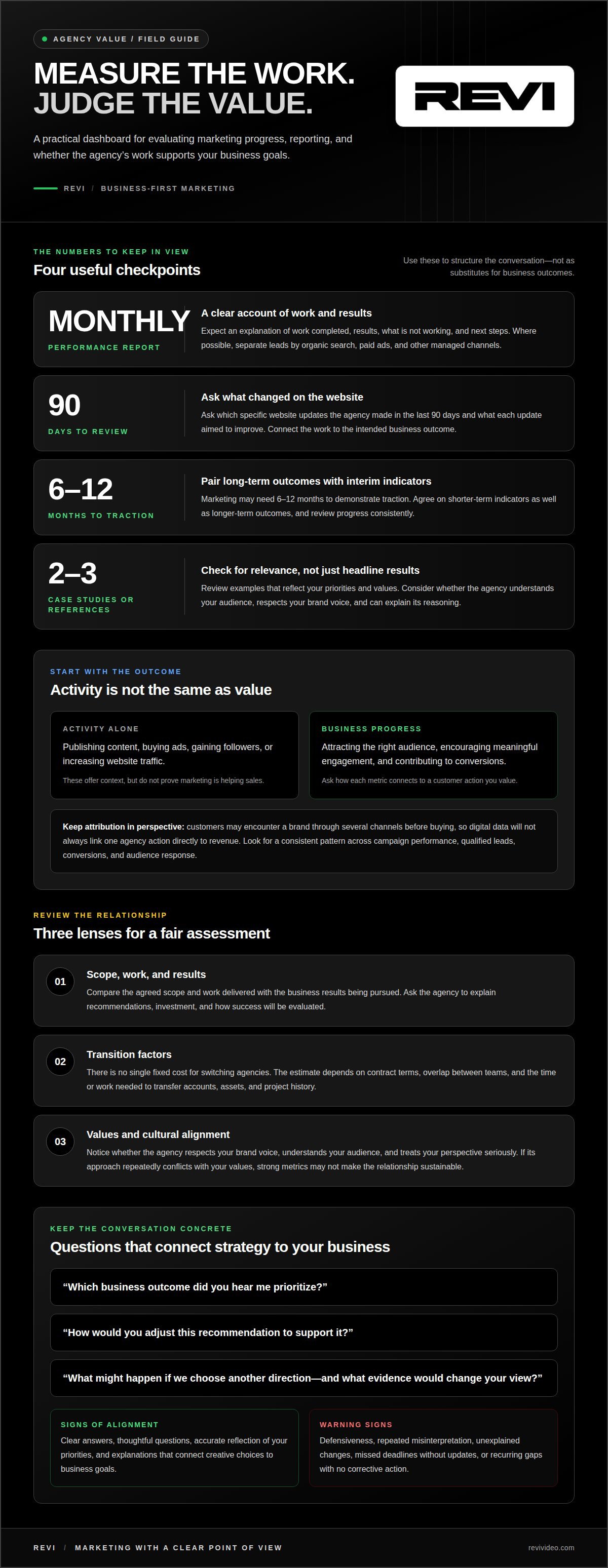
Expect a monthly performance report with clear data and an explanation of the work completed, results, what isn’t working, and next steps. Where possible, reports should distinguish leads from organic search, paid ads, and other managed channels. Regular meetings add context: the agency can explain a recommendation, the investment behind it, and how success will be evaluated. Proactive communication means flagging risks or proposing a new direction before a missed target becomes a surprise.
If the agency fails to follow the brief, identify the specific mismatch and point to the agreed goal or example. Ask what caused the difference, what correction it proposes, and how the revised work will meet the brief. If priorities have changed, update the brief together and document the decision. If the same gap recurs without explanation or corrective action, reassess the working relationship.
3. Assessing whether a marketing agency delivers value
Start with the business outcome, not the activity list. A digital marketing agency can publish content or buy ads, but those tasks matter only if they support your goals. Track whether campaigns attract the right audience, encourage meaningful engagement, and contribute to conversions. Followers and website traffic offer context, but neither proves that marketing is helping sales. Ask how each metric connects to a customer action you value.
Attribution also has limits. A customer may encounter a brand through several channels before buying, so digital marketing data won’t always link one agency action directly to revenue. Look for a consistent pattern across campaign performance, qualified leads, conversions, and audience response. Ask what specific website changes the agency made in the last 90 days, and what those updates aimed to improve. Marketing may need 6-12 months to demonstrate traction, so agree on interim indicators as well as longer-term outcomes.
To assess agency costs, compare the agreed scope and work delivered with the business results being pursued. Switching agencies has no single fixed cost: it depends on contract terms, any overlap between teams, and the time or work needed to transfer accounts, assets, and project history. Review those factors before making a change, then plan the handoff to limit disruption. The cost depends on the case and is given after a quote request; contract terms, transition scope, and overlapping work shape the estimate.
Value also depends on cultural and values alignment. Notice whether the agency respects your brand’s voice, understands your audience, and explains its reasoning without dismissing your perspective. Ask for 2-3 relevant case studies or references, then consider how the work reflects your priorities, not just its headline results. If its approach repeatedly conflicts with your values, strong metrics may not make the relationship sustainable. For a closer look at vision-aligned digital marketing, focus on partners who connect creative choices to your business direction.
4. Choosing an agency that understands your vision
Choose for alignment, not just a polished pitch deck. Give each agency the same business challenge and ask how it would approach your audience, brand voice, and priorities. Compare whether its proposed message sounds like your business rather than a generic competitor. For example, a premium service may need trust-building content, while a new product may need stronger awareness. The right partner can explain its choices and adapt them to your direction.
Ask practical questions when an agency misunderstands your goals: “Which business outcome did you hear me prioritize?” and “How would you adjust this recommendation to support it?” Then ask what might happen if you choose another direction and what evidence would change the agency’s view. Clear answers show whether the team can challenge an idea constructively while keeping your vision central. Defensiveness, repeated misinterpretation, or unexplained changes can be red flags.
Look beyond platform fluency. An agency may know social media formats but still miss the audience you want to reach. Ask it to explain how a sample campaign connects its creative choices to engagement, conversions, and your brand’s values. Separate strategy from presentation: a confident pitch matters less than a clear link between your business priorities and the work. Also ask who makes day-to-day decisions and how your input will shape them.
Use a simple selection test: share a short brief, review the agency’s interpretation, and note whether it asks thoughtful questions. A strong fit reflects your priorities accurately, flags assumptions, and explains how it would refine the approach. A weak fit treats your vision as a hurdle or pushes familiar tactics without considering your audience. Metrics should support the strategy, not replace judgment about brand fit. Choose an agency that can translate your direction into consistent decisions across channels and explain how it will recognize progress.
Request monthly reports with hard data; documented strategies are 313% more likely to report success. Assess keywords with 10 monthly searches, maintain pages ranked well eighteen months ago, and plan agency changes before signing to avoid downtime.
4. Explaining Brand Vision to a Marketing Agency
Give the agency a clear picture of where you want the business to go. Describe your audience, what makes your offer distinct, and what you want people to think or feel. For example, a neighborhood bakery might want to be known for handcrafted celebration cakes, not low-cost everyday snacks. That distinction guides messaging, visuals, and campaign choices. The National Institute of Standards and Technology recommends developing specific objectives and measurable goals to move an organization toward its vision.
Turn that direction into a short working document. Include your purpose, audience priorities, brand personality, and the business outcome marketing should support. Add examples of language or visuals that feel right, then explain why they fit. Also show examples that miss the mark and identify what feels wrong. “Too formal” is a start; “uses corporate language that doesn’t sound welcoming” gives the agency a clearer creative cue.
Separate firm principles from flexible choices. Your core values and customer promise may stay consistent, while a campaign format or social media concept can change after testing. Mark what must remain true, such as an approachable tone, and where the team can experiment. Then ask the agency to explain how each idea reflects your direction. This creates a practical feedback loop: connect the work to your vision, identify the mismatch, and agree on a specific adjustment.
Keep the vision active as the business evolves. If you shift toward a new audience or introduce a different offer, explain what changed and what should stay consistent. A quarterly strategy review can help reconnect campaign decisions with the larger direction without reopening every brand choice. Use brand building to turn your priorities into a coherent market presence. Strengthen your brand vision by aligning the story, design, and audience experience around what matters most.
REVI
REVI helps turn a clear brand vision into coordinated marketing work. If your direction is set but your campaigns, creative, or website feel disconnected, REVI can support the next step with brand building, ad buying, video production, and website development. Each service addresses a practical need: strengthen your brand presence, reach an audience through advertising, tell your story with video, or build a website that supports your business goals.
Bring your priorities, audience, and examples of what feels true to your brand into the conversation. This gives the work a sharper starting point and helps keep decisions aligned with your vision. If you’re ready to explore a more aligned approach, contact REVI to discuss your goals.
Make your next move with your vision in focus
Your vision should shape the marketing, not disappear inside the process. Use it as the standard for your next decision: does the proposed work sound like your brand, serve the audience you want, and move the business in the right direction? If my marketing agency doesn’t understand my vision, I can make the gap clear and decide whether the relationship can reset or needs a new start.
When you’re ready to turn a clearer direction into practical marketing work, REVI can support it with ad buying, video production, and website development. Choose a next step that fits your priorities, whether that means building visibility, sharpening your story, or improving how your website supports the business.
Contact REVI to discuss your marketing and bring your vision into the conversation. Your next marketing chapter can start with a direction that feels unmistakably yours.
Frequently Asked Questions
If Your Marketing Agency Can’t Explain It, Do They Really Understand It?
Not necessarily. An agency should be able to explain its recommendation clearly, but a complicated idea may need discussion before it’s easy to summarize. Ask the team to walk through its reasoning, assumptions, and intended audience response. For example, if it proposes changing a campaign message, it should explain what the current message misses and what the revised version aims to communicate.
So What Do You Do With This?
Turn the concern into a specific conversation. If my marketing agency doesn’t understand my vision, I can describe a recent decision that felt off, explain what the brand needs instead, and ask the team to restate the goal. Its response can show whether the gap comes from unclear direction, a strategic disagreement, or a deeper mismatch. Agree on one next action and who owns it.
How to transition marketing accounts and assets to a new agency
Before signing with a new agency, plan the handoff and identify the time or work needed to transfer accounts, assets, and project history. Review contract terms and any overlap between teams, then coordinate the transition to limit disruption and avoid downtime.