

Eligibility comes before lead volume. HVAC companies, plumbers, pool cleaning companies, and pest control companies are examples of local service businesses that may use Google Local Services Ads, but eligibility depends on trade and location. For contractors in Scottsdale, effective Local Services Ads management starts with confirming that the business and service category qualify, then building an accurate profile that attracts relevant inquiries.
It’s easy to focus on visibility and overlook what happens after a lead arrives. These ads charge for leads rather than clicks, so prompt responses, a practical service area, and tracking which inquiries become jobs all affect performance. This guide explains which businesses may qualify, how lead quality and budgets affect return on ad spend, and what to measure when optimizing campaigns. You’ll see how the system works and where careful management can turn local demand into a more useful pipeline.
Key Takeaways
- Check how trade and location affect eligibility before building a campaign, then prepare the business details needed for verification.
- Assess lead quality by tracking which inquiries become jobs, not just how many calls arrive.
- Use completed-job data to guide budget decisions, service-area adjustments, and the types of work you promote.
- Compare campaign results with the revenue they generate to understand whether your advertising is supporting business growth.
What Are Local Services Ads for Contractors, and Do They Work?
Google Local Services Ads connect eligible contractors with nearby customers searching for specific services. Local Services Ads management in Scottsdale focuses on eligibility, accurate profiles, and inquiries with the potential to become jobs.
Ad Visibility and Lead Generation
Google Local Services Ads can appear above paid search ads, map listings, and organic results. Contractors pay for leads when potential customers successfully contact them through the ad, rather than for each display or click. HVAC companies, plumbers, pool cleaning companies, and pest control companies are examples of eligible business types. Qualification depends on industry and location, so visibility starts with checking the correct service category.
Business Profile Setup and Optimization
Getting ready to apply means preparing the business profile and required verification. Google Local Services Ads may require background checks, business insurance verification, proper licensing, a Google Business Profile, and customer reviews. Requirements vary by trade and location and can change over time. The Google Guarantee badge is connected to Google’s verification process; completing required checks supports eligibility, but accurate profile details still matter.
Reviews and ratings shape customer confidence and the strength of a profile. Recent, consistent review activity matters alongside the overall rating, so a steady flow of authentic feedback can support a contractor’s credibility.
Comparing Local Advertising Options
Local Services Ads use pay-per-lead billing, while Google Search Ads generally charge for clicks. Search campaigns can capture broader keyword demand, while other local marketing options may build visibility through maps, websites, or community presence. The right mix depends on eligibility, the jobs you want, and your ability to respond to inquiries. Treat each channel as a distinct path to customer action, not an interchangeable placement.
Scottsdale Campaigns and Local Demand
In Scottsdale, campaign settings should reflect the neighborhoods and service area a contractor can actually cover. Broad metro targeting can bring inquiries from outside a useful work radius. Competition also affects ad visibility and which businesses customers consider. Seasonal demand can shift search volume and service needs, so review lead patterns and adjust service areas or promoted job types as conditions change.
Lead quality, conversion rates, and ROI reporting
Lead volume alone can’t show whether Google Local Services Ads support profitable work. Track contact quality, completed jobs, and the spend behind each result.
Lead Quality and Conversion Rates
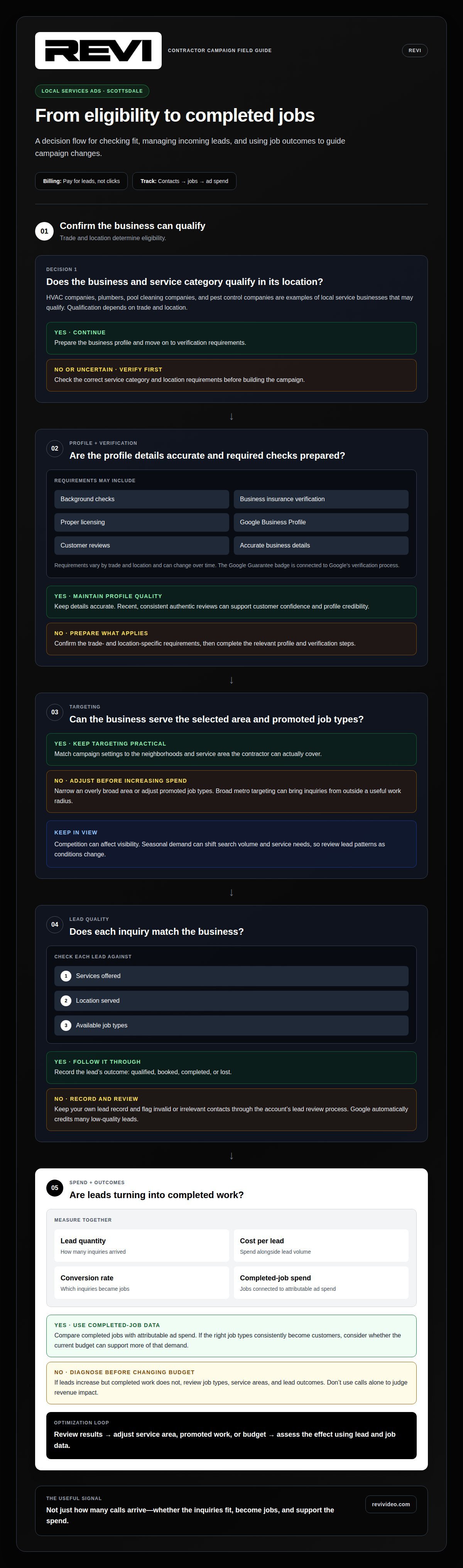
Assess lead quality by recording whether each inquiry matches your services, location, and available job types. Then track which leads become booked appointments and completed work. For example, separate a relevant repair request from an inquiry outside your service area. Google automatically credits many low-quality Local Services Ads leads, but keep your own lead records too. Eligibility and the Google Guaranteed badge may influence visibility, while conversion depends on how well each inquiry fits your business.
Pay-Per-Lead Budgeting and Cost Tracking
Google Local Services Ads use pay-per-lead billing, so budget decisions should account for chargeable contacts, not impressions. Track total spend alongside lead volume and cost per lead, then compare those figures with the share of inquiries that become jobs. If leads increase but completed work doesn’t, the budget may be attracting the wrong job types or service areas. Review disputed or low-quality contacts for possible credits, since Google automatically credits many such leads. Monitor billed amounts and lead outcomes together.
Lead Tracking and ROI Reports
Build a report that follows each lead from first contact to outcome: qualified, booked, completed, or lost. Compare lead quantity, cost per lead, and conversion rate to understand where the campaign needs attention. To assess return on ad spend, connect completed jobs to their attributable advertising spend; calls alone don’t show revenue impact. Review patterns by service type and location before changing the target. A campaign performance review can help organize these measures into clearer budget decisions.
Budget control and ongoing optimization
Set budgets around the jobs you can serve, then adjust them using completed-job data. Flag invalid leads through the account’s lead review process; Google automatically credits many low-quality leads.
Setting an Advertising Budget
Start with the work that best fits your capacity, service area, and business goals. A Scottsdale contractor focused on repairs, for example, can assess whether incoming leads match those jobs before expanding the campaign. Set a budget that supports the volume of relevant inquiries you can answer and handle, rather than pursuing the greatest number of contacts.
Review budget performance alongside booked and completed work. If leads come from outside the areas you serve, narrow the service area before increasing spend. If the right job types consistently turn into customers, consider whether the current budget can support more of that demand. Tie optimization to business outcomes, not just ad activity.
Budget and Bidding Management
Google Local Services Ads charge for leads, so measure spend against useful contacts and resulting jobs. Budget and bidding decisions work best as one strategy: the budget sets how much you’re willing to spend, while lead and job data show whether that spend supports your targets. Review campaign performance before making a change, then assess its effect.
For an invalid or irrelevant contact, review its details in the account and flag it through the available lead review process. Google automatically credits many low-quality leads, but keep the lead record and outcome in your tracking. Reconcile credits with billed leads so your budget reflects actual charges and each optimization decision has a clearer basis.
Review reputation and service-area accuracy together. Broad targeting can attract inquiries you can’t fulfill, while outdated business details can weaken customer confidence. Check whether your ads appear for the work and locations you want, then adjust targeting if lead patterns show a mismatch. In Google search, a tighter campaign may make more sense than paying for reach beyond your operating area.
Local Services Ads performance and ROI
Measure performance by business outcomes, not profile views alone. Local Services Ads receive 13.8% of local Google clicks. When these ads appear, 25.3% of clicks go to paid results, compared with 14.6% when they’re absent. That visibility creates an opportunity, but tracking must show whether it attracts quality leads and completed work.
Separate ad visibility from its contribution to revenue. Record each inquiry’s source, service requested, location, and outcome. Connect completed jobs to their revenue, then compare that amount with advertising spend. A simple return calculation is (attributed revenue minus ad spend) divided by ad spend. Use the same method across reporting periods to see whether returns improve or decline.
Conversion tracking can capture meaningful actions such as calls, forms, and bookings. For example, a Scottsdale contractor can distinguish a call that books a job from one about an unavailable service. Google Search Ads may also generate leads, so label channels consistently. This helps avoid attributing a customer to one campaign when they first found the business elsewhere.
Review search results, lead outcomes, and completed work together before changing campaign settings. If the profile generates contacts but few qualified jobs, investigate the service mix, location fit, and response process. If relevant inquiries regularly become booked work, assess whether the current budget can support more demand. Compare like with like, such as the same service category and attribution method, so a seasonal shift isn’t mistaken for campaign improvement.
Use a consistent report to decide what to keep, refine, or pause. Track lead volume, cost per lead, conversion rate, and attributable revenue in one view. This makes it easier to maximize the value of effective campaigns without treating visibility as proof of profit. Review your campaign performance to connect advertising activity with business results.
REVI
REVI helps contractors connect advertising decisions with a stronger digital presence. If your Local Services Ads attract attention but few qualified inquiries, review how your campaign, website, and brand work together. REVI’s ad buying, website development, brand building, and video production can support a more cohesive marketing approach for businesses in Scottsdale, Phoenix, Gilbert, Mesa, Chandler, Paradise Valley, and Tempe.
For example, use campaign insights to clarify which services to promote, then align website content and brand messaging with those priorities. This creates a more consistent path from search results to customer action without treating ad visibility as the only measure of progress. Turn to REVI to connect advertising performance with the rest of your marketing. Contact REVI to discuss your goals.
Turn Campaign Insights Into Your Next Move
The next opportunity is to use campaign insights to shape a stronger marketing system. For Local Services Ads management in Scottsdale, connect advertising decisions with the experience customers find after discovering your business. Clear service messaging, a cohesive brand, and a useful website can carry customer interest forward across Scottsdale, Phoenix, Gilbert, Mesa, Chandler, Paradise Valley, and Tempe.
REVI brings ad buying together with website development and video production, supporting a consistent path from discovery to action. Identify what you want your marketing to accomplish, then shape the approach around that goal. Start a focused conversation with REVI about where your campaigns should go next.
Discuss your advertising goals with REVI, and keep building momentum with a strategy designed around your business.
Frequently Asked Questions
What types of local service businesses are eligible for Local Services Ads?
Eligible business types vary by industry and location. HVAC companies, plumbers, pool cleaning companies, and pest control companies are examples of local services that may qualify. A Scottsdale contractor should identify the precise service category, since availability for one trade doesn’t establish eligibility for another. Google’s verification process and the business profile are also part of preparing to advertise.
How Do They Work?
Local Services Ads connect people searching on Google with businesses in participating service categories. The ad displays business details and a way to contact the provider, and the advertiser pays for qualifying leads rather than clicks. For example, a homeowner looking for plumbing help can use the ad to contact a plumbing business. The business then handles the inquiry and records whether it becomes a job.
How much does an LSA ad cost?
Local Services Ads use pay-per-lead billing, so charges relate to customer contacts through the ad, not its display. There isn’t one universal cost for every contractor or service category. To manage spending, set a budget in line with the work you can take on, then track billed leads against booked jobs. Review charges and outcomes together before adjusting the campaign.
What happens to Local Services Ads leads that do not qualify?
Google automatically credits many low-quality Local Services Ads leads, but don’t assume every unsuitable inquiry will receive a credit. Review the lead in your account and use the available lead review process if it appears irrelevant or otherwise low quality. Record the reason and final outcome to make billing reviews and future campaign decisions easier to assess.
What are Google Local Services Ads and how do they work?
Google Local Services Ads are a lead-generation format for eligible local service businesses. They can appear prominently in search results and let potential customers contact an advertiser directly. Unlike a standard Google Search Ads campaign, which charges for clicks, Local Services Ads charge for leads. Contractors can assess their value by tracking which contacts match their services and which progress to completed work.
Which service categories are eligible for Local Services Ads in Scottsdale, Arizona?
HVAC, plumbing, pool cleaning, and pest control are examples of categories that may use Local Services Ads, but that list doesn’t guarantee availability for every Scottsdale business. Eligibility depends on trade and location, and verification requirements vary by industry. Identify the exact service category and Scottsdale coverage when assessing whether this ad format fits your business.