

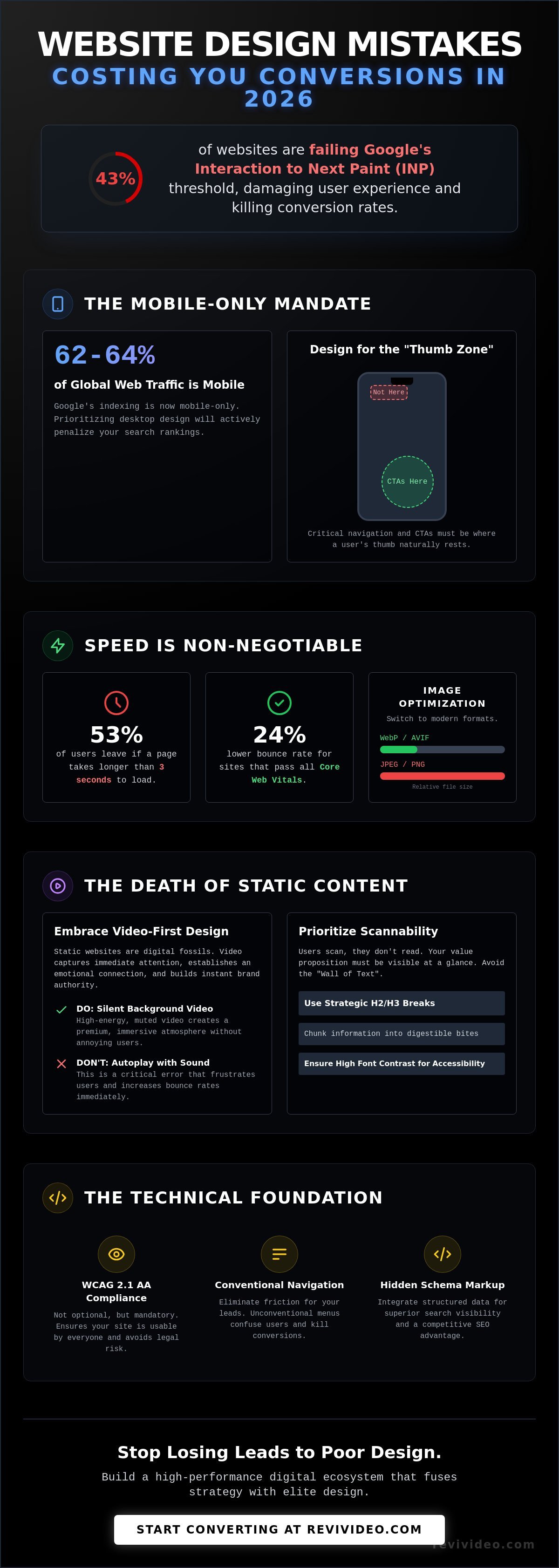
43% of websites are currently failing Google’s Interaction to Next Paint (INP) threshold, effectively killing their conversion rates before a user even clicks a button. In 2026, these common website design mistakes to avoid aren’t just minor inconveniences. They’re expensive leaks in your revenue bucket. You know the frustration of watching high bounce rates eat your ad spend while your brand image feels inconsistent across different devices. It’s exhausting to build a vision only to have a slow, clunky interface stand in the way of your audience growth.
This guide shows you how to stop losing leads to poor design. We’ll identify the high-impact mistakes sabotaging your conversion and show you how to fix them instantly for a high-performance website. You’ll get a clear look at the new WCAG 2.1 Level AA compliance requirements and the mobile-only strategies that will finally increase your ROI on digital ads. It’s time to turn your site into a seamless storytelling machine that works as hard as you do. Let’s build the conversion-driven architecture your brand deserves.
Key Takeaways
- Master the mobile-only standard to protect your search rankings from desktop-centric indexing penalties.
- Replace static, low-energy content with video-first layouts that capture immediate attention and drive deeper brand engagement.
- Identify and eliminate common website design mistakes to avoid, specifically unconventional navigation that creates friction for your leads.
- Secure your digital presence by integrating mandatory accessibility standards and hidden schema markup for superior search visibility.
- Build a high-performance digital ecosystem that fuses ad strategy with elite design to dominate your local market.
The Foundation: Why Mobile-First Design is Now Mobile-Only
In 2026, mobile devices account for approximately 62-64% of all global web traffic. This isn’t just a trend; it’s a total takeover. Designing for a desktop and then “making it work” for smaller screens is one of the most common website design mistakes to avoid. Google’s mobile-first indexing has transitioned into a mobile-only reality. If your layout prioritizes the desktop experience, Google will penalize your rankings because it crawls the mobile version of your site exclusively. You can’t afford to treat your mobile audience as a secondary thought.
You must design for the “thumb-zone.” Most users interact with their devices using one hand, and your most critical navigation and CTA buttons must sit where their thumb naturally rests. Forcing a user to reach for a tiny menu at the top left of a massive screen creates friction. Friction kills conversions. Speed is no longer a backend technicality; it’s a core design element. Every millisecond of lag costs you money. 53% of users will leave a page if it takes longer than three seconds to load. Sites that pass all Core Web Vitals thresholds see a 24% lower bounce rate on average.
The Speed Trap: Optimization or Obsolescence
Unoptimized assets are the primary reason users abandon websites. Heavy, legacy image formats like JPEG or PNG slow down your Largest Contentful Paint (LCP) and frustrate your audience. Switch to modern formats like WebP or AVIF to maintain high visual quality with a fraction of the file size. Core Web Vitals are the 2026 benchmark for speed and search visibility. With 43% of websites still failing the Interaction to Next Paint (INP) threshold of 200 milliseconds, optimizing your site’s responsiveness is your fastest path to outperforming the competition. Don’t let a slow site sabotage your ad spend.
Responsive vs. Adaptive: Choosing the Right Framework
Modern Responsive web design must account for more than just “stacking” content. As foldable devices and varied aspect ratios become mainstream, simple vertical stacking often results in broken layouts or oversized elements that hide the most important information. Pinch-to-zoom failures in e-commerce designs are particularly damaging; if a customer has to zoom in to click a “Buy Now” button, they’ll likely leave. To ensure your site remains a high-performance tool, you must test your design on at least five different screen ratios. This proactive approach ensures your brand storytelling remains seamless, regardless of the hardware your audience uses.
Visual Hierarchy and the Death of Static Content
Static websites are digital fossils. In 2026, a page that just sits there is a page that gets ignored. Modern consumers crave immersion and movement. They want to feel the energy of your brand before they read a single word of copy. Relying on flat, uninspired layouts is one of the most common website design mistakes to avoid if you want to maintain a competitive edge. Your site needs to breathe, move, and react to the user’s presence. When a page feels “dead,” your audience assumes your brand is too.
Video-First Design is the new gold standard for capturing immediate attention. It establishes an emotional connection that text simply cannot match. Integrating professional commercial video production into your hero section or service pages can dramatically increase time-on-page and build instant authority. Visual weight should always direct the eye toward your primary conversion points. If your call-to-action button carries the same visual weight as your footer links, you’re leaving money on the table. High-growth brands use scale, color, and motion to create a clear roadmap for their customers.
Integrating Professional Video for Instant Credibility
Professional video production moves the needle because it proves your brand’s legitimacy in seconds. While DIY clips might work for a quick social media story, luxury brand positioning requires high-end storytelling that reflects the quality of your services. One critical error to sidestep is autoplaying sound. Your visuals should be powerful enough to speak for themselves. Silent, high-energy background videos create a premium atmosphere without annoying the user. This approach ensures your brand feels like an insider in the fast-moving digital world.
Typography and Scannability: Don’t Make Them Read
Stop burying your value proposition in a “Wall of Text.” 2026 users scan; they don’t read every word. Use strategic H2 and H3 breaks to chunk your information into digestible bites. High font contrast is not just an aesthetic choice. It is a fundamental necessity for meeting Web Content Accessibility Guidelines (WCAG) and ensuring your message reaches everyone. Micro-interactions are the secret sauce of modern engagement. These subtle animations reward scrolling behavior and make the user feel like they are interacting with a living entity. Elevate your brand with a design that prioritizes active engagement over information dumping.
The Conversion Killers: UX and Navigation Errors
Don’t let “Creative Overload” kill your sales. Designers often fall into the trap of reinventing the wheel with experimental navigation that leaves users confused. If your visitors can’t find your products within seconds, they’ll leave. This is one of the most common website design mistakes to avoid if you want to maintain a high-performance site. Stick to established website design best practices to ensure your interface remains intuitive and fast. Clarity always beats cleverness when revenue is on the line.
The “Paradox of Choice” is a silent conversion killer. Overwhelming your visitors with a 20-item dropdown menu leads to decision paralysis. Simplify your architecture. Less is always more. Guide your users with a clear, logical path that leads directly to your revenue-generating pages. Hiding your Call to Action (CTA) below the fold is the fastest way to waste your traffic. Your primary offer must be visible the moment the page loads. Don’t make people work to give you their money. If your user journey ends at the bottom of a blog post without a clear next step, you’re losing warm leads. Every page must have a clear exit path that moves the prospect closer to a sale.
Frictionless Navigation Architecture
Implement “Sticky Navigation” to keep your core menu accessible as users scroll. This ensures they never feel lost or trapped on a long page. Follow the “Three-Click Rule”: every service or product should be accessible in three clicks or less. When you’re vetting a video production agency, look at their own site paths. If they can’t guide you through their own story effortlessly, they won’t be able to do it for your brand. High-performance navigation is about removing barriers, not adding bells and whistles.
CTA Design: Beyond the “Submit” Button
Generic buttons like “Submit” or “Click Here” are common website design mistakes to avoid when you’re optimizing for growth. They’re boring and provide zero incentive. Use action-oriented, benefit-driven copy like “Start Growing Today” or “Claim Your Strategy” to drive clicks. Apply the “Contrast Rule” to make your buttons pop. Your CTA must be the most visually distinct element on the screen. Finally, stop asking for ten fields in your lead forms. Every extra field reduces your conversion rate. Keep it lean, get the lead, and close the deal later. Efficiency is the ultimate shortcut to a professional-grade digital presence.
Technical Blind Spots: SEO and Accessibility in 2026
Technical excellence is the silent engine of your digital growth. In 2026, failing to prioritize accessibility is one of the most common website design mistakes to avoid. It’s no longer just a suggestion. The U.S. Department of Justice has mandated that public entities serving 50,000 or more people must comply with WCAG 2.1 Level AA by April 24, 2026. While private businesses have more leeway, the legal and SEO risks of ignoring these standards are mounting. If your site isn’t accessible, you’re locking out a massive portion of your potential audience and signaling to search engines that your site is low-quality.
Your “invisible” architecture matters more than ever. Missing Alt text and Schema markup are silent killers of search visibility. AI-search crawlers and voice assistants rely on this structured data to understand and categorize your content. If you aren’t using Schema, you won’t appear in AI-generated answers or rich snippets. Link rot is another major pitfall that drains your authority. Broken internal links frustrate users and stop search bots in their tracks, wasting your crawl budget. Ignoring these technical elements is among the common website design mistakes to avoid if you want to rank in an AI-driven search world.
Accessibility as a Competitive Advantage
WCAG 2.2 is the modern global standard you should aim for today to stay ahead of future regulations. High color contrast isn’t just about aesthetics; it’s about making your content readable for everyone on every device. Accessibility features like keyboard navigation and semantic headers improve your overall site SEO ranking by making your content easier for crawlers to index. Inclusivity is a competitive edge that expands your market reach and builds long-term brand loyalty.
The SEO-Design Handshake
Your visual identity and technical foundation must work in total harmony. A savvy branding agency understands that a beautiful site is useless if it can’t be found by your target audience. Optimize for “Zero-Click” search results by using layouts that highlight key data points for search engine snippets. Your URL structure should be short, descriptive, and keyword-heavy to maximize click-through rates. Stop using long, complex strings of characters that confuse both users and bots. Efficiency is the benchmark of a professional-grade digital presence.
Accelerate your brand’s visibility with expert website development that bridges the gap between high-end design and technical data.
The REVI Solution: Integrated Strategy for Phoenix Brands
Local businesses in Phoenix and Scottsdale face a unique challenge in 2026. You aren’t just competing with the shop down the street; you’re competing for the fragmented attention of a high-speed, mobile-only audience. A beautiful website is only half the battle. If your site lacks a cohesive digital ecosystem, you’re essentially shouting into a void. REVI bridges this gap by integrating ad buying, video, and website development into a single, high-octane growth engine. We don’t just build sites; we build conversion architectures that turn local traffic into loyal customers. Our approach ensures your brand storytelling remains consistent across every touchpoint.
Professional video production is the ultimate fix for the “Trust Gap” that plagues most small business sites. When a visitor lands on your page, they need to see the face and heart of your brand immediately. High-energy visuals eliminate skepticism and prove you’re an insider who understands the pace of the modern market. Identifying common website design mistakes to avoid is the first step toward digital dominance. The second step is fueling that design with professional assets that demand attention. Don’t let a “dead” static layout be the reason a lead chooses your competitor.
Scaling Your Brand in the Valley
The Scottsdale and Gilbert markets are among the most competitive in the country. To stand out, you need more than just a template. Elite video production companies provide the high-converting assets necessary to stay relevant in a feed-driven world. The biggest mistake you can make is treating your website as a “set it and forget it” project. Your digital presence must evolve as fast as the algorithms do. Static brands die while dynamic brands thrive. We ensure your site is a living tool that grows alongside your revenue goals.
Your 2026 Digital Roadmap
Success in 2026 requires a results-driven mindset over a purely aesthetic one. We follow a lean, four-stage process designed for maximum impact: Strategy, Production, Launch, and Optimization. This roadmap removes the production barriers that keep most businesses stuck in the past. Stop settling for a site that looks good but fails to generate leads. Audit your current presence for the five critical errors we’ve identified in this guide. If your site feels slow, clunky, or disconnected from your brand voice, it’s time for a visionary partner. Ready to fix your design and start converting? Let’s build your brand.
Scale Your Brand with High-Performance Design
You’ve identified the leaks in your revenue bucket. From mobile-only indexing to the legal necessity of WCAG compliance, the stakes for your digital presence have never been higher. Mastering the common website design mistakes to avoid is the first step toward reclaiming your market share. You now have the roadmap to replace static, low-energy layouts with high-impact, video-first experiences that drive real results. High-performance design is not just about looking good; it’s about building a conversion-driven architecture that scales.
Don’t let a clunky interface sabotage your growth. REVI is a full-service Phoenix-based creative agency built for the fast-paced world of social media trends and high-stakes ad buying. We combine expertise in high-impact video with results-driven brand building to ensure your site works as hard as you do. Our team removes production barriers and replaces them with a frictionless digital ecosystem. Stop losing customers to bad design; schedule your REVI strategy session today.
Your brand deserves a platform that matches your vision. Take control of your digital roadmap and start building for tomorrow. Success is just one strategic shift away.
Frequently Asked Questions
What is the most common website design mistake for small businesses?
Failing to design for mobile-only users is the most frequent error among small businesses. With over 60% of global traffic coming from mobile devices, a desktop-centric layout is a liability. This is one of the most common website design mistakes to avoid if you want to capture leads effectively. Prioritize the thumb-zone and fast interactions to keep your audience engaged.
How does poor web design affect my Google search ranking in 2026?
Poor design triggers high bounce rates and slow Interaction to Next Paint (INP) scores, which Google uses to demote your site. If your site fails the 200-millisecond INP threshold, your visibility will drop. Google prioritizes sites that offer a seamless, accessible experience across all devices. Technical SEO and user experience are now inseparable in the eyes of search algorithms.
Why is video content considered essential for modern web design?
Video content captures immediate attention and establishes brand authority in seconds. Static pages feel dead to 2026 consumers who prefer immersive storytelling over walls of text. High-quality video production increases time-on-page and bridges the trust gap. It turns passive viewers into active leads by showing the human side of your business.
Can I fix these design mistakes myself or do I need a professional agency?
You can fix basic content errors yourself, but technical blind spots like Schema markup and WCAG compliance often require professional expertise. A professional agency ensures your design, video, and ad strategy work together as a cohesive ecosystem. DIY attempts often result in inconsistent branding and hidden technical flaws that sabotage your ROI. For inspiration on how to approach high-end creative design, check out Insight Multimedia. Efficiency requires a partner who understands the modern production landscape.
How often should I update my website design to avoid becoming obsolete?
You should audit your site every quarter and consider a major design refresh every two to three years. Digital trends and search algorithms evolve rapidly. A “set it and forget it” mindset is one of the common website design mistakes to avoid. Constant optimization ensures you never fall behind your competitors in the fast-moving Phoenix and Scottsdale markets.
What are the legal requirements for website accessibility in Arizona?
Arizona businesses must comply with the Americans with Disabilities Act (ADA), which increasingly mandates WCAG 2.1 Level AA as the standard. Public entities serving over 50,000 people face a strict April 24, 2026, deadline for compliance. Private companies should check current federal guidance and state-level court rulings to manage their legal risk. Accessibility is now a legal and business imperative.
How much does a professional website redesign cost for a Phoenix business?
Redesign costs depend entirely on your specific goals, the complexity of your site, and the scale of video integration required. Every project is unique. You should check with local providers to get a custom quote based on your specific business needs. Investing in a high-performance site is a strategic move to increase your long-term ROI on digital ads and brand visibility.