

What if your dental campaign gets plenty of clicks but few relevant patient inquiries? That’s the risk of judging PPC for dentists in Tempe AZ by traffic alone. Before investing, ask whether paid search can reach people in your practice’s service area and whether the campaign is generating inquiries your team can act on.
A useful campaign starts with a defined local area, ads that match the services you offer, a relevant landing page, and tracking that connects ad activity to inquiries. No agency can responsibly promise a specific number of patients or a guaranteed return. You can ask for clear goals, transparent reporting, and evidence to support performance claims.
This guide explains how to plan dental PPC in Tempe, choose meaningful measures of lead quality, and compare agencies using practical questions rather than big promises. It also covers campaign structure, ad messaging, and the website experience to review before committing budget. The goal is to make decisions based on qualified inquiries and accountable measurement, not vanity metrics.
Key Takeaways
- Use PPC for dentists in Tempe AZ to reach people searching for nearby dental services, but treat each click as a chance to qualify an inquiry, not as a guaranteed patient.
- Build campaigns around clear goals, relevant ad groups, and landing pages that match the service each person searched for.
- Track the path from impressions and clicks to qualified inquiries and booked appointments, then compare platform data with practice records where reliable.
- Set geographic targeting around your practice’s actual patient catchment area instead of automatically including every nearby city.
- Choose an agency by asking about account access, reporting, testing, communication, and independently verifiable experience.
Why PPC for Dentists in Tempe Can Support Local Patient Acquisition
Someone searching for a dentist near their Tempe home or workplace has signaled an interest in dental care. Paid search lets a practice show an ad in response to relevant searches. In the pay-per-click (PPC) model, advertisers generally pay when someone clicks an ad, not simply when it appears. A click creates an opportunity to start a conversation, not a promise of a new patient.
PPC ads appear separately from organic search results and map listings, which rely on different factors. Each can help people discover a practice, but none guarantees an inquiry or appointment. For PPC for dentists in Tempe AZ, judge value by whether the campaign attracts relevant local inquiries and supports booked appointments, not by click volume alone.
Which dental practices may benefit from PPC in Tempe?
PPC may suit a practice that wants to increase visibility for a specific service or draw attention to appointment availability it can accurately support. For instance, a practice might focus on searches for general checkups or a particular treatment it offers. The right focus depends on the practice’s goals, patient catchment area, and ability to respond to inquiries.
Set the basics before launching. Decide what the campaign should promote, who it should reach, and what the practice can handle if inquiries increase. Paid search won’t fit every practice, treatment, or growth stage. If the goal, capacity, or measurement plan is unclear, resolve that first.
What should a dental PPC campaign aim to generate?
Choose actions that show a prospective patient is taking a meaningful next step. These might include a call, an appointment request, or a contact form submission. Distinguish that first action from what follows: an inquiry is not automatically a confirmed appointment, and a booking does not prove that a visit took place.
A qualified dental PPC lead is an inquiry from someone in the practice’s intended service area who is seeking a service the practice offers and has taken a clear step toward contacting it.
Use that definition to review leads consistently. Check whether inquiries match the practice’s location and services, then compare their quality with appointment outcomes. A click shows interest in an ad. A relevant inquiry is a stronger signal, and a confirmed appointment offers a more useful measure of campaign contribution.
How a Tempe Dental PPC Campaign Works from Search to Inquiry
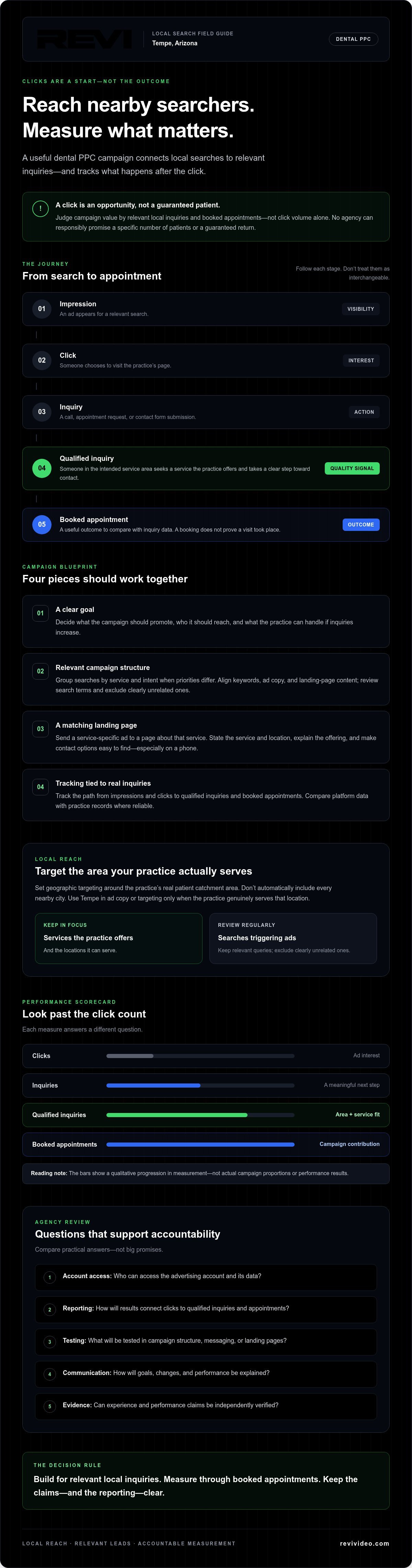
A useful campaign connects a search to a clear next step. The process is straightforward: set a goal, organize campaigns, write relevant ads, send visitors to matching landing pages, and measure the actions they take. In PPC for dentists in Tempe AZ, each step should reflect the services the practice offers and the patients it can serve.
How should Tempe dental campaigns organize services and search terms?
Group searches by service and intent when the practice’s priorities differ. Someone searching for a routine checkup needs different ad messaging from someone looking for dental implants. Separate ad groups can keep keywords, ad copy, and landing-page content aligned. Campaign structure can also help the practice manage budget and attention according to its priorities.
Use Tempe in ad copy or search targeting only when the practice genuinely serves that location. Review the search terms that trigger ads, too. Keep relevant queries and exclude clearly unrelated ones so the campaign stays focused on the services and area the practice intends to reach.
What should a dental PPC landing page include?
Carry the ad’s message through to the page. If an ad promotes a specific service, send visitors to a page about that service rather than a general homepage that makes them search for details. State the service and location clearly, explain what the practice offers, and make contact options or appointment-request steps easy to find, especially on a phone.
Keep claims direct and accurate. Avoid implying a clinical outcome or making promises the practice can’t substantiate. The Federal Trade Commission’s truth-in-advertising principles offer a general reference for health-related claims. Practices should verify which requirements apply to their advertising and seek appropriate guidance when needed. Direct clinical questions to the dental practice rather than trying to answer them in ad copy.
Creative can support the campaign, too. A short video may help explain the practice’s approach or introduce its team, as long as the message fits the service and stays accurate. REVI shares ideas in its Phoenix commercial video production guide. Practices considering video creative can also explore video production options.
Measure actions that matter, such as calls, appointment requests, and form submissions. Check that tracking records those actions accurately, then review how inquiries progress. This feedback can point to changes in keywords, ad messaging, or the page experience. Clicks alone can’t show where the campaign needs attention.
How to Evaluate Dental PPC Performance Beyond Clicks
Clicks show that an ad attracted attention. They don’t prove patient growth, confirm an inquiry was relevant, or show whether a campaign is profitable. To evaluate PPC for dentists in Tempe AZ, follow the signals from first exposure through appointment outcomes, and understand what each metric can and can’t tell you.
Which PPC metrics should a dental practice review?
Read metrics as a sequence, not a scorecard of isolated wins. Impressions measure how often ads appeared. Clicks show how often people selected them. Click-through rate (CTR) is the share of impressions that generated clicks. Conversion rate is the share of measured interactions that completed a defined action, such as submitting a form. Neither rate confirms that a prospective patient booked or attended an appointment.
| Metric | What it reveals | Limitation and follow-up question |
|---|---|---|
| Impressions | How often ads appeared | Visibility isn’t interest. Are the searches relevant to the practice? |
| Clicks and CTR | Whether people selected the ad | Clicks don’t confirm intent. Which searches drove them? |
| Inquiries and conversion rate | Whether people took a tracked action | Tracking can count low-quality or duplicate actions. Did real calls or requests come through? |
| Qualified inquiries | Whether contacts match the practice’s service area and offerings | Are they seeking a service the practice provides, or are they spam or wrong-service contacts? |
| Booked appointments | Whether inquiries progressed to scheduling | Not every booking can be attributed to an ad. How were outcomes confirmed? |
Review call quality, appointment requests, and the practice’s follow-up process alongside platform reports. A conversion shown in an ad platform is a recorded event, not automatic proof of a genuine patient inquiry. Where reliable data is available, compare platform records with call logs and practice records. Attribution can be incomplete, so consider factors such as timing and changes in appointment capacity before drawing conclusions.
How can a practice assess lead quality and return?
Agree on a simple lead-review process with the team. For each inquiry, record whether it was relevant, whether the person sought a service offered, whether staff reached them, and whether an appointment was booked. Use appropriate records and follow the practice’s applicable privacy procedures.
Compare campaign activity with appointment outcomes over a consistent reporting period. Ask whether relevant inquiries are turning into bookings and whether some search terms produce clicks but mostly spam or mismatched requests. If data is incomplete, flag that limitation rather than claiming a precise return. A sound review connects ad activity to verified outcomes while recognizing what the available evidence can’t establish.
How to Target Dental PPC Around Tempe Without Wasting Reach
More geographic reach doesn’t automatically mean more suitable inquiries. Start with the places your practice can realistically serve, then use campaign data to decide whether to expand. For PPC for dentists in Tempe AZ, the goal isn’t to cover every nearby city. It’s to reach people who can reasonably travel to the practice and are looking for services it provides.
How should a Tempe practice define its PPC service area?
Start with your own patient patterns. Review where current patients come from, consider practical travel distance, and map the area your team wants to serve. Then assess nearby communities such as Mesa, Chandler, or Scottsdale individually. Don’t add them simply because they’re close to Tempe. Confirm that the practice welcomes patients from those locations and can support the added demand.
Before launch, check the advertising platform’s current location-targeting options and how it defines a match. Settings and location signals can vary, so a selected boundary may not guarantee that every person who sees an ad lives inside it. Review available location reports and incoming inquiries, then adjust based on the evidence. Ask whether people contacting the practice are from places it intends to serve.
What local details help a dental ad feel relevant?
Make local information accurate and consistent. Use the practice’s verified address and describe its actual service area. Mention Tempe or a nearby community only if the practice serves people there. A location reference can help a searcher recognize relevance, but it shouldn’t imply a local credential, clinical outcome, or appointment option the practice hasn’t confirmed.
Make the next step clear, too. If the practice accepts appointment requests online, say so accurately and ensure the linked page reflects that option. If people should call, make the contact details easy to find. Consistency between the ad, landing page, and practice information reduces confusion and makes mismatches easier to spot.
Use inquiry location as a refinement signal. Review where callers and form submissions come from, whether those contacts fit the intended catchment area, and whether they’re seeking a service the practice offers. If a nearby city brings relevant inquiries and the practice has capacity, test that area as a measured expansion. If contacts repeatedly fall outside the practical service area, tighten targeting or review campaign settings.
Make each change deliberately: document the area tested, monitor inquiry relevance, and compare outcomes before expanding again. Discuss local ad-buying goals with REVI to explore how geographic targeting and campaign measurement can support a Tempe practice’s plans.
How to Choose a PPC Agency for Dentists in Tempe
The right agency should make its process easy to inspect. For PPC for dentists in Tempe AZ, look for clear goals, transparent reporting, and a practical plan for reviewing inquiry quality. Treat confident claims as claims, not proof. Ask for evidence you can verify, and make sure the practice understands who controls the account and how campaign decisions are made.
What should dentists ask before hiring a PPC agency?
Use these questions to compare an agency’s approach:
- Experience: Have you worked with dental practices? Can you share relevant case studies or references I can verify?
- Account access: Who owns and manages the advertising account, and what access will the practice retain?
- Reporting: What will reports include, how often will they arrive, and how will you distinguish inquiries from qualified leads and booked appointments?
- Testing: What will you test in the campaigns, and how will you decide whether a change helped?
- Communication: Who will answer questions, and how will you discuss issues or changes in campaign direction?
Verify any dental-sector experience, client references, and specialist claims independently before relying on them. Ask what the evidence actually supports and how results were measured. An agency should explain its method without implying that past performance guarantees future outcomes.
When can integrated creative and website support help?
Ad buying, video production, design, and website development can support different parts of one campaign. Relevant video or design may help communicate a practice’s message, while responsive website development can make the transition from ad to inquiry clearer on mobile. These capabilities matter when they address a defined campaign need, not simply because they’re available.
For ideas on assessing creative support, see REVI’s guide to choosing a Phoenix video production agency. Keep the focus on fit: what the campaign needs, what the practice can support, and how the team will measure progress.
REVI provides ad buying alongside video production and responsive website development, but its dental-industry experience should be verified rather than assumed. Tempe practices can discuss REVI ad buying services and outline campaign goals, measurement needs, and questions before deciding whether the approach fits. Don’t assume a performance outcome in advance.
Build a Smarter PPC Plan for Your Tempe Practice
Effective PPC for dentists in Tempe AZ starts with a clear goal and a realistic view of what campaign data can prove. Focus on relevant local searches, connect each ad to a useful next step, and measure progress beyond clicks. Review whether inquiries match your services and service area, then check how they move toward booked appointments.
Choose an agency that explains its process, provides clear reporting, and welcomes questions about account access, testing, and lead quality. Verify dental-sector experience, references, and results independently before treating them as proof. A transparent plan is more useful than an unsupported promise.
REVI serves Tempe and other Phoenix-area communities, offering ad buying alongside video production, website development, brand building, and design. These capabilities may support a coordinated campaign when they fit your goals. Talk with REVI about PPC goals for your Tempe practice, including how you want to measure campaign activity before making performance claims. Set a focused plan, ask for clear evidence, and take the next step with confidence.
Frequently Asked Questions
Is PPC worth it for a dental practice in Tempe?
PPC can be worth testing if your practice has a clear goal, relevant services to promote, and capacity to respond to inquiries. It can place ads in front of people searching for dental care, but clicks alone don’t show whether the campaign is valuable. Set a measurement plan before launch, then review relevant inquiries, appointment outcomes, and how well the campaign reaches people in your actual service area.
How does PPC for dentists work?
PPC for dentists uses paid ads that can appear when people search for relevant dental services. The practice sets goals, chooses search terms and geographic targeting, creates ads, and connects them to a relevant page or contact option. Advertisers generally pay when someone clicks, depending on the ad platform and campaign setup. Track calls and appointment requests, then check whether they’re genuine, relevant inquiries rather than assuming every click signals a potential patient.
How much should a dentist spend on PPC in Tempe?
There isn’t one budget that fits every Tempe dental practice. Choose an amount the practice can sustain while testing a specific service and measuring inquiry quality. Consider the campaign’s goals, competition for relevant searches, appointment capacity, and the time needed to learn from results. Separate advertising spend from any agency management charges, and ask for a clear breakdown. Avoid choosing a budget based on promised lead volume or unsupported return estimates.
Can PPC help a new dental practice attract patients?
PPC can give a new practice an opportunity to appear for relevant local searches while it builds visibility, but it can’t guarantee inquiries or appointments. Start with services the practice is ready to provide, accurate location information, and a clear way to contact the office. Define the practice’s actual catchment area first. Review where inquiries come from and whether they match the services offered before deciding to expand targeting or adjust the campaign.
How do I know if my dental PPC campaign is working?
Look beyond impressions and clicks. Review calls, form submissions, qualified inquiries, and booked appointments, then compare platform conversion reports with real calls and practice records where reliable information is available. Check whether contacts are in the service area and seeking a service the practice offers. Tracking can be incomplete, so note its limits and interpret results in context. A click or reported conversion by itself doesn’t prove patient growth or profitability.
Should a Tempe dental practice hire a dental PPC specialist?
A dental PPC specialist may be useful, but the title alone doesn’t prove experience or performance. Ask who manages the account, what access the practice keeps, how reporting works, and how the agency assesses lead quality. Verify dental case studies, client references, and specialist claims independently. REVI offers ad buying and serves Phoenix, Scottsdale, Gilbert, Mesa, Chandler, Paradise Valley, and Tempe. Verify any dental-sector experience or results before treating them as proof.