

A rebrand doesn’t win executive approval because a new logo looks sharper. It wins when leaders can see how it addresses a real business problem. If leadership sees the project as a cosmetic expense, learning how to get executive buy-in for a rebranding project starts with connecting the change to priorities such as market position, lead quality, or customer retention.
That case needs more than creative ambition. Executives want evidence, clear measures of success, a realistic scope, and confidence that the rollout won’t disrupt the business. Leaders may also have different concerns, from budget control to preserving customer recognition. Address those concerns directly, and the conversation can shift from whether the brand needs a refresh to what the business needs the rebrand to deliver.
This guide explains how to build an evidence-based business case, prepare for objections, and present a practical plan with options, risk controls, and measurable outcomes. You’ll also learn how to align stakeholders before the approval meeting and leave with a clear decision, an accountable owner, and concrete next steps.
Key Takeaways
- Frame the rebrand around a business challenge, not a visual preference, and show how strategy, messaging, identity, and customer experience connect.
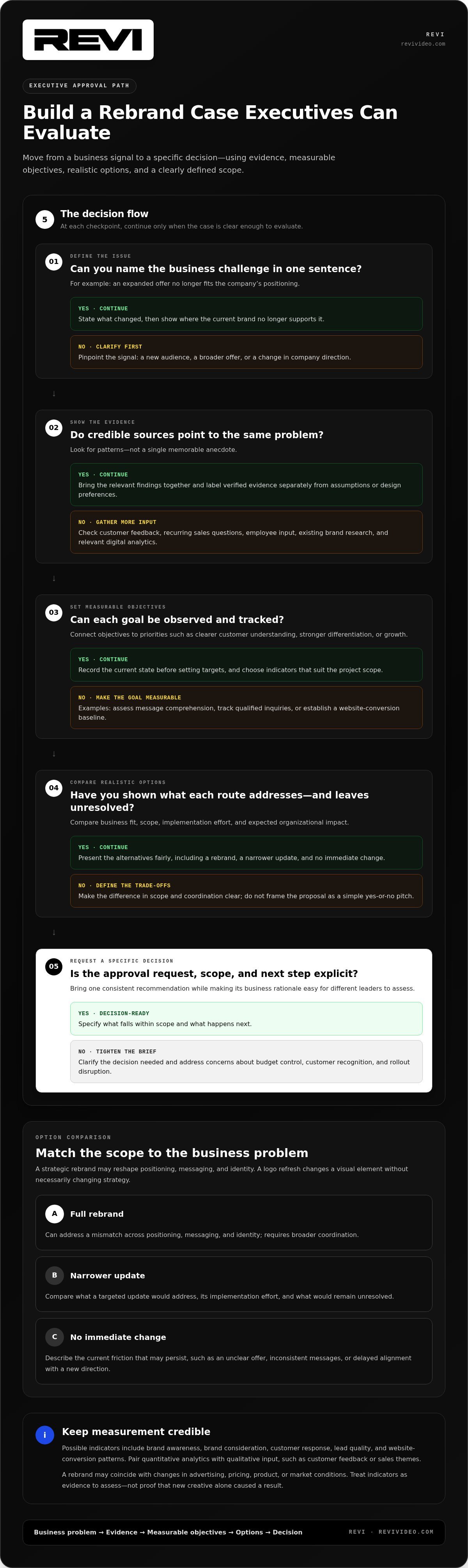
- Build your case in a clear sequence: define the issue, present evidence, set measurable objectives, compare options, and request a specific decision.
- Learn how to get executive buy-in for a rebranding project by anticipating leadership concerns and pairing each one with evidence and a practical safeguard.
- Prepare a concise decision brief that keeps one strategic recommendation consistent while speaking to executives’ different priorities.
- Turn approval into action with phased rollout planning and clear ownership for brand decisions, digital updates, internal communication, and market-facing materials.
Why an Executive Buy-In Case for Rebranding Must Start With a Business Problem
Before leadership considers a new identity, it needs to understand what the current brand is making harder. A redesign may be visible, but visibility alone doesn’t establish a business need. To learn how to get executive buy-in for a rebranding project, start with a specific signal: the company has changed, its audience has shifted, or customers struggle to understand its value.
Rebranding can involve far more than visual identity. It may reshape strategy, market positioning, messaging, and the coordinated experience customers encounter across channels. As the overview of Rebranding explains, organizations take on this work for different strategic reasons. A strategic rebrand aligns what a business stands for and how it communicates with the direction it’s taking; a logo refresh changes a visual element without necessarily changing that strategy. Neither guarantees better results. The case depends on evidence and a clear purpose.
Identify the business signal behind the rebrand proposal
Pinpoint what has changed. A new audience may not recognize the company’s value. A broader offer may no longer fit the old positioning. A shift in company direction may leave sales teams relying on inconsistent explanations. Name the change first, then show where the brand no longer supports it.
Build the case from sources executives can assess: customer feedback, recurring sales questions, employee input, and existing brand research. Look for patterns across sources rather than relying on a memorable anecdote. Label findings clearly: verified evidence is different from a working assumption or a personal preference about design. This distinction keeps the conversation focused on the business, not on which logo someone likes best.
Show why the status quo deserves attention
Make the current friction concrete. Compare how the company describes its offer across its website, sales materials, and advertising. Note where messages conflict, customers misunderstand the offer, or the identity fails to reflect the company’s current position. Business indicators such as lead quality, conversion patterns, and customer feedback can help identify where to investigate. Treat them as signals to examine, not proof that rebranding alone will fix the issue.
Then describe the cost of waiting without inventing a revenue-loss figure. The organization may continue presenting an unclear offer, reinforcing inconsistent messages, or delaying alignment with a new direction. Tie each risk to an observed example and explain what further evidence would confirm it. That gives executives a grounded reason to consider change while keeping the proposal credible and appropriately scoped.
Build the Rebranding Business Case Executives Can Evaluate
A credible proposal makes the logic easy to follow: what needs to change, what supports that conclusion, and what decision leadership needs to make. This five-step sequence turns the case into a practical business discussion rather than a design presentation.
- Define the issue. State the business challenge in one sentence, such as an expanded offer that no longer fits the company’s positioning.
- Show the evidence. Bring relevant customer research, sales feedback, audience response, or digital analytics that supports the problem.
- Set objectives. Connect each goal to an executive priority, such as clearer customer understanding, stronger differentiation, or growth.
- Compare options. Show what a rebrand, a narrower update, or no immediate change would address and leave unresolved.
- Request a decision. Specify the approval you need, what falls within scope, and what happens next.
Keep each objective tied to an observable measure. If the goal is clearer messaging, assess message comprehension. If the aim is to attract better-fit prospects, track qualified inquiries. For digital performance, establish a baseline for conversion before rollout. Choose indicators that suit the organization and project scope, and record the current state before setting targets.
Choose evidence and measures that make the case credible
Use measures executives can interpret and teams can track consistently. Depending on the business need, these may include brand awareness, brand consideration, customer response, lead quality, or website conversion patterns. Pair quantitative analytics with qualitative input, such as customer feedback or sales themes, to understand what the numbers may be signaling.
Be candid about attribution. A rebrand may coincide with changes in advertising, pricing, product, or market conditions, so don’t promise that new creative alone will cause a specific result. Measure a rebrand against its business objectives, not just whether leaders approve the design. To surface concerns before the decision meeting, stakeholder surveys or consensus-building discussions can help gain stakeholder buy-in.
Compare a rebrand with realistic alternatives
Give leaders real choices, not a yes-or-no pitch. Compare each route by business fit, scope, implementation effort, and expected organizational impact. A full rebrand can address a mismatch across positioning, messaging, and identity, but requires broader coordination. Targeted messaging updates can clarify an offer with less change, while leaving visual or positioning issues untouched. A visual refresh updates expression without necessarily resolving strategic confusion. Postponing preserves the status quo and its known friction.
Make the trade-offs visible. A focused strategy and identity process can connect positioning to the creative, website, and advertising work that carries it into the market. Once your decision criteria are clear, strategic brand building can help translate that direction into a coordinated presence.
Address Rebranding Objections, Costs, and Risks Before the Approval Meeting
Executives are more likely to engage with a rebrand when they can see what’s included, what it asks of the organization, and how the team will manage risks. Define the scope and success measures before asking for commitment. Separate essential work, such as strategy and core messaging, from optional extensions, such as adapting additional materials. This lets leaders weigh the trade-offs instead of reacting to an open-ended proposal.
Use an objection table to show you’ve considered competing priorities and practical safeguards. Tailor the evidence to your organization rather than treating each concern as a reason to dismiss the project.
| Likely objection | Evidence to bring | Response and practical safeguard |
|---|---|---|
| “The project could expand beyond its purpose.” | Document the business issue, required deliverables, and success measures. | Set a defined scope, identify optional extensions, and use decision gates to approve changes. |
| “The timing could disrupt other work.” | Map dependencies, key business dates, and teams affected by the rollout. | Phase the work, assign accountable owners, and sequence updates around operational priorities. |
| “Customers may not recognize us.” | Review customer feedback, brand research, and familiar assets customers associate with the business. | Use research and testing to assess which elements support recognition before changing them. |
| “Employees may not know how to explain the change.” | Gather employee input and identify teams that use brand messaging with customers. | Prepare clear internal communications and practical guidance before market-facing changes go live. |
Respond to budget, timing, and disruption concerns
Present a plan executives can inspect: phases, dependencies, decision gates, and an owner for each major workstream. For example, establish strategy and messaging before adapting the website and customer-facing materials. Make the operational impact clear for each option. A focused update may require fewer changes across channels, while a wider rebrand calls for more coordination. Avoid unsupported cost or timeline promises. Define what’s in scope so leaders can assess the commitment accurately.
Protect brand recognition while making necessary change
List the assets and associations worth protecting, such as a recognizable name, a distinctive visual element, or language customers already understand. Then test how audiences interpret those elements and whether they still fit the organization’s direction. Research can reveal what to retain, refine, or replace; assumptions alone can’t settle that question.
Reduce transition risk with clear ownership. Assign responsibility for brand decisions, employee updates, digital channels, and customer-facing materials. Use a phased rollout and review materials for consistency before launch. These controls won’t remove every uncertainty, but they make the change easier to coordinate and give leaders a practical way to monitor progress. That’s a stronger approach to how to get executive buy-in for a rebranding project than asking executives to approve a design without a transition plan.
Present the Rebranding Proposal and Build Executive Sponsorship
A strong proposal makes the decision clear before it makes the creative direction vivid. Give executives a concise brief covering the business problem, supporting evidence, objectives, options considered, risks, success measures, and the specific decision you’re requesting. Keep one strategic recommendation throughout, then tailor the emphasis for each leader. A finance executive may focus on scope and oversight; a marketing leader may want to understand audience relevance and channel impact.
Structure an executive presentation around the decision
Open with the business issue and requested decision, not mood boards or logo concepts. Use a focused set of evidence-led slides to show what the audience needs, how the proposed direction responds, and why it fits better than the alternatives. Connect each point to the case you’ve built, and distinguish what you know from what the project will need to test.
Close with the practical details: what the project includes, how decisions will be governed, which measures will track progress, and what sponsorship or approval you need now. A useful reference point for explaining the role of identity in that direction is The Power of a Strong Brand Identity.
Build support beyond the executive room
Map the people who will decide, contribute expertise, or carry the change into daily work. That may include leaders from marketing, sales, customer service, HR, and digital teams. Gather relevant input before the formal presentation, then show how it informed the recommendation. This builds trust without turning the proposal into a vote on every detail.
Identify a senior sponsor who can resolve cross-functional questions, reinforce priorities, and keep the work moving after approval. During the meeting, invite questions and capture the outcome in writing. Record the decision, unresolved issues, accountable owners, and follow-up dates. If leadership needs more evidence before approving the full scope, agree on exactly what evidence is needed and who will provide it.
That’s the practical core of how to get executive buy-in for a rebranding project: present a decision leaders can evaluate, make space for their concerns, and secure visible ownership for what happens next. For support turning brand strategy into a cohesive identity and market-facing materials, explore REVI’s brand-building support.
Turn Executive Approval Into a Rebrand That Reaches the Market
Approval sets the direction. Execution makes it real. Turn the decision into a working brief that names the scope, owners, milestones, dependencies, and review measures. Then move through a clear sequence: strategy, identity and messaging, channel adaptation, launch, and review. This keeps teams aligned and helps prevent a strong strategic decision from becoming a collection of disconnected updates.
Coordinate brand expression across customer touchpoints
Start with positioning and messaging. Once teams know what the brand needs to communicate and to whom, they can apply the direction to visual identity and campaign assets. Adapt the work across the website, video content, design materials, and advertising so customers encounter a coherent brand wherever they meet the business.
Assign an owner to each workstream. Brand leadership should guide strategic decisions; internal communications should prepare employees to explain the change; digital owners should coordinate website updates; and marketing teams should manage customer-facing materials. Before launch, use a shared review process to catch inconsistent messaging, outdated assets, or gaps between channels.
For additional context on evaluating a partner for this work, read The Ultimate Guide to Choosing a Branding Agency in Phoenix (2026 Edition).
Make the next step easy after leadership says yes
Approval should trigger action, not another round of uncertainty. Convert the approved recommendation into a brief that records what’s in scope, who owns each decision, which milestones come next, and how progress will be reviewed. Set review points against the baseline and objectives agreed earlier. If a measure moves differently than expected, investigate the evidence before changing direction. Don’t treat a single result as proof of success or failure.
REVI connects brand building, design, video production, website development, and ad buying to carry an approved direction into the market. That coordinated execution can help keep strategy, creative, digital experiences, and advertising aligned while making ownership clear. For teams learning how to get executive buy-in for a rebranding project, a clear path from approval to market helps show leaders that the proposal is built for implementation, not just presentation.
Ready to put an approved brand direction into action? Explore REVI’s integrated brand-building and digital services to connect your strategy with the creative, website, and advertising work that brings it to customers.
Move From Executive Approval to Market Impact
A rebrand earns support when leaders can see the business need, weigh a clearly scoped plan, and understand how success will be reviewed. The strongest proposals connect evidence to business priorities, address risks before they become objections, and give the rollout clear owners. That’s the practical answer to how to get executive buy-in for a rebranding project: make the decision credible, then make implementation accountable.
Once leadership approves the direction, connect strategy to every customer touchpoint. REVI’s brand-building work covers identity, messaging, and market positioning, while design, video production, website development, and ad buying can help carry that direction into the market consistently.
For businesses in Phoenix, Scottsdale, Gilbert, Mesa, Chandler, Paradise Valley, and Tempe, a locally grounded brand strategy can help bring the company’s positioning, messaging, and customer-facing materials into alignment.
Explore REVI’s brand-building and digital services to connect strategy with execution. With a clear case, committed sponsor, and practical rollout plan, you can turn approval into focused momentum for your brand.
Frequently Asked Questions
How do you convince executives that a rebrand is necessary?
Show how the current brand connects to a specific business challenge, then support the case with evidence. For example, customer feedback may reveal confusion about an expanded offer, while sales teams may report recurring questions about what makes the company different. Separate documented patterns from assumptions and design preferences. Explain what risks the business faces by maintaining the status quo, and be clear about what a rebrand can and can’t solve.
What should a rebranding business case include?
A rebranding business case should include the business problem, supporting evidence, objectives, options, risks, measures, and a specific decision request. Define the proposed scope and connect each objective to an organizational priority, such as differentiation or customer clarity. Compare a full rebrand with narrower updates or delaying the work. Include a practical plan for ownership and rollout so executives can evaluate the commitment, trade-offs, and next steps.
How do you measure the success of a rebranding project?
Measure the project against its business objectives, using a baseline established before changes begin. Depending on the goal, track message comprehension, brand consideration, qualified inquiries, conversion patterns, or customer feedback. Select indicators that fit the project’s scope and review them at planned intervals. Consider other changes that may affect results, such as advertising or product updates. A rebrand may contribute to an outcome, but it shouldn’t be credited with results the evidence can’t attribute to it.
How do you respond when executives say a rebrand is too expensive?
Clarify the scope and trade-offs instead of arguing for an undefined project. Separate essential work, such as strategy and core messaging, from optional extensions, then compare a full rebrand with targeted messaging changes or a visual refresh. Explain what each option addresses, what it leaves unresolved, and how it affects teams and channels. Give executives enough detail to judge the commitment without promising unsupported costs or outcomes.
Can a company rebrand without losing existing customer recognition?
Yes. A company can use research and testing to identify which familiar elements support recognition and which no longer fit its direction. Review customer associations with the name, messaging, and visual identity before deciding what to retain, refine, or change. Then coordinate the transition across customer-facing materials, digital channels, and employee communications. Clear rollout ownership helps customers encounter a consistent change rather than a confusing mix of old and new brand elements.
Who should be involved in approving a rebranding project?
Include the executives who control strategic direction and resources, plus the teams responsible for using and implementing the brand. Depending on the organization, that may involve leaders from marketing, sales, customer service, HR, and digital teams. Gather input from affected groups early, but keep decision authority clear. A senior sponsor can resolve cross-functional questions, reinforce the agreed direction, and help maintain momentum after approval.
How long does it take to get executive approval for a rebrand?
There’s no universal approval timeline. It depends on the organization’s decision process, the number of stakeholders, and whether the proposal answers questions about evidence, scope, risk, and measurement. Prepare the business case before the meeting, identify decision-makers, and surface concerns early to reduce avoidable back-and-forth. For businesses in Phoenix, Scottsdale, Gilbert, Mesa, Chandler, Paradise Valley, and Tempe, REVI connects brand building with design, video, web, and ad buying execution.