

64% of marketers say they can’t accurately measure ROI, according to MarketerHire’s June 2026 report. So if you’re asking how to prove marketing ROI to my CFO while ad platforms, CRM records, and finance reports disagree, you’re facing a common measurement challenge. Clicks and attributed conversions show activity, but they don’t prove that marketing generated additional profit. For businesses in Phoenix, Scottsdale, Gilbert, Mesa, Chandler, Paradise Valley, and Tempe, the same principle applies: connect campaign data to sales and financial outcomes before making a budget case.
Your CFO needs a clear investment case: what changed because of marketing, how much revenue and margin resulted, and when the investment paid back. That requires transparent assumptions, an approach that accounts for long buying cycles, and a clear distinction between correlation and incremental impact. A precise-looking dashboard isn’t enough if its numbers don’t connect to business results.
This guide explains how to build a defensible ROI calculation and turn it into a practical budget decision. You’ll learn how to align campaign, website, and CRM data; assess revenue, margin, and payback; and recommend where to invest, pull back, or run a focused test. The aim is to give finance a clear view of marketing’s contribution and what the evidence supports next.
Key Takeaways
- Learn how to prove marketing ROI to my CFO by defining returns in financial terms and distinguishing revenue from profit.
- Build a transparent calculation that aligns campaign costs with resulting sales over consistent time periods and cohorts.
- Choose between attribution, incrementality testing, and marketing mix modeling based on the question each method can answer.
- Shape a CFO-ready report that separates observed results, modeled estimates, and causal evidence, then connects findings to a specific budget decision.
- Use shared measurement goals to guide decisions across ad buying, video creative, and website experience.
Why Marketing ROI is Hard to Prove & What CFOs Need
Marketing teams often report impressions, clicks, leads, and platform-attributed conversions. Finance asks a different question: did marketing generate additional business, and did that business produce enough profit to justify the investment? The gap between these views makes ROI difficult to defend. A useful case shows not only the result, but also how the team calculated it, where the data came from, and how certain the conclusion is.
What does marketing ROI mean to a CFO?
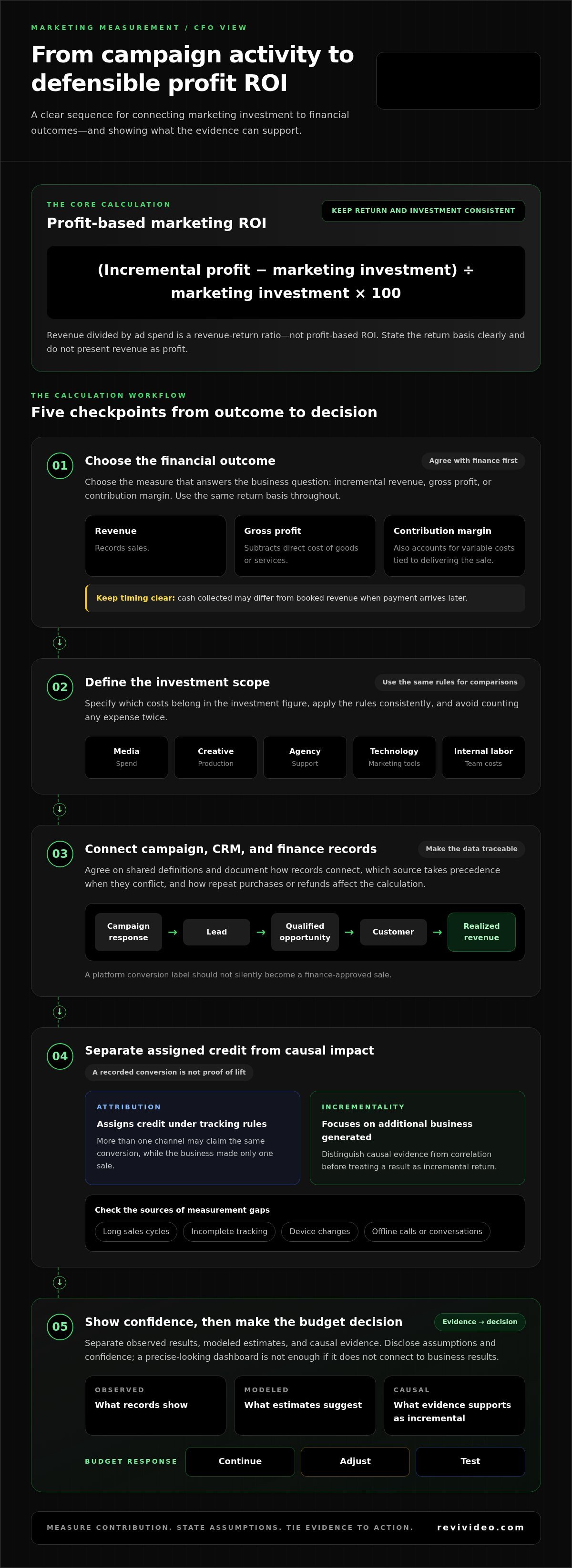
Marketing ROI is the net return generated by marketing divided by the investment required to generate it, expressed as a percentage. The formula is: ROI = (incremental return − marketing investment) ÷ marketing investment × 100. First define “return.” It could mean incremental revenue, gross profit, or contribution margin, depending on the question. State the basis clearly: revenue-based return is not the same as profit-based ROI.
Keep related financial measures distinct. Revenue records sales; gross profit subtracts the direct cost of goods or services; and contribution margin also accounts for variable costs tied to delivering the sale. Cash collected shows money received, which may differ from booked revenue when payment arrives later. A CFO assessing profitability will usually need more than a revenue total.
Define the investment just as carefully. Specify whether it includes media spend, creative production, agency support, marketing technology, and internal labor. Apply the same rules across the campaigns you compare, and don’t count an expense twice. A clear scope makes the result easier to reproduce and discuss.
Why clicks and platform conversions rarely settle the debate
A conversion report shows that a platform recorded an action and assigned credit according to its tracking rules. It doesn’t prove that the campaign caused the sale. One customer might see a video, click a paid search ad later, and then speak with sales before buying. More than one channel may claim that same conversion, even though the business made only one sale.
Several gaps can complicate the picture. A long sales cycle may push revenue beyond the reporting window. Incomplete tracking can miss a device change or an unrecorded lead. Offline touchpoints, such as a phone call or an in-person conversation, may not connect neatly to digital campaign data. Treat platform results as useful evidence, but label them accurately instead of presenting attributed conversions as confirmed incremental revenue.
For a stronger measurement plan, distinguish credit assignment from causal evidence and consider what different methods can establish. Marketing Mix Modeling (MMM), for example, offers a broader way to analyze how marketing activity relates to outcomes, but its estimates still depend on the data and assumptions used.
The goal when learning how to prove marketing ROI to my CFO is to support a decision, not claim perfect certainty. Show what marketing contributed, disclose your confidence in the estimate, and connect the evidence to a clear next step: continue, adjust, or test the investment.
Build a trustworthy marketing ROI calculation from revenue to profit
A defensible calculation starts with agreed definitions, not a spreadsheet full of platform totals. Before pulling numbers, align with finance on the business outcome, reporting period, customer cohort, and costs to include. Then trace the result from campaign activity through CRM and finance records. This makes the math easier to check and the final decision easier to act on.
Choose the financial outcome and denominator before calculating
Agree whether the calculation will use incremental gross profit, contribution margin, or another financial outcome. Use the same return basis throughout, and define which campaign and delivery expenses belong in the investment figure. Keep booked revenue, revenue recognized in the reporting period, and cash collected separate when their timing differs. A closed deal isn’t necessarily collected cash, and revenue alone doesn’t reveal the profit left after costs.
Profit-based marketing ROI equals (incremental profit − marketing investment) ÷ marketing investment × 100; revenue divided by ad spend is a revenue-return ratio, not profit-based ROI. If finance wants a revenue-based view, label it clearly and don’t present it as profit. Include the agreed costs, such as media, creative, agency, technology, internal labor, or applicable delivery costs, consistently in the denominator. Don’t count the same expense twice.
Connect campaign data to CRM and finance records
Set shared field definitions before reporting. Decide what qualifies as a campaign response, lead, qualified opportunity, customer, and realized revenue. Document how each stage connects, which source takes precedence when records conflict, and how repeat purchases or refunds affect the calculation. These rules prevent a platform’s conversion label from silently becoming a finance-approved sale.
Use this five-step workflow to build the calculation:
- Choose the outcome. Select the financial measure with finance and state whether it’s incremental revenue, gross profit, or contribution margin.
- Align the data. Match campaign identifiers and lead records across ad platforms, analytics, CRM, and finance systems. Flag duplicates and missing tracking.
- Calculate the return. Connect eligible customer records to the chosen outcome, applying consistent rules for refunds, revenue timing, and attribution windows.
- Compare the investment. Include the agreed marketing costs and any applicable delivery costs in the same scope as the returns.
- Disclose assumptions. Note exclusions, gaps, cohort rules, and modeled estimates so finance can see what the result does and doesn’t establish.
Keep the time frame and cohort consistent. If campaign costs cover one quarter, compare them with sales generated by the defined cohort over an agreed follow-up period, rather than mixing those costs with unrelated annual revenue. For long sales cycles, show which opportunities remain open instead of counting pipeline as realized profit. A concise assumptions note can explain incomplete tracking, duplicate-record handling, and why the selected attribution window fits the analysis.
For coordinated measurement, align campaign execution with the customer journey across media, creative, and website experience. REVI’s integrated advertising and creative work can be planned around shared business outcomes, giving teams a consistent framework for evaluating results.
Compare attribution, incrementality, and MMM without overstating certainty
One measurement method rarely answers every finance question. Attribution maps credit across customer touchpoints. Incrementality testing estimates whether a specific marketing action changed outcomes. Marketing mix modeling (MMM) uses aggregate patterns to estimate how channels contribute over time. Each can inform a budget decision, but none should be presented as more conclusive than its data and design allow.
Attribution answers which touchpoints received credit, incrementality asks whether marketing caused additional results, and MMM estimates how channels contributed across a broader period. Keep that distinction visible in reports. It helps finance interpret the evidence without mistaking a tracking model for a causal finding.
- Attribution: Use campaign and customer-path data to understand where tracked interactions occurred and optimize within a consistent model. Its limits include incomplete tracking, overlapping channel claims, and model rules that affect how credit is assigned.
- Incrementality: Compare outcomes for a group exposed to a marketing intervention with an appropriate comparison group. The estimate is only as useful as the test design, sample, and ability to limit outside differences between groups.
- MMM: Analyze aggregate marketing activity and business outcomes over time to estimate channel contributions. Results depend on data quality and history, the variables included, and the assumptions behind the model.
When attribution helps, and where it can mislead
Attribution is useful for inspecting customer paths and spotting patterns, such as which recorded touchpoints often appear before a lead or sale. Set one model and reporting window for the comparison, then label the result as attributed performance. Different platforms may have different tracking coverage, credit rules, and windows, so their reported returns aren’t automatically comparable. A platform’s credit is evidence about recorded interactions, not standalone proof that its ads caused the conversion.
When to use incrementality tests or marketing mix modeling
A controlled test can help answer a focused question: did changing this campaign, audience, or market produce lift compared with what likely would have happened otherwise? Where feasible, define the intervention, comparison, outcome, and test period before launch. Check whether the groups are comparable and whether there’s enough data to interpret the difference. If those conditions don’t hold, report the result as uncertain instead of claiming a definitive causal effect.
MMM suits broader planning questions, such as how channel contributions may shift over time or how spend allocation relates to aggregate outcomes. It can help include channels that don’t produce a trackable click, but it relies on suitable historical data and explicit assumptions. Marketing Mix Modeling (MMM) offers an overview of the method and its place alongside other measurement approaches.
For a practical framework on balancing long-term brand activity with near-term campaign results, see this guide to brand and performance marketing. When explaining how to prove marketing ROI to my CFO, label each finding by evidence type: observed, attributed, modeled, or tested. Then state what decision that evidence supports and what further test could reduce uncertainty.
Turn the evidence into a CFO-ready report and budget recommendation
A useful marketing ROI report fits the decision on one page. Put the conclusion up front, show the financial basis, then make the evidence behind the recommendation easy to inspect. Your CFO shouldn’t have to decode a platform dashboard or guess whether a result is observed, modeled, or causal.
What to put in a marketing ROI report
Use a consistent structure so finance can compare results from one reporting period to the next:
- Objective: State the business outcome the campaign aimed to influence, such as qualified opportunities or incremental contribution margin.
- Investment and period: Show the included spend, calculation dates, and cohort definition. Note whether the figure covers media alone or other agreed campaign costs.
- Outcomes: Summarize qualified outcomes and attributable revenue, clearly distinguishing reported sales from modeled or incremental results.
- ROI and basis: Give the calculation and name the return measure, such as gross profit or contribution margin. Include the period used.
- Confidence and caveats: Label results as observed, attributed, modeled, or supported by a controlled test. List key data sources, attribution rules, assumptions, and material tracking gaps.
- Decision: Recommend whether to scale, maintain, reduce, or test, and state what evidence supports that choice.
Keep the trend view focused. Compare the current period with a meaningful prior period or agreed target, using the same definitions. Explain changes that affect the decision, such as a shift in lead quality or a delay between opportunity creation and revenue. Leave out metrics that add detail but don’t change the interpretation.
How to present uncertainty and ask for a budget decision
Don’t disguise uncertainty with a precise-looking number. If tracking is incomplete or results vary across reasonable assumptions, show a range or describe confidence as limited, moderate, or strong, with a short explanation. For example, note that CRM records clearly show attributed results while incremental lift remains untested. That’s more useful than treating both findings as equally certain.
Make the budget request a decision with a learning goal. Specify what you recommend changing, what outcome will count as success, when you’ll review it, and what you’ll do if the test misses the mark. Match the reporting cadence to the sales cycle: short-cycle campaigns can support more frequent reviews, while longer buying journeys need enough time for opportunities to progress and revenue to appear. Align checkpoints with finance’s planning calendar so the evidence arrives before budget choices are made.
Include creative in the measurement plan. If a campaign uses video, define how its role and results will be assessed alongside media and the website journey. REVI’s commercial video production in Phoenix can be part of a coordinated campaign plan, with outcomes agreed before launch.
That’s how to prove marketing ROI to my CFO with a report that leads to action: connect the evidence to a specific decision, make uncertainty visible, and name the next review point. To align your campaign plan with business outcomes, explore REVI’s advertising and creative capabilities.
Make marketing ROI actionable with an integrated growth plan from REVI
A measurement report earns its place when it changes what the team does next. If the data points to weak lead quality, adjust targeting or the offer. If prospects engage but don’t take the next step, review the creative and landing-page experience. If results look promising but causality remains uncertain, run a suitable test before expanding investment. Measurement becomes a growth tool when it guides action, not just documentation.
Connect media, creative, and website performance to one measurement plan
Before launch, align the campaign objective, conversion definitions, tracking, and CRM handoff. Then coordinate ad buying with creative variations and the page each audience sees. This lets the team assess how the pieces work together against agreed business goals, rather than judging each channel by its own metrics. REVI brings ad buying, professional video production, and website development together, giving teams a shared execution context for that plan.
Give creative a clear role in the measurement design. If a video introduces the brand, for example, don’t judge it only by immediate clicks. Define the audience response or downstream action it’s meant to support, then assess it alongside the rest of the journey. For guidance on the creative production process, explore choosing a video production agency in Phoenix.
For teams in Phoenix, Scottsdale, Gilbert, Mesa, Chandler, Paradise Valley, and Tempe, REVI can connect campaign execution with shared business outcomes. The value comes from setting the measurement plan together and using the findings to refine media, creative, or the website experience, not from assuming any channel or asset will deliver a guaranteed result.
Choose the next step based on your measurement gap
Don’t scale simply because a dashboard looks strong. Match the next move to the weakest link in the evidence, and give the team a specific action to resolve it:
- Tracking is unreliable: Standardize campaign and conversion definitions, validate key events, and reconcile digital records with CRM outcomes.
- Causality is unclear: Design a suitable incrementality test with a defined comparison, outcome, and decision threshold before expanding spend.
- Reporting is fragmented: Align campaign, CRM, and finance views around shared time periods, customer cohorts, and outcome definitions.
- Evidence supports a change: Adjust the relevant media, creative, or website element, then monitor the agreed business outcome.
Use customer and finance feedback to keep optimization grounded in business results. A campaign may attract responses but still miss the mark if those leads don’t become qualified opportunities or profitable sales. Bring those signals back into planning, and document what changed, why, and what the next review will assess.
That’s the practical answer to how to prove marketing ROI to my CFO: connect measurement to a clear business decision, then use what you learn to improve the next campaign. Build your next growth plan with REVI, aligning ad buying, video, and website experience around agreed business goals.
Make your next marketing decision with confidence
The next budget conversation can be more than a defense of last quarter’s spend. Use it to set a sharper decision rule before the next campaign begins: what outcome matters, what evidence will guide investment, and what you’ll change if results fall short. That turns the question of how to prove marketing ROI to my CFO into an ongoing practice, not a last-minute scramble for numbers.
REVI helps businesses across the Phoenix metro area connect strategic ad buying and media planning with video production and website development, so campaign decisions can work toward shared business goals. The value isn’t a promised return. It’s a coordinated approach that gives your team a clearer way to measure, learn, and refine its marketing.
Build a clearer case for your marketing investment with REVI. Take the next step with a plan that makes each decision more intentional and gives growth a stronger foundation.
Frequently Asked Questions
How do you calculate marketing ROI?
To answer how to prove marketing ROI to my CFO, first agree with finance on the return measure, then apply: ROI = (incremental return minus marketing investment) divided by marketing investment, multiplied by 100. Reconcile the sales included in the return with CRM and finance records before calculating. Keep the reporting period and expense categories consistent, and label whether the return uses revenue, profit, or another financial measure.
What does a CFO want to see in a marketing report?
A CFO needs a clear business outcome, the investment tied to it, and the basis for trusting the result. Add a concise comparison with the prior period or forecast, plus the source of any material change. For example, if lead volume rose but qualified opportunities didn’t, make that distinction visible. End with a specific recommendation and its rationale so the report supports a decision rather than simply documenting campaign activity.
Can you prove marketing ROI without perfect attribution?
Yes. Perfect attribution isn’t required to make a useful investment decision. Use the strongest evidence available, identify what remains uncertain, and match your conclusion to that evidence. For example, CRM records may confirm closed sales even if they can’t capture every earlier touchpoint. Report confirmed outcomes separately from estimated channel influence, then recommend better tracking or a focused test to strengthen the next evaluation.
What is the difference between ROI and ROAS?
ROI evaluates net return against investment, while ROAS compares revenue attributed to advertising with advertising spend. ROAS can help monitor media efficiency, but it doesn’t account for product or delivery costs, and it may not show whether ads caused the sale. Use ROAS for a clearly defined advertising view; use a profit-based ROI measure when the decision depends on whether the broader investment generated value after relevant costs.
How do you measure marketing ROI for a long sales cycle?
Track a defined group of leads or opportunities from first recorded campaign interaction through later sales outcomes. Use CRM stages to show progress without treating open pipeline as realized revenue. For businesses operating across Phoenix, Scottsdale, Gilbert, Mesa, Chandler, Paradise Valley, and Tempe, compare geographic segments only when campaign exposure and reporting definitions are consistent. Review early indicators between revenue updates, then revisit the cohort as sales mature.
Is marketing attribution enough to prove that a campaign worked?
No. Attribution shows how a selected model distributes credit among tracked interactions, not whether a campaign caused additional sales. A customer may encounter several channels, and tracking or model rules can affect which one receives credit. Use attribution to inspect customer paths and guide optimization, then look for stronger causal evidence, such as a well-designed comparison test, before making a confident claim about incremental impact.
How often should marketing ROI be reported to the CFO?
Set reporting frequency around the sales cycle and the decisions finance needs to make. Shorter-cycle campaigns may support more frequent performance reviews, while campaigns tied to longer buying journeys need enough time for opportunities to mature. Keep operational updates distinct from formal ROI reporting, and align the latter with forecast and budget reviews. That gives the CFO timely signals without presenting incomplete outcomes as final results.