

What if your next brand workshop ended with fewer open questions, not another wall of sticky notes? If you’re wondering what to expect from a brand strategy workshop in Scottsdale, the value is a shared direction your team can use, not a quick logo concept or a stack of abstract ideas. Leaders often bring different assumptions about customers, positioning, and priorities. A focused session puts those assumptions on the table and turns business goals, audience insight, and market context into clear decisions.
A strong workshop also separates strategy from visual design. Strategy defines who you’re speaking to, what makes your business matter, and how to position it. Design brings that direction to life. This article covers what to prepare, what happens during the session, and what useful follow-through looks like. REVI connects brand building with design, video production, website development, and ad buying, helping carry brand direction into execution. You’ll see what workshop outputs your team can put to work and how an integrated approach can support your business.
Key Takeaways
- Learn what to expect from a brand strategy workshop in Scottsdale, from business discovery through positioning and decision-making.
- See how a flexible workshop agenda can reflect your goals, audience needs, and market context.
- Compare workshop approaches by research depth, facilitation, decision ownership, and clarity of outputs.
- Prepare your team with clear goals, relevant business evidence, stakeholder perspectives, and key decisions to resolve.
- Understand how shared brand direction can guide messaging, design, website experiences, video storytelling, and advertising.
What a Scottsdale Brand Strategy Workshop Is Designed to Clarify
A brand strategy workshop is a facilitated process for turning business context into focused brand decisions. Rather than jumping straight to slogans or visual concepts, the team examines what the business needs to achieve, whom it needs to reach, and why customers should choose it. That focus helps leaders leave with direction they can apply, not a collection of disconnected opinions.
The agenda should follow the business challenge. A company entering a new market may need to clarify its audience and position. A business with inconsistent messaging may need to agree on its core promise. That’s the practical answer to what to expect from a brand strategy workshop in Scottsdale: a structured conversation shaped by goals, audience needs, and market position, with decisions prioritized for the work ahead.
Brand strategy defines what a business should mean to its audience; visual branding expresses that meaning through design.
That distinction matters. Strategy establishes the choices behind the brand, including its audience, promise, positioning, and voice. An identity system, website look, or campaign asset can then express those choices consistently. A logo may be part of later design work, but it can’t settle who the business serves or what makes its value relevant. These decisions sit within broader brand management principles, which focus on shaping and managing how people understand a brand.
Which business questions should the workshop answer?
Useful discussion turns broad ambitions into customer-facing direction. “We want to grow” needs a follow-up: grow with which customers, and by giving them what reason to choose us? The team should clarify what it wants customers to understand, feel, or do, then identify the audience segments and needs that deserve priority. This keeps the work tied to real business choices.
Teams can test their thinking with questions like these:
- What should customers remember after encountering the brand?
- Which customer need can the business address especially well?
- What makes the offer meaningfully different, beyond claims like “quality” or “great service”?
Specific answers create a stronger foundation than generic language. “We help busy families plan reliable home care” gives a team more to work with than “we put customers first,” provided the business has evidence to support that distinction.
Why Scottsdale context belongs in the discussion
Local context adds useful evidence, not automatic assumptions. Research can map relevant Scottsdale competitors and the alternatives customers consider, including doing nothing or choosing a provider elsewhere. The goal isn’t to imitate local messaging. It’s to understand what customers already see, where offers overlap, and which needs appear underserved.
Clarify who the business serves: Scottsdale residents, visitors, regional clients, or a mix. A service focused on local customers, for example, may emphasize familiarity and ongoing support, while a business serving clients across Arizona may need to communicate broader reach. These are strategic possibilities to test against customer insight, not stereotypes about the market. Local knowledge can sharpen positioning while leaving room for growth beyond Scottsdale.
What Happens During a Scottsdale Brand Strategy Workshop
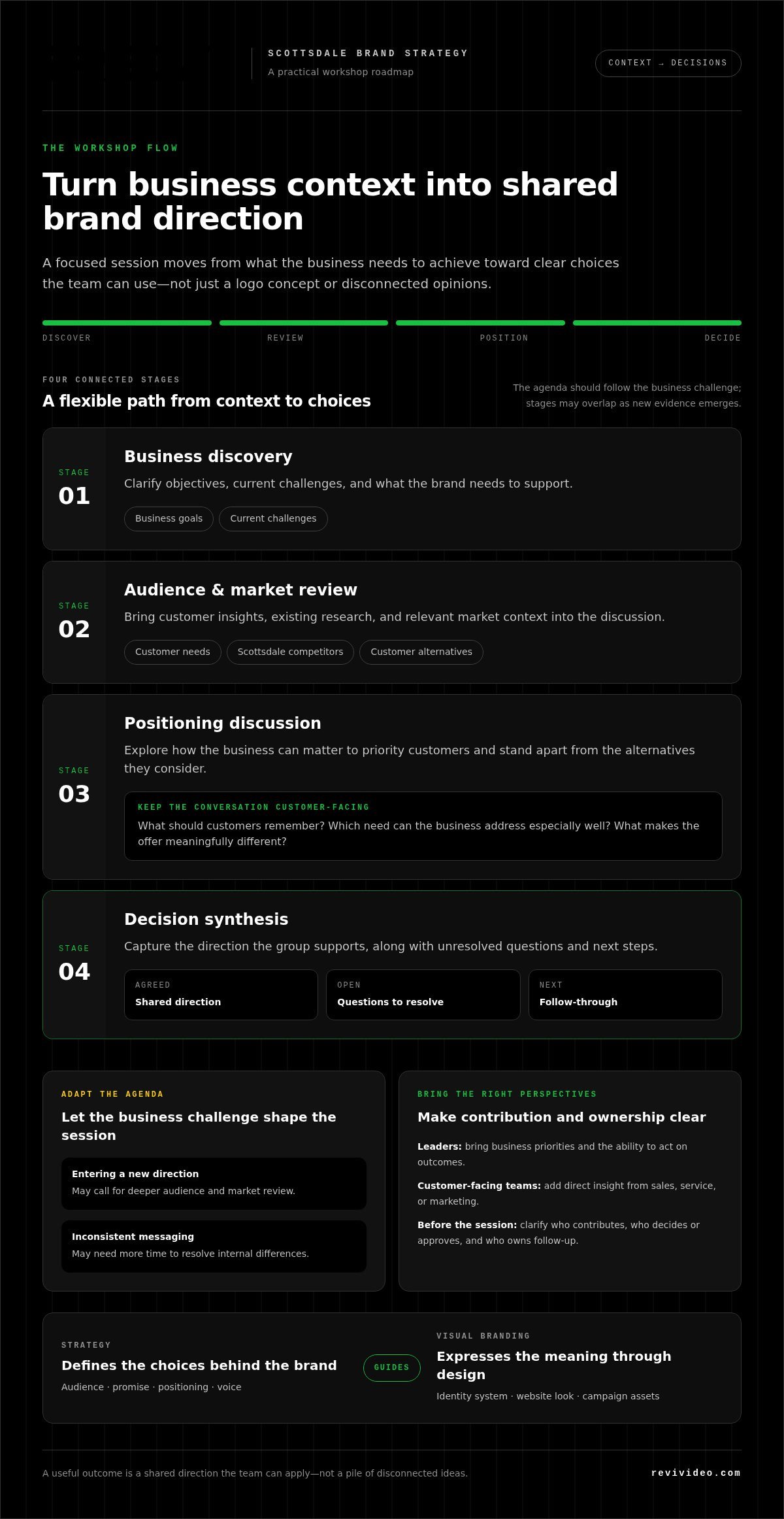
A workshop should move from context to choices, not force every business through the same template. The sequence depends on the challenge: a new direction may call for deeper audience and market review, while inconsistent messaging may need more time to resolve internal differences. If you’re considering what to expect from a brand strategy workshop in Scottsdale, expect the facilitator to shape activities around the decisions your business needs to make.
A flexible process often includes four connected stages:
- Business discovery: Clarify objectives, current challenges, and what the brand needs to support.
- Audience and market review: Bring customer insights, existing research, and relevant market context into the discussion.
- Positioning discussion: Explore how the business can matter to priority customers and stand apart from their alternatives.
- Decision synthesis: Capture the direction the group supports, along with unresolved questions and next steps.
These stages can overlap. A customer comment may challenge an assumption from discovery; a positioning idea may reveal a gap in the evidence. A skilled facilitator makes room for different perspectives, then brings the conversation back to what the team knows, what customers need, and what aligns with business goals. The workshop turns individual inputs into shared brand decisions the team can use.
Who should participate, and what do they contribute?
Include leaders who understand business priorities and can act on the outcomes. Add customer-facing perspectives from sales, service, or marketing when they bring direct insight into customer questions, objections, and expectations. Before the session, clarify who contributes expertise, who makes or approves decisions, and who owns follow-up. That clarity helps prevent a productive discussion from ending with “we’ll think about it” and no agreed direction.
How discussion becomes a usable direction
Facilitation gives the group a way to sort observations into themes. Recurring insights can be grouped as audience needs, existing brand strengths, and market opportunities. For example, if customer feedback repeatedly highlights a confusing buying process, the team can consider whether clarity should become a sharper part of its brand promise, then test that idea against business priorities and customer relevance.
Rather than choosing the most memorable phrase in the room, compare positioning options against practical criteria: Does this direction support the business goal? Does it matter to the intended audience? Can the company credibly deliver on it? The answers help distinguish an appealing idea from a useful strategic choice.
Close by recording decisions in plain language, including the agreed audience, key positioning direction, and any messaging implications. List open questions separately, assign an owner to each follow-up, and note what evidence would resolve it. This creates a working reference for the next phase, not a transcript the team has to interpret later.
REVI connects brand direction with creative and digital execution, so agreed strategy can guide the work that follows. Explore how REVI’s brand-building work can connect messaging and positioning to design, video, websites, and advertising.
How to Compare Brand Workshop Approaches in Scottsdale
A workshop can feel energetic and still leave your team unsure what to do next. Compare approaches by how they gather evidence, guide discussion, clarify decision ownership, and document outcomes. The right format depends on the challenge your business needs to solve, not on a fixed agenda or a long list of activities.
Use this framework to see whether a process is exploratory or designed to support business decisions:
| What to compare | Exploratory approach | Evidence-informed approach |
|---|---|---|
| Research depth | Relies mainly on ideas and assumptions raised in the room. | Uses relevant customer feedback, business context, and market research to test assumptions. |
| Facilitation | Encourages open conversation, but may not resolve competing views. | Guides discussion, draws out different perspectives, and returns to the agreed objectives and evidence. |
| Decision ownership | Leaves unclear who approves the direction or acts on it. | Names decision-makers and makes approval points explicit. |
| Clarity of outputs | Produces brainstorm notes or a broad set of possibilities. | Records priorities, decisions, open questions, and practical next steps. |
Brainstorming has a place. It can help a team surface possibilities and question familiar assumptions. Ideas become strategically useful when the group tests them against customer relevance and business objectives. For example, a proposed brand promise should connect to a need the audience has and a strength the business can credibly deliver, rather than simply sounding distinctive.
What useful workshop outputs can look like
Useful outputs might include priority audience segments, a positioning direction, and messaging guidance that clarifies what to emphasize. The right set depends on the business challenge and agreed scope, so don’t judge a workshop by how many pages it produces. A concise decision record can help leaders and creative teams apply the chosen direction consistently across future work.
Look for more than discussion notes. A clear record distinguishes decisions from ideas still under consideration. It can capture why the team chose a direction, what evidence informed it, and what questions need follow-up. That makes the strategy easier to use when the team plans messaging, design, a website experience, or advertising.
How to recognize a process that fits your business
Start with the challenge. Workshop activities should connect clearly to it. A business trying to reach a new audience may need customer and market insight; a team with conflicting messages may need structured discussion and explicit agreement. In either case, stakeholders should participate actively, research should be relevant, and the process should show where decisions happen.
Finally, check whether the approach connects strategic thinking to implementation without jumping prematurely into creative outputs. Ask what the team will be able to decide and how those decisions can guide the next phase. For wider partner-evaluation context, REVI’s branding agency selection guide for Phoenix can help you think through fit beyond the workshop itself. That’s a practical way to assess what to expect from a brand strategy workshop in Scottsdale: not just engaging conversation, but direction your team can put to work.
How Scottsdale Teams Can Prepare for a Brand Strategy Workshop
Good preparation gives the session a sharper starting point. If you’re considering what to expect from a brand strategy workshop in Scottsdale, arrive with the business challenge, useful evidence, and the right people ready to contribute. You don’t need to solve the brand in advance. You do need to separate what the team knows from what it assumes.
Use this checklist to focus your preparation:
- Goals: Name the business objective behind the workshop, such as improving awareness with a priority audience or making the company’s value easier to understand.
- Evidence: Gather current messaging, customer feedback, sales insights, service questions, and relevant market information where available.
- Stakeholders: Identify who brings useful customer or business perspectives, who makes decisions, and who will act on the results.
- Decisions: List the questions the team needs to resolve and note which topics can remain open for follow-up.
Label assumptions clearly. “Customers choose us for convenience” is a hypothesis until customer conversations, feedback, or other evidence supports it. Keeping both in view helps the group explore ideas without treating a strongly held opinion as a proven insight.
What to align on before the session
Write one clear challenge the workshop should address. “We need a new brand” is broad; “customers don’t understand how our service differs from alternatives” gives the discussion a useful target. Agree in advance who can approve a direction and how the group will handle unresolved disagreements. Bring audience, sales, and customer-service insights that relate to the challenge, rather than every document the business has.
A focused Scottsdale market scan can add context. Note relevant competitors and alternatives customers might choose, including providers outside the city if customers compare across locations. Capture what their messaging emphasizes, but don’t assume local patterns define your opportunity. Consider whether the business serves residents, visitors, regional clients, or a combination, then connect those audiences to wider growth goals.
What to do after the workshop
Turn the session into a concise record while decisions are fresh. Summarize the agreed direction, the rationale behind it, the evidence that informed the choices, and next steps with owners. Keep open questions distinct from decisions. That separation helps the team avoid reopening settled points every time new creative work begins.
Next, translate approved positioning and messaging into the customer touchpoints that matter most. Depending on the business objective, that might mean refining website language, shaping video storytelling, or aligning advertising with the agreed value proposition. REVI connects brand-building work with design, video production, website development, and ad buying, helping carry strategic direction into execution.
Review progress against the original business objective, not personal preferences about a color, layout, or phrase. If the goal was to make the offer clearer to a priority audience, assess whether the communication now does that. Plan your brand strategy workshop with REVI to connect preparation, positioning, and practical next steps.
How REVI Connects Brand Strategy to Creative Execution
Brand direction matters most when it shapes what customers actually see and experience. REVI connects brand-building work, including messaging and market positioning, with design and digital execution. That link helps teams carry strategic choices forward instead of treating strategy as a document apart from the website, video, and advertising work that follows.
Understanding what to expect from a brand strategy workshop in Scottsdale also means seeing what happens after the discussion: audience, value, and positioning decisions can become a shared reference point for creative choices. They guide the work without prescribing one fixed look or set package of deliverables.
From brand direction to customer-facing creative
Positioning and messaging give creative teams a reason behind each choice. If the strategy prioritizes a particular audience need, the website can make the relevant value easy to understand, video storytelling can bring the message to life, and advertising can reinforce the same promise. The format changes; the central direction stays consistent.
That doesn’t mean every touchpoint should look or sound identical. Design, video, and web work should express a coherent brand, with choices rooted in the audience and business objectives. Identity decisions can support recognition and clarity rather than rely only on personal taste. REVI’s brand video production guide for Phoenix offers an example of how strategic direction can inform creative storytelling.
- Website: Organize content around what priority customers need to understand.
- Video: Shape stories and messages to reflect the brand’s positioning.
- Advertising: Keep campaign messaging connected to the same value proposition.
Deciding whether REVI is the right strategic partner
Start with the gap you need to close. If leaders disagree about the audience or what makes the business relevant, brand clarity may be the priority. If the direction is already clear but customer-facing work feels disconnected, coordinated creative execution may matter most. Some teams need both: shared strategic choices and the design or digital work that brings them into the market.
REVI brings brand building and design together with video production, website development, and ad buying. This integrated range can connect positioning and messaging to the channels where customers encounter the business. Shape the scope around your objectives, the decisions you need, and how the resulting direction can guide practical work.
Ready to connect your brand goals with the right next steps? Talk with REVI about your brand goals.
Turn Brand Clarity Into Your Next Move
Turn what you’ve learned into a focused conversation with your team. Decide which business challenge matters most, what you still need to learn about your audience, and which choices would help your brand move forward. That gives you a practical starting point for applying what to expect from a brand strategy workshop in Scottsdale to your own goals.
REVI serves Scottsdale and nearby Phoenix-area communities, including Phoenix, Scottsdale, Gilbert, Mesa, Chandler, Paradise Valley, and Tempe. The agency connects brand building with design, video production, website development, and ad buying. This gives your creative and digital efforts a shared strategic foundation while keeping the work grounded in what your business needs.
Ready to explore the next step? Talk with REVI about your brand goals and start shaping a clearer path forward.
Frequently Asked Questions
How long does a brand strategy workshop in Scottsdale usually take?
There isn’t one standard schedule. The time depends on the business challenge, how many stakeholders need to contribute, and how much research the team needs to review. A focused working session may address a specific decision, while a broader strategy engagement may involve more preparation and follow-up. To plan what to expect from a brand strategy workshop in Scottsdale, define the decisions you need before setting the scope.
Is a brand strategy workshop useful for a small business?
Yes, a workshop can help a small business sharpen its positioning, clarify its message, or decide which customers to prioritize. Company size matters less than having a real business question to work through. For example, a small business serving Scottsdale or Tempe customers might need to explain how its offer differs from familiar alternatives. Connecting the discussion to customer needs helps make the resulting direction useful in marketing.
Can a brand strategy workshop help before launching a new business?
Yes, it can help a new business decide whom it intends to serve and how to explain its value before those choices shape a website or advertising. Treat early positioning as a well-reasoned starting point, not a permanent answer. A business planning to serve customers across Phoenix, Scottsdale, Gilbert, Mesa, Chandler, Paradise Valley, and Tempe can use available market insight to shape its initial message, then refine it as customer responses come in.
Should a business include customers in a brand strategy workshop?
Customer input is valuable, but customers don’t always need to attend the internal session. The team can bring insights from interviews, feedback, reviews, or service conversations and discuss what those sources actually show. For example, distinguish a repeated customer question from an internal belief about why people buy. If direct input is limited, record assumptions as questions to investigate rather than presenting them as established customer preferences.
Does a brand strategy workshop create a new logo?
Not automatically. A workshop focuses on strategic choices, and the team may decide its current logo still fits the direction. If the identity feels misaligned, the strategy can give designers a clearer basis for considering changes. For instance, a business repositioning toward a different audience may need to review whether its existing visuals communicate the intended value. Design should express the brand direction, not stand in for it.
What should I bring to a brand strategy workshop?
Bring the materials that reveal how the business currently presents itself and what customers respond to. That could include website copy, sales presentations, campaign examples, customer comments, and common questions heard by the team. You don’t need to create a polished deck. Flag which items reflect verified feedback and which reflect internal opinions, so the group can weigh each kind of input appropriately.
How can we tell whether a brand strategy workshop was successful?
A successful workshop gives the team decisions it can explain and apply to the original business challenge. Look for a clear rationale behind the chosen audience or message, plus an agreed way to use that direction in upcoming work. Afterward, compare relevant customer-facing materials against the objective. If the goal was clearer communication, review whether customers can more easily understand the offer, rather than judging success by personal taste alone.