

High-performing marketing teams are 72% more likely to use integrated tracking systems to measure ROI across channels, according to HubSpot. If you feel like your ad spend is vanishing into a black hole of disconnected data, you aren’t alone. Learning how to track ad campaign success in 2026 requires more than just a basic dashboard; it demands a strategy that outpaces new privacy laws in states like Oregon and Indiana. You need a framework that connects your high-impact video creative directly to your bottom line without the guesswork.
It’s frustrating to see brilliant creative underperform because your tracking is broken or outdated. You deserve a clear view of your growth. This article will show you how to master the metrics and server-side technologies that bridge the gap between creative impact and massive ROI. We’ll move past the confusion of privacy-first changes and build a data-backed engine for your brand. Our goal is to turn your technical stack into a competitive advantage that drives immediate action.
We are diving into the essential tools for multi-touch attribution, the latest GA4 configurations, and the specific ways to align your ad buying with real-time performance data. Stop wasting budget and start scaling with confidence.
Key Takeaways
- Pivot from vanity metrics like likes and follows to outcome-driven data that measures actual revenue and creative resonance.
- Master the 2026 tracking stack by implementing UTM parameters and privacy-first pixels to gain granular visibility into your traffic sources.
- Learn how to track ad campaign success by identifying the “Hook Rate” in the first three seconds of your video to measure true creative impact.
- Execute a five-step plan to audit your technical stack for data leakages while aligning North Star KPIs like ROAS and CAC.
- Bridge the gap between elite ad buying and professional video production to ensure your creative and data work in perfect sync.
Beyond the Click: Why Tracking Ad Success Is Critical in 2026
Clicks are cheap; conversions are everything. In a market as aggressive as Phoenix or Scottsdale, every dollar in your budget must fight for its life. Ad campaign tracking isn’t just about managing spreadsheets or reading charts. It’s the real-time measurement of ROI and creative resonance. If you don’t know exactly which video hook stopped the scroll and which one failed, you’re just gambling with your marketing budget. Untracked campaigns don’t just underperform; they bleed your capital dry while your competitors capture your audience.
Mastering ad effectiveness tracking allows you to pivot instantly. You move away from vanity metrics like likes and shares to focus on outcome metrics that actually hit your bank account. This is how you win. You turn raw data into a decisive action-benefit logic that fuels rapid growth. Understanding how to track ad campaign success means knowing your numbers better than anyone else in the room. It gives you the power to double down on what works and kill what doesn’t before it costs you a fortune.
The Evolution of Tracking: From Cookies to Context
The tracking landscape shifted forever as we entered 2026. With new privacy laws in Oregon and Kentucky banning the sale of precise geolocation data and requiring universal opt-out signals, your old-school pixel strategy is likely failing you. You need a first-party data strategy to maintain visibility into your customer journey. Modern tracking has moved from simple browser-based pixels to robust server-to-server API integrations. This shift ensures your data remains accurate even as browsers block traditional cookies. In 2026, the Conversion API is the undisputed gold standard for capturing reliable performance data without compromising user privacy.
The Emotional Toll of ‘Blind’ Spending
There is a specific kind of anxiety that comes with blind spending. It’s that sinking feeling when you see a high ad bill but can’t point to the specific creative that drove the sales. This lack of clarity is a massive barrier to your business impact. It keeps you playing small because you’re afraid to scale what you can’t measure. We position ourselves as your visionary partner to remove these tedious production and data barriers. When you finally learn how to track ad campaign success with precision, that anxiety vanishes. You gain a sense of cool, calculated success. Accurate tracking is the ultimate shortcut to a professional-grade digital presence. It gives you the confidence to scale your ad buying and video production because you finally have the receipts.
The 2026 Tracking Stack: UTMs, Pixels, and Privacy-First Data
Stop relying on luck to grow your brand. In 2026, your tracking infrastructure is the engine that drives your entire marketing operation. As third-party cookies vanish, a fragmented tracking setup is a liability you can’t afford. A modern stack must integrate first-party data, server-side communication, and granular traffic tagging to survive. This is how to track ad campaign success with surgical precision. By building a robust technical foundation, you ensure that every click is accounted for and every conversion is attributed to the right creative asset.
Your stack starts with Google Tag Manager (GTM) acting as the central nervous system. It organizes your Meta Pixel, LinkedIn Insight Tag, and GA4 events without cluttering your website code. But tracking in 2026 goes beyond just installing a script. You must implement cross-platform attribution to understand the multi-touch journey of your customers. Most users won’t convert on the first touchpoint. They might see a vertical video on Instagram, search for your brand on Google, and finally convert through a retargeting ad. Without a unified stack, you’ll misattribute that sale and kill the very ads that started the fire.
Mastering UTM Parameters for Granular Insights
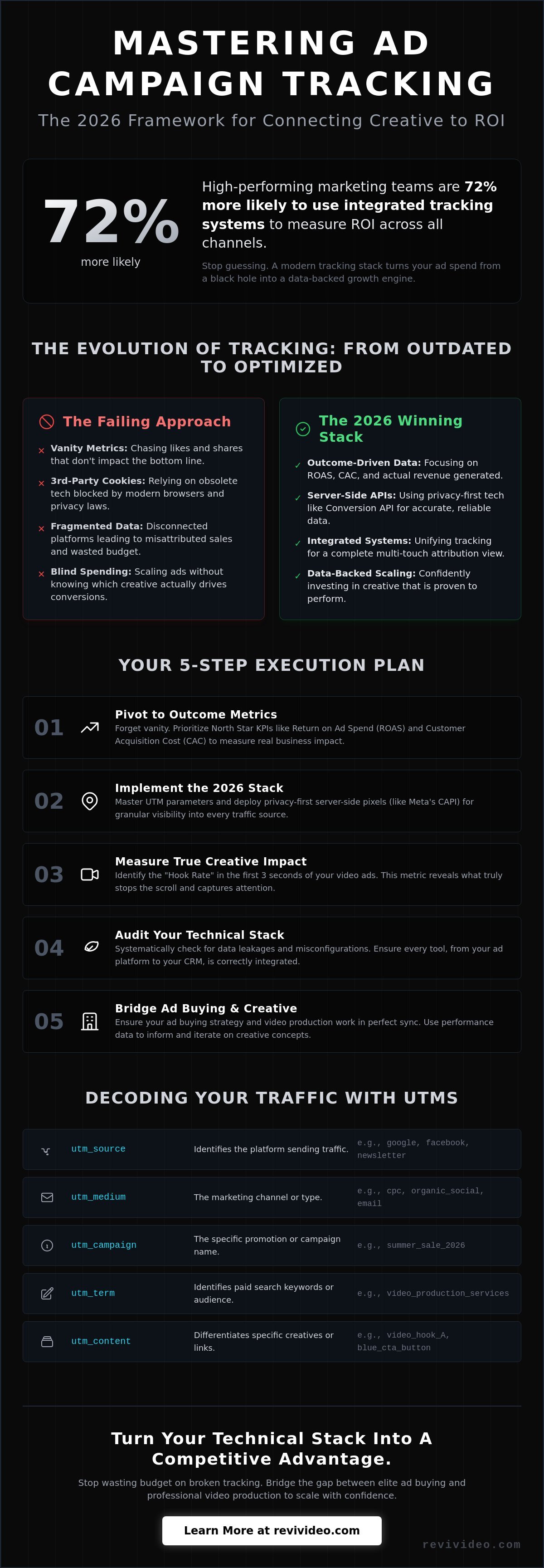
UTM parameters are the DNA of your traffic data. They tell your analytics platform exactly where a visitor came from and what they clicked. To get the full picture, you must use all five standard tags consistently:
- Source: The platform (e.g., facebook, google, newsletter).
- Medium: The channel type (e.g., cpc, organic_social, email).
- Campaign: The specific promotion name (e.g., summer_sale_2026).
- Term: The specific keyword or audience target.
- Content: The specific ad creative version (e.g., video_hook_A).
Messy data is worse than no data. Establishing a rigid, lowercase-only naming convention for your UTM parameters is the only way to prevent your analytics from turning into a graveyard of unusable data. Pairing this granular data with professional ad buying strategies ensures every dollar is spent on audiences that actually convert.
Server-Side Tracking: The 2026 Necessity
Browser-based tracking is dying. With new privacy laws in states like Oregon and Kentucky mandating universal opt-out signals, browsers are blocking more data than ever. Server-to-Server (S2S) tracking is your solution. Instead of relying on the user’s browser to send a signal to Meta or Google, your server sends the data directly. This bypasses ad blockers and cookie restrictions, giving you a 20% to 30% boost in data accuracy. It empowers you to see the full funnel, from the first scroll to the final checkout. Implementing S2S tracking is the ultimate move for any Innovative Efficiency Expert who values truth over vanity metrics. It’s the only way to truly master how to track ad campaign success in a privacy-first world.
Measuring Creative Impact: Why Video Metrics Are the New North Star
Video is the most tracked asset in 2026. It’s also the most misunderstood. Most brands stare at view counts and call it a day. That’s a mistake. Views don’t pay the bills; resonance does. To master how to track ad campaign success, you must dissect your video performance frame by frame. High-end video production isn’t a luxury; it’s a data-gathering tool. Our commercial video production strategy starts with tracking in mind, ensuring every scene serves a measurable purpose. When your creative is sharp, your Customer Acquisition Cost (CAC) drops. It’s that simple. High-quality visuals stop the scroll, while data tells you why they stopped.
You need to stop guessing which ads work. The bridge between creative impact and massive ROI is built on specific video metrics that most competitors ignore. We don’t just produce content; we engineer visibility. By analyzing how users interact with every second of your footage, you can identify exactly where you’re losing interest and where you’re winning hearts. This level of insight transforms your ad buying from a shot in the dark into a precision strike. It’s about turning audience interaction into a predictable growth engine.
The 3-Second Rule: Tracking the ‘Hook’
The “Thumb-Stop Ratio” is your most honest metric. You calculate it by dividing your 3-second video views by total impressions. If your hook rate is below 25%, your visual storytelling is failing. Your audience is scrolling past you before you even say hello. Use this data to iterate. If viewers drop off at the 2-second mark, your opening visual isn’t punchy enough. Change the first frame. Test a different headline. High-energy hooks lead to high-impact ROI. Every millisecond counts when you’re fighting for attention in a saturated feed.
Average Watch Time vs. Conversion Rate
Watch time builds trust. High average watch times correlate directly with higher conversion rates because you’ve earned the viewer’s attention. But don’t ignore the “View-Through Conversion.” This metric tracks users who watched your video, didn’t click immediately, but converted later. It’s essential for understanding how to track ad campaign success across the entire funnel. Strategic brand video production builds a massive data pool for retargeting. It allows you to serve specific ads to people who watched 50% or more of your content, turning cold leads into loyal customers with surgical efficiency. This frictionless transition from viewer to buyer is the ultimate benchmark of quality.
Your 5-Step Execution Plan to Track and Optimize Campaigns
Execution is where your data earns its keep. You’ve built the tracking stack; now you must run the play. A framework is only as good as the action it triggers. To master how to track ad campaign success, you need a repeatable process that turns raw numbers into profit. This five-step plan ensures your budget is always flowing toward growth, not waste. It removes the guesswork and replaces it with a cold, calculated strategy for scaling.
- Step 1: Define North Star KPIs. Fix your focus on ROAS, CAC, and LTV before you spend a single dime. These are the numbers that dictate your business health.
- Step 2: Audit for Data Leakage. Check your funnel for technical gaps where clicks vanish before they reach your analytics. A 10% leakage can hide a winning ad.
- Step 3: Implement Deep-Link Tracking. Use mobile-first deep links for your social campaigns. This ensures a frictionless transition from an Instagram scroll to your checkout page.
- Step 4: Weekly ‘Creative vs. Data’ Syncs. Bring your ad buyers and creators together. Review the performance data to kill underperforming hooks and scale the winners immediately.
- Step 5: Use Predictive Modeling. Analyze your historical data to forecast future success. This allows you to front-load your spend on the creative styles proven to convert.
Stop playing defense with your marketing budget. When you know how to track ad campaign success with this level of granularity, you gain the confidence to outspend your competition. You aren’t just buying ads; you’re buying predictable outcomes. Scale your brand today by mastering data-driven ad buying.
KPI Selection: Choosing Metrics That Move the Needle
Differentiate between leading and lagging indicators to stay ahead of the curve. Click-Through Rate (CTR) is a leading indicator; it tells you if your creative is interesting. Revenue is a lagging indicator; it tells you if your business is growing. For high-impact ad buying, Return on Ad Spend (ROAS) remains the ultimate pulse check. However, you must also master your acquisition efficiency. Customer Acquisition Cost (CAC) represents the total sales and marketing cost required to earn a new customer over a specific period. If your LTV isn’t significantly higher than your CAC, your tracking is telling you to pivot.
The Feedback Loop: Turning Data Into New Creative
Data should dictate your next production cycle. If your tracking shows a high hook rate but low conversion, your landing page or offer is the bottleneck. If the watch time is low, your storytelling needs more energy. Use these insights to brief your video production agency with surgical precision. Test headlines and visual hooks simultaneously to find the winning combination. Once you find a winner, add it to your “Creative Library” to speed up future production. This loop ensures you never start from zero; you only build on what is already proven to work.
Scaling Success with REVI: Integrating Ad Buying and High-End Creative
Data without action is just a spreadsheet. You’ve learned how to track ad campaign success using UTMs, server-side pixels, and hook rate analysis. Now you need the engine to run it. REVI operates as your Innovative Efficiency Expert, bridging the gap between cold numbers and high-impact storytelling. We don’t believe in silos. When your ad buyers and video directors sit in the same room, magic happens. Optimization moves at a staccato pace. We identify a winning hook in the morning and have three new iterations live by the afternoon. This isn’t just marketing; it’s a calculated assault on your competition.
Stop guessing. Start growing. Knowing how to track ad campaign success is only half the battle; the other half is having the creative agility to act on those insights. Most agencies treat creative and data as separate departments. That’s a recipe for wasted spend and missed opportunities. We integrate these functions to remove tedious production barriers. This synergy allows us to pivot instantly based on real-time ROI. You gain a visionary partner that values your time and your bottom line. We turn your visibility into a predictable growth engine that scales as fast as you do.
Local Expertise for Phoenix Brands
The market dynamics in Phoenix, Chandler, Gilbert, and Mesa are unique. A generic national strategy won’t cut it here. You need a partner that understands the local landscape and consumer behavior. Our knowledge as a local video production company ensures your ads feel authentic and hit home with your target audience. This integrated approach reduces friction for busy business owners. We handle the technical website development, the high-end design, and the complex tracking so you can focus on running your business. It’s a frictionless experience designed for maximum impact and audience reach.
The REVI Difference: Creative That Performs
We blend technical expertise with elite storytelling to create ads that don’t just look good; they perform. Our process is rooted in the data-driven framework we’ve outlined, ensuring every frame of video and every dollar of ad spend is optimized for conversion. We are the ultimate shortcut to a professional-grade digital presence. Don’t let your brand get lost in the noise of a crowded social feed. Secure your visibility and dominate your market with expert Ad Buying. Your audience is waiting. Let’s give them something worth watching.
Own Your Data and Dominate the Feed
Success in 2026 belongs to the brands that treat data as a weapon. You’ve seen why vanity metrics are dead and how a server-side tracking stack protects your visibility. By focusing on the 3-second hook and aligning your creative with real-time conversion data, you’ve already outpaced the competition. Mastering how to track ad campaign success isn’t just a technical hurdle; it’s the ultimate shortcut to scaling your business with absolute certainty. You now have the roadmap to turn every ad dollar into a measurable asset.
Since 2018, we’ve helped high-end lifestyle brands in Phoenix, Scottsdale, and Paradise Valley turn creative vision into massive ROI. We remove the barriers between web development, video production, and ad strategy to ensure your brand wins every single time. Stop leaving your growth to chance and start making data-backed decisions that drive results. Scale your brand with REVI’s data-driven ad buying and elite video production today. You have the framework and the tools. Now it’s time to execute with confidence and watch your audience reach explode.
Frequently Asked Questions
How do I track ad success without third-party cookies?
Shift your strategy to first-party data collection and server-side APIs immediately. Browser-based cookies are obsolete; instead, use tools like Meta’s Conversions API or Google’s server-side tagging to send data directly from your server to the ad platform. This method bypasses browser restrictions and ensures your data remains accurate even as privacy laws tighten. It’s the most reliable way to maintain visibility into your customer’s journey without relying on unstable third-party data.
What is a good ROAS for a Phoenix-based small business in 2026?
Aim for a 3x to 4x Return on Ad Spend (ROAS) as a healthy baseline for growth in the competitive Phoenix market. While specific targets vary by industry, this range ensures you cover your production costs and ad spend while maintaining a profit. High-performing brands often push for 5x or higher by optimizing their video hooks and landing pages. Focus on your specific margins to determine your unique break-even ROAS and scale from there.
Can I track offline sales from my digital video ads?
Yes, you can track offline sales by uploading customer transaction data back into your ad platforms. Use “Offline Conversions” tools to match email addresses or phone numbers from in-store purchases with users who viewed or clicked your digital video ads. This closes the loop between online visibility and physical sales. It’s a powerful way to prove the real-world impact of your digital storytelling efforts and justify your total marketing investment.
How often should I check my ad tracking dashboard?
Perform a quick pulse check daily to ensure your spend is on track and no technical errors have occurred. Save your deep-dive analysis for a weekly review. This rhythm allows enough data to accumulate for statistically significant decisions without letting underperforming ads drain your budget for too long. Checking too frequently can lead to knee-jerk reactions that disrupt the platform’s machine-learning phase and hurt your long-term results.
What is the difference between attribution and tracking?
Tracking is the technical process of collecting data points like clicks, views, and purchases. Attribution is the strategic framework used to assign credit for a sale to specific touchpoints. Think of tracking as the raw footage and attribution as the final edit that tells the story of your ROI. You need both to understand how to track ad campaign success across a complex, multi-channel funnel that includes social media and search.
How do I know if my video creative is the reason my ads are failing?
Analyze your Hook Rate and Average Watch Time to diagnose creative failure. If your 3-second view rate is below 25%, your opening hook is too weak to stop the scroll in a crowded feed. If users drop off immediately after the hook, your content isn’t delivering on the initial promise. Creative failure shows up in these engagement metrics, while funnel failure shows up in low conversion rates despite high engagement and click-throughs.
Is server-side tracking expensive to implement for a boutique brand?
Implementing server-side tracking requires an upfront technical investment, but it’s far more expensive to fly blind with inaccurate data. For boutique brands, the cost of lost data and misattributed sales quickly exceeds the setup fees. Use scalable solutions like Google Tag Manager’s server-side containers to manage costs while gaining professional-grade accuracy. It’s a strategic move that pays for itself through higher ROI and more efficient, data-backed ad buying.
How do I track success across multiple platforms like Meta, TikTok, and Google simultaneously?
Use a centralized analytics dashboard like GA4 paired with a rigid UTM tagging system. This allows you to see all your traffic sources in one place and compare performance side-by-side. Learning how to track ad campaign success across platforms requires a “source-of-truth” model where you value the data in your own analytics over the platform-specific dashboards. This prevents double-counting conversions and provides a clear, unbiased view of your total audience growth.