

Brand awareness alone can’t prove that brand building is working. To measure brand building efforts effectively, track awareness, consideration, branded search, and changes in traffic and revenue, then use a controlled test to assess whether a campaign drove incremental lift. The key is to connect what people think about your brand with what they do next.
It’s easy to focus on impressions, clicks, or a spike in visits. Those signals show attention, but they don’t establish whether people remember your brand or whether a campaign changed their behavior. That’s why measurement needs both perception metrics and performance data.
This guide explains how to set a useful baseline, choose awareness and search metrics, and track their relationship to traffic and revenue. You’ll also learn how to use holdout audiences, matched markets, and brand lift studies to test impact, so your next decision rests on more than a promising chart.
Key Takeaways
- Pair awareness measures with consideration and purchase intent to see whether people are moving closer to choosing your brand.
- Track branded search and new-user traffic as signals of growing interest, then connect those trends to campaign activity.
- Use media mix models to estimate how brand investment contributes to incremental traffic, revenue, and customer acquisition.
- Choose a causal test, such as a matched-market or audience holdout test, to compare campaign outcomes with a control group.
- Turn each finding into a practical next move: refine the audience, creative, or campaign based on what the evidence shows.
What is brand awareness?
Measure awareness as one stage in a consumer relationship, not as a standalone campaign result. Then track whether recognition develops into consideration, intent, and usage.
-
Define Awareness Alongside Related Brand Measures
Start by defining each stage you want to measure. Awareness asks whether consumers recognize or recall a brand. Familiarity measures how well they feel they know it. Consideration asks whether they would include it among their choices. Usage records whether they have bought or used it. Keep these metrics separate so a rise in recognition isn’t mistaken for a rise in preference.
Next, map those measures to your business’s brand equity goals. Brand equity metrics capture consumer mindsets, attitudes, and intent, rather than behavior alone. A brand health tracker can compare what consumers think with the perception your business wants to build. Track awareness, consideration, investigation, preference, and usage to see where people progress or drop off.
Connect awareness to a meaningful next step. For example, ask whether people who recognize your brand also consider it or intend to purchase. A brand lift study can survey exposed and unexposed consumers before and after a campaign. It can measure top-of-mind and unaided awareness, perception, consideration, and purchase intent. Use consistent audience definitions to identify meaningful changes.
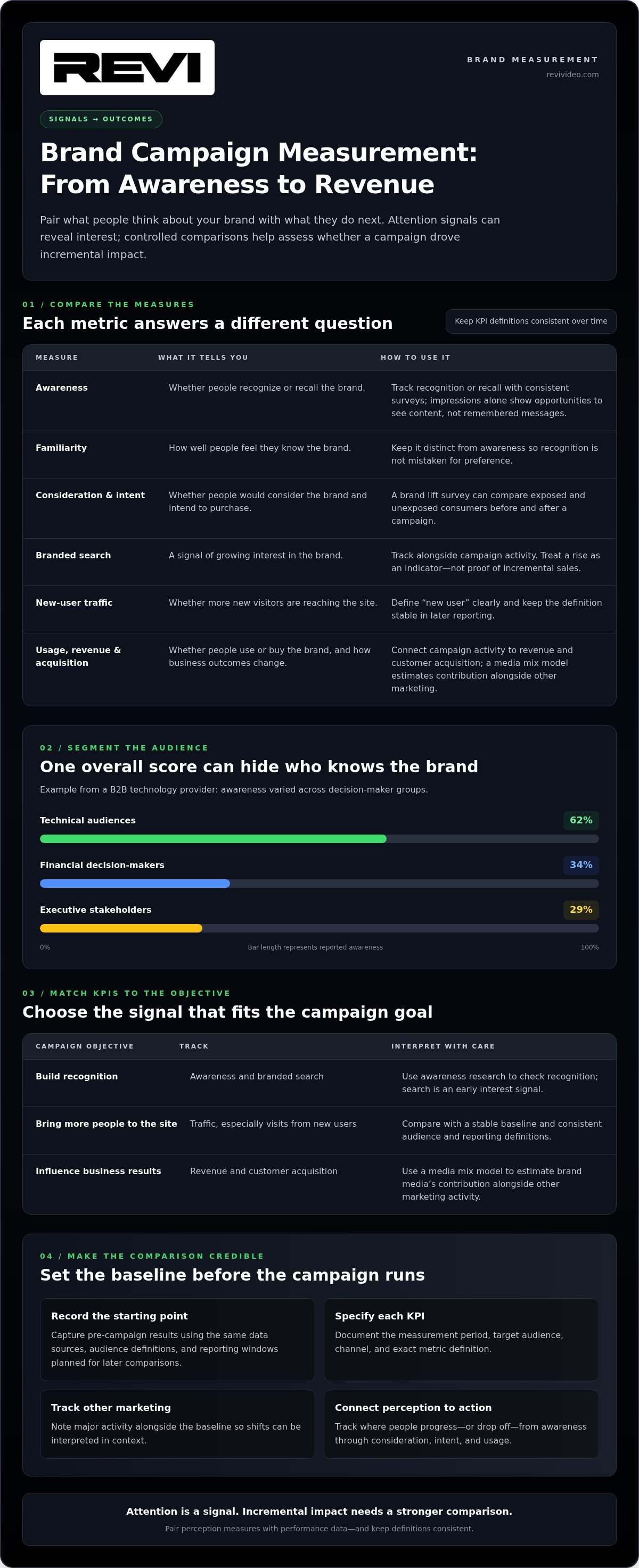
Use audience segments when the overall score hides gaps. One B2B technology provider measured awareness at 62% among technical audiences, 34% among financial decision-makers, and 29% among executive stakeholders. Those differences show why a single blended awareness score may conceal which decision-makers know the brand.
-
Assess Awareness Metrics and Research Tools
Choose research tools that test memory and meaning, not just exposure. Impressions count opportunities to see content; they don’t prove that consumers noticed, understood, or retained a brand message. Pair campaign reach data with consumer surveys, focus groups, social media reviews and mentions, and website search volume. Use the same questions and audience criteria over time to make comparisons useful.
For sentiment, ask consumers how they perceive the brand, then compare responses before and after a campaign. A brand lift survey can measure changes in sentiment, consideration, and purchase intent. Social likes, shares, comments, and mentions add context about reactions to content, but they don’t replace direct perception measures. Net promoter score can offer a simple indication of customers’ willingness to recommend a brand. Pair that score with follow-up research to understand the reasons behind it.
How much should companies spend on brand measurement and research? Set the budget according to the research frequency, audience coverage, and analysis required.
What tools measure brand awareness and brand sentiment? Use surveys and focus groups for direct consumer feedback, alongside social reviews, mentions, and website search volume as supporting signals. Choose a brand lift study when you need to compare awareness or sentiment before and after campaign exposure.
Measuring brand campaigns’ incremental traffic and revenue with media mix models
Set a baseline before launch, then compare consistent brand and business KPIs over time. A media mix model can help estimate how brand investment contributes to incremental traffic and revenue.
-
Set a Consistent Baseline for Brand KPIs
Record the starting point for each metric before the campaign runs. Include the measurement period, target audience, channel, and exact KPI definition. For example, specify whether “new-user traffic” means first-time visitors or another analytics segment. Keep those definitions stable in later reporting.
How do you set a baseline and measure brand KPIs consistently? Capture pre-campaign results using the same data sources, audience definitions, and reporting windows you’ll use afterward. Note other major marketing activity alongside the baseline, so you can interpret shifts in context rather than attributing every change to brand media.
Build a shared view of brand recognition, site traffic, and revenue. Use first-party customer data to connect campaign exposure with new customer acquisition where possible. A reliable baseline gives each later comparison a clear starting point.
-
Select KPIs for Campaign Objectives
Choose metrics that match the outcome the campaign is designed to influence. If the objective is recognition, track awareness and branded search. If it’s to bring more people to the site, monitor traffic, especially visits from new users. For a revenue objective, connect campaign activity with revenue and customer acquisition.
Separate leading indicators from business outcomes. Search activity and new-user visits can show rising interest before revenue shifts. Treat them as signals, not proof of incremental sales. A campaign focused on a particular audience or brand attribute should use measures that show whether that audience noticed the message and whether its intended meaning registered.
Limit the KPI set to measures that support a decision. A long list of unrelated metrics can obscure whether the campaign achieved its purpose. Compare each selected KPI with its baseline and assess changes alongside other active marketing efforts.
-
Measure Incremental Traffic and Revenue
Use a media mix model to estimate how brand media contributes to traffic and revenue alongside other marketing activity. The model helps distinguish the incremental effect of investment from outcomes that may have occurred without the campaign. Include first-party customer data when assessing how brand activity contributes to new customer acquisition.
Read the results as part of the brand’s broader performance. A model can reflect brand investment through an increase in the brand equity base, not only through immediate conversions. Compare modeled impact with changes in traffic, new users, and revenue. If search rises while other channels perform better, investigate whether brand activity helped drive that response.
Turn each finding into a campaign adjustment. Use brand research to refine the target audience, creative, or messaging, then measure the next cycle against the same baseline. For practical brand campaign planning, connect the research insight to the media choices and message you want to test.
Share of search as an early indicator of brand relevance
Track branded search volume and share of search to spot changes in audience interest. Compare these signals with site visits and campaign timing before linking them to business outcomes.
- Calculate share of search using a consistent category. Divide searches for your brand by searches for your brand and relevant competitors, then multiply by 100. For example, include the same competitor set and search terms in every reporting period. Share of search measures a brand’s searches relative to total searches in its industry or category.
Branded searches account for 45.7% of Google searches. That makes brand-specific query volume a useful recognition signal, but context matters: category demand can change too. Track branded search volume alongside total category searches to distinguish a rising brand share from a wider increase in interest.
- Compare your search share with competitor visibility, not just your own trend. Share of voice percentage and social media mention share can show how much conversation your brand captures relative to competitors. For a fair comparison, define the channel, audience, competitor set, and measurement period first. Use the same scope each time, then see whether gains in search share coincide with stronger social visibility.
How do you calculate share of voice and compare it with competitors? Choose one consistent measure, such as mentions in a defined set of social channels, then divide your brand’s mentions by all included brand mentions. Compare the resulting share across the same competitors and period; don’t mix mention counts with impressions.
- Separate website search volume from branded search volume. Website search volume reflects how often people search within your site, while branded search volume captures queries on search engines that include your brand. Read both alongside direct, organic, and referral traffic. If branded searches rise but visits don’t, review whether your search listings and website content match consumer intent.
Then compare search changes with campaign dates and new-user traffic. An increase in site traffic, especially from new users, can serve as an early indicator of brand marketing. Correlating traffic with share of search helps assess whether a campaign influenced brand metrics and potential conversion or revenue.
- Set expectations by category and campaign conditions. Consumer packaged goods brands with substantial media weight might see measurable awareness shifts within 4-8 weeks after awareness campaigns launch. Complex B2B offerings typically require 3-6 months after campaign launch before significant awareness changes appear.
How long does it take to see results from brand-building efforts? Timing depends on the offer, audience, and media weight. Use category patterns as context, and watch search share and site traffic together rather than treating one early movement as proof of lasting impact.
Recognition, recall, familiarity, and advocacy
Measure awareness, reach, and recall by combining campaign exposure data with consumer surveys. Track whether people recognize your brand, remember it without prompts, and move toward preference or advocacy.
-
Run Aided and Unaided Recall Surveys
Ask an unaided question first: which brands come to mind in your category? Then show a list that includes your brand and competitors, and ask which names consumers recognize. This sequence separates spontaneous recall from aided awareness, where a prompt helps people identify a brand.
Repeat the survey every quarter with the same target audience and question wording. Compare results over time, rather than changing the audience or survey format between waves. A premium food brand, for example, recorded 72% aided awareness while unaided recall fell from 35% to 21% over three years. The contrast reveals why recognition and recall need separate measures.
Set a specific goal before fielding the survey. One example is increasing brand recall by 20% among millennials within six months. Keep the audience and timeframe attached to the target, so the result stays meaningful.
-
Measure Brand Recognition, Recall, and Advocacy
Track familiarity separately from recognition. Familiarity scores typically use a 1-5 or 1-7 scale, giving consumers room to distinguish knowing a name from understanding what it offers. Compare ratings across audience groups and key competitors to see where familiarity is strong or weak.
Then map measures to the relationship funnel: awareness, familiarity, consideration, preference, usage, and advocacy. Watch whether consumers progress between stages, not only whether the top-stage score rises. Brand strength includes recognition, influence, and reputation in the marketplace, so use survey questions that capture each dimension.
Use net promoter score to track recommendation intent. Ask customers how likely they are to recommend the brand, and treat their answers as one advocacy signal. Treat the score as one advocacy signal, not an explanation: it won’t reveal why customers would recommend or reject the brand.
- Separate reach from retained awareness. Reach reports how many people encountered a campaign, while recognition and recall surveys test what stayed with them. Compare findings by audience and channel; awareness gained in one channel doesn’t necessarily transfer to another.
For example, a campaign can deliver broad reach but leave unaided recall unchanged. Compare exposed consumers’ responses with earlier survey results, and use the gap to refine the message or audience. Social mentions and reviews can add useful context about public response.
- Connect perception measures to business progress without treating correlation as proof. A professional services firm found general brand awareness had a correlation of r=0.23 with opportunity creation, while specific capability awareness had a correlation of r=0.68 with eventual revenue. Track which attributes consumers remember, then compare those perceptions with funnel movement and revenue outcomes.
Use the results to identify the next test: improve recognition, deepen familiarity, or strengthen advocacy. For businesses seeking an evidence-led marketing strategy, agencies like Fresh Faced help translate these brand insights into cohesive campaign iterations. A clear measure for each stage makes the next campaign decision more precise.
Experimental approaches and causal measurement
Use a control group to separate campaign influence from background changes. Experiments turn tracking from correlation into a stronger test of incremental impact.
- Choose a test design that fits your audience and market. A geo-matched market test compares similar geographic areas, exposing one to a brand campaign while the other acts as a control. An audience holdout test withholds a segment from campaign exposure, then compares its behavior with that of the exposed audience.
Before launch, define the outcome you’ll compare, such as awareness, preference, site visits, or conversion. Keep other campaign activity as consistent as possible across groups. If the test and control areas differ in major ways, their results may reflect those differences rather than the brand campaign.
- Use a brand lift study when you need to measure changes in consumer perception. Tag media exposure, then compare survey responses from people who saw the digital campaign with responses from an unexposed control audience. Measure a clear set of outcomes, such as awareness, sentiment, consideration, or purchase intent.
Keep survey questions consistent across exposed and control groups. A lift in preference can show a change in attitude, while a shift in conversion signals behavior. Read both against the campaign objective, and don’t treat one result as proof of every outcome.
- Design tests to answer one strategic question at a time. For example, test whether a new audience responds differently, whether creative improves recognition, or whether an emerging publisher adds incremental reach. Brand marketing experiments can also compare audience targeting and new ad formats.
Set the comparison before the campaign begins. If you change the audience, message, and format together, the results won’t show which change influenced the outcome. A focused test gives the team a practical next move: keep the approach, refine it, or test another variable.
- Build a repeatable test, measure, learn, and adapt cycle. Record the campaign setup, control definition, surveys, and outcome measures so later tests remain comparable. Review results alongside other marketing activity, since a control group helps isolate campaign impact but doesn’t explain every market change.
When third-party studies aren’t within reach, platforms and publishers may offer brand lift studies as a value-add when minimum investment requirements are met. Use available experiments to learn which audiences, publishers, creative choices, and formats strengthen preference or drive incremental conversion. Apply each finding to the next campaign, then test again.
REVI: Ad buying
REVI helps businesses turn brand-building plans into cohesive market presence through brand building, ad buying, video production, and website development. Turn to REVI when your measurement points to a clear next move, such as improving campaign reach, sharpening your message, or aligning campaign creative with your website experience.
Use your findings to guide the work: identify the audience you want to reach, the perception you want to build, and the campaign outcome you’ll track. Then connect those priorities to the right mix of creative and advertising activity. Keep measurement focused on what to refine next, not on promising a result before the campaign runs.
Contact REVI or visit revivideo.com to discuss your brand-building goals.
Turn Measurement Into Your Next Strategic Move
Make measurement part of campaign planning, not a report assembled after the work is done. Decide what evidence would lead you to keep an approach, refine it, or shift investment. That decision rule gives each measurement a purpose and helps your team act on what it learns.
To learn how to measure brand building efforts effectively for your business, connect the metrics you value to the choices you can make. Assign someone to review the results, share findings with the people shaping campaigns, and turn each insight into a testable next action. Progress comes from learning and adapting, not from collecting dashboards no one uses.
REVI can help you discuss how measurement priorities connect with campaign planning. Contact REVI to discuss measurement and take the next step with a clearer plan. Start with one decision you want your data to inform, then build from there.
Frequently Asked Questions
What Is Brand Equity?
Brand equity is the added value a brand gains from consumers’ knowledge, experiences, and associations. For example, two businesses may offer similar services, yet buyers may favor one because they recognize its name or associate it with a useful attribute. Track how these associations shape choice, not just whether people remember a logo. Stronger equity can support preference and make future campaigns more meaningful.
What are the best KPIs for measuring brand-building effectiveness?
The best KPIs depend on the outcome you need to influence. For regional businesses in Phoenix, Scottsdale, Gilbert, Mesa, Chandler, Paradise Valley, and Tempe, useful measures might include branded search, visits from target areas, consideration, and qualified inquiries. Choose a focused set that connects audience perception with business activity. Keep definitions steady, and assign each KPI to a clear decision, such as refining a message or shifting audience focus.
How can businesses measure brand consideration, preference, and purchase intent?
Use separate survey questions for each measure. Ask whether respondents would consider the brand, which option they prefer among relevant alternatives, and how likely they are to purchase. Keep the wording neutral, and let people choose “none” or “not sure” to avoid forcing a positive response. Compare results across audience groups, then examine which attributes accompany stronger preference or intent.
How do you track brand lift from advertising campaigns?
Track lift by comparing survey responses from people exposed to an ad with responses from a comparable unexposed group. Use a clear exposure window and ask the same questions about campaign recognition, brand perception, or intent. Review differences by audience and creative version, not only as one overall score. This can show whether a message connected with its intended audience or needs adjustment.
How can you measure brand-building impact on sales and revenue over time?
Connect campaign periods with changes in customer acquisition, sales, and revenue, while accounting for other marketing activity and seasonal demand. Examine new-customer behavior separately from repeat purchases to see where brand influence may be strongest. For attribution, combine first-party customer records with channel-level analysis. To measure brand building efforts effectively, use those findings to guide future investment, then compare performance against the same definitions over time.
What are the limitations and risks of relying on short-term brand metrics?
Short-term indicators can overstate progress if attention rises without stronger preference, customer acquisition, or sales. A temporary increase in branded searches may reflect news, promotions, or seasonal interest rather than lasting brand strength. Measurement systems may also miss some consumer activity, making channel comparisons incomplete. Treat quick signals as prompts for investigation, then review longer-term patterns before changing strategy or judging a campaign’s overall contribution.