

The best Phoenix marketing agency isn’t the one making the biggest promises. Look for a marketing agency that feels like a partner in Phoenix: one that explains its strategy, understands your market, communicates clearly, and uses performance data to guide campaign adjustments. A strong working relationship should make decisions easier, not leave you guessing.
You should expect more than campaign setup. You need to know what the work is designed to achieve, how progress will be discussed, and how the team responds when a campaign needs to change. Clear answers can show whether an agency’s approach fits your goals and working style.
This guide explains how to compare Phoenix agencies by strategy, local understanding, responsiveness, and execution. You’ll also see how different approaches suit different priorities, and how coordinated advertising, video, brand, design, and website work can create a more consistent market presence.
Key Takeaways
- Compare agencies by how clearly they connect strategy and campaign choices to your business goals.
- Look for local insight that shapes relevant messaging, audience targeting, and creative decisions.
- Agree on communication and adjustment practices so you know how performance feedback informs next steps.
- When your marketing needs coordinated creative and execution, REVI brings together ad buying, video production, website development, and brand building.
What Are the Best Digital Marketing Agencies in Phoenix?
The right fit depends on your goals, the work you need, and how you want to collaborate. Compare each agency’s services, local understanding, communication, and campaign execution before deciding.
Services and Industry Experience
Phoenix agencies may specialize in paid advertising, local SEO, content, website development, or broader digital strategy. Full-service teams coordinate several disciplines, while specialists focus on a defined task, such as improving local search visibility or generating leads through a landing page.
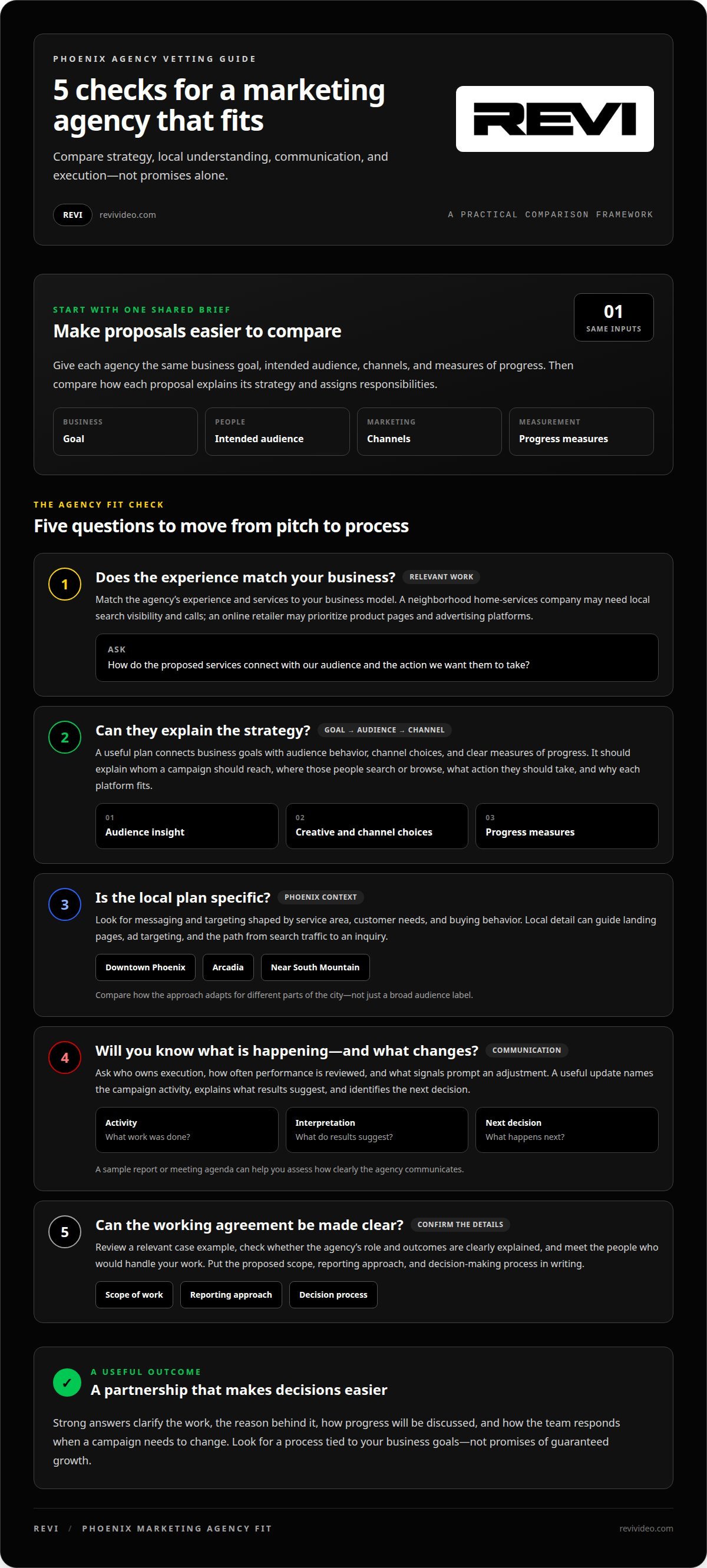
Match an agency’s relevant experience to your business model. A neighborhood home-services company, for example, may need local search visibility and calls; an online retailer may prioritize product pages and advertising platforms. Ask how the proposed services connect with your audience and the action you want them to take.
Partnership and Communication
Customer service shows in practical details: who owns the work, how progress is reported, and how questions are answered. Phoenix marketing agency reviews can offer clues about communication and collaboration, but look for specific examples rather than broad praise. Repeated mentions of clear updates or missed follow-through are more useful than a single general rating.
Ask to see a sample report or meeting agenda. A useful update names the campaign activity, explains what the results suggest, and identifies the next decision. This structure helps you understand the work without having to interpret platform data alone.
Small-Business Agency Comparisons
Small businesses can compare Phoenix agencies by giving each the same brief: business goal, intended audience, channels, and measures of progress. Then assess whether each proposal explains its strategy and assigns clear responsibilities. This makes a full-service team easier to compare with a specialist, even when their approaches differ.
For local SEO and lead generation, look for a connected plan: accurate business details, relevant local pages, a clear contact path, and a way to track inquiries. A local service business, for example, should be able to see how search visibility can lead nearby customers to call or book.
Agency Questions and Vetting
Before hiring, ask who will manage execution, how often you’ll review performance, and what signals prompt a campaign adjustment. Also ask how the agency will connect advertising, local search, or website activity to your business goal. Direct answers should clarify the process, not depend on promises of guaranteed growth.
Assess the fit by reviewing a relevant case example, checking whether the agency’s role and outcomes are clearly explained, and meeting the people who would handle your work. Put the proposed scope, reporting approach, and decision-making process in writing. These steps help show whether the partnership can support your priorities.
Agency strategy and execution styles
A useful strategy connects business goals with audience behavior, channel choices, and clear measures of progress. In Phoenix, define whom a campaign should reach, where those people search or browse, and what action they should take. A local service business might target searches tied to its service area, while a regional brand may need broader Arizona reach. The plan should explain why each platform fits.
Execution styles differ. Performance-focused agencies prioritize acquisition cost, traffic quality, and regular optimization. Brand-led teams focus more on positioning, consistent messaging, and creative that helps people recognize and remember a business. Neither approach works in isolation: performance data can reveal which messages attract qualified interest, while a strong brand strategy gives campaigns a distinct point of view.
Curiosity sharpens strategy. Start with a clear audience hypothesis, such as which customer need matters most or which message earns attention. Then test creative variations on suitable platforms and compare meaningful actions, not just views. For example, a campaign can explore whether customers respond to convenience, expertise, or a specific service benefit. Use the findings to refine future ads and messaging.
To assess an agency’s process, ask how it turns insight into execution. A solid answer connects research, creative choices, channel selection, and reporting in a logical sequence. It also explains what would prompt a change, such as weak lead quality or a message that fails to connect. If your priority is a more cohesive market presence, explore brand strategy and creative direction as part of the conversation. The best partnership makes each campaign decision understandable, targeted, and tied to a business goal.
Local Phoenix expertise and community involvement
Phoenix is the fifth most populous city in the United States, so a local strategy needs more than one broad audience label. Compare how an agency adapts messaging for a Downtown Phoenix customer versus someone in Arcadia or near South Mountain. Service area, customer needs, and buying behavior should shape the campaign. For companies serving several neighborhoods, that local detail can guide landing pages, ad targeting, and the path from search traffic to an inquiry.
Community involvement can make a brand feel relevant beyond its advertising. A practical plan might connect a neighborhood business with a local nonprofit, event, or community group, with a clear purpose for each collaboration. The agency should explain whom the activity aims to reach, what the business contributes, and how the team will share the message. For example, a local café could promote a community event through social media and in-store materials, then track responses.
Reporting turns activity into decisions. A useful dashboard separates local traffic, calls, form submissions, and campaign engagement instead of blending every result into one total. Ask how the agency connects those signals to business outcomes, such as qualified inquiries or revenue trends. If a campaign attracts visits from outside the service area, the report should make that pattern visible and inform a targeted adjustment.
Strong collaboration keeps local context in the work. Set a regular rhythm: share upcoming offers or community plans, review dashboard findings, agree on the next action, and assign an owner. A company expanding from Downtown Phoenix into nearby neighborhoods, for instance, may need updated location messaging before increasing its reach. Clear reporting shows what changed and why, while open communication gives the team timely context. Together, they make community activity measurable and keep decisions connected to audience needs.
Responsive support and campaign adjustments
Responsive support starts with a funnel that connects each campaign touchpoint to a clear next step. A Phoenix company might guide a social media viewer from a targeted ad to a service page, then to an inquiry form. The agency should map that path, identify where prospects disengage, and explain which change could improve the experience. Personalized messaging should fit the audience’s needs at each stage.
Optimization takes observation and time. Paid media campaigns may take a few weeks to optimize toward an efficient cost per acquisition. During that period, review traffic quality, lead relevance, and engagement rather than judging performance by clicks alone. If an ad attracts attention but few qualified inquiries, the next move could be to refine the audience, message, or landing page.
Clear communication makes adjustments actionable. Agree on how the agency reports campaign changes, which performance signals it reviews, and who approves new creative. A useful update might explain that a social media ad generated visits but few form submissions, then recommend revising the offer or page. This gives the business context for each decision without promising instant results.
Creative work also needs a defined process. For a seasonal Phoenix promotion, the team can align the message, visuals, and landing page before launch, then adapt the assets as audience response emerges. Ask how the agency gathers feedback, handles revisions, and keeps each version consistent with the brand. That process helps the campaign stay relevant as the local landscape shifts.
Build a working rhythm around campaign reviews, decision owners, and the next test. If video creative is part of your campaign plan, discuss a production approach that supports the message and audience journey.
REVI
REVI helps Phoenix businesses connect marketing decisions across brand building, ad buying, video production, and website development. Turn to REVI when you want a coordinated approach that links your message, creative, and digital presence instead of treating each task as separate work. The right starting point is your business goal: clarify the audience you want to reach, the message you want to share, and the campaign or website priorities that support it. From there, REVI can help shape work around those needs and keep the pieces aligned as your marketing develops. For a straightforward conversation about your goals, contact REVI.
Make Your Next Marketing Move Count
Turn your comparison into a working brief. Write down the business outcome you want, the audience you need to reach, and the decisions you want to make together. The brief gives a potential partner a clear starting point and helps you assess whether its approach fits your priorities. If you’re looking for a marketing agency that feels like a partner in Phoenix, focus on shared direction, not just a list of deliverables.
REVI can bring ad buying, video production, and website development into a connected plan shaped around your marketing needs. Start with the challenge that matters most now, then discuss how the work can support your next stage of growth. A focused conversation can help turn your goals into a practical path forward. Contact REVI to discuss your marketing needs, and take the next step with clarity.
Frequently Asked Questions
Should I hire a local Phoenix agency or a national one?
Choose based on where your customers are and how much local context your campaigns need. A Phoenix-area agency may understand neighborhood audiences, while a national agency may suit campaigns spanning multiple markets. REVI focuses on Phoenix, Scottsdale, Gilbert, Mesa, Chandler, Paradise Valley, and Tempe. For a business serving these communities, local focus can help shape relevant messaging and geographic targeting.
Which Phoenix marketing agencies are known for a collaborative, partner-like approach?
Look for a clear process for sharing decisions, discussing performance, and adapting creative. A marketing agency that feels like a partner in Phoenix should explain how its work connects to your goals, rather than treating each deliverable separately. REVI brings strategic advertising, creative work, and technical expertise together to support a business’s market presence.
What services and specialties does a Phoenix full-service marketing agency offer?
Full-service agencies can combine paid media planning, video creation, website development, brand positioning, and design. What matters is how those specialties connect. REVI’s Ad Buying & Management includes media buying and campaign management, while its video production supports commercials, social media, and brand storytelling. Web development can align the site experience with business objectives, giving campaigns a relevant destination.
How should I assess Phoenix marketing agency case studies and measurable results?
Look for case studies that explain the starting goal, the work completed, and the measures used to evaluate performance. Useful measures might include qualified inquiries, completed forms, or sales attributed to a campaign. Ask how the agency handles tracking limits: REVI states that 40 % of the population opts out of tracking, so reports should explain attribution clearly rather than imply every result is captured.
How can I assess an agency’s industry expertise and local market knowledge?
Ask how the agency would adapt a campaign to your customer journey, service area, and buying considerations. For a Phoenix-area service business, that might mean distinguishing a local searcher from someone outside its coverage area. Assess whether the agency connects that context to audience targeting, landing-page messaging, and lead quality. Strong local understanding should influence specific campaign choices, not just appear in general claims.
Which Phoenix marketing agencies are a fit for ongoing strategic support?
Look for a working process that connects reporting to ongoing decisions. REVI’s Ad Buying & Management includes daily optimizations, automated dashboards, and daily, weekly, or monthly reporting. This structure can help a business review campaign activity and understand what the data suggests doing next. Before work begins, align on the business priorities the reporting should guide, such as lead quality or campaign efficiency.