

Stop treating your marketing budget like a donation to Google’s bottom line. Most small businesses view ad spend as a fixed tax on growth, but the truth is far more exciting: your creative quality acts as a direct discount on every single click. You don’t need a massive treasury to win; you need a smarter strategy that turns every dollar into a lead-generating machine.
It’s exhausting to watch your budget disappear into a black hole of clicks that don’t convert, especially when you’re fighting national brands for the same digital real estate. We understand the pressure to perform. This article reveals exactly how much do google ads cost for a small business in 2026 and provides a clear framework to maximize your ROI. You’ll master the mechanics of current pricing, learn how to lower your cost-per-click through superior design and video production, and gain the confidence to launch campaigns that actually drive growth.
We’re diving into the latest 2026 benchmarks, including why businesses spending at least $2,000 per month see 35% better cost-per-acquisition rates. You’ll get the full breakdown on industry-specific CPC data and the tactical shifts required to dominate local markets. Get ready to transform your ad account from a cost center into your most powerful sales asset.
Key Takeaways
- Master the auction mechanics to ensure your ad placement depends on quality rather than just the highest bid.
- Access the latest 2026 data on how much do google ads cost for a small business to benchmark your spend against high-performing competitors.
- Use high-impact video and design to boost your Quality Score and unlock a direct discount on every click.
- Develop a scalable budget strategy based on customer lifetime value to ensure every dollar spent drives measurable lead generation.
- Stop wasting budget on irrelevant traffic by applying professional ad buying strategies that prioritize conversion over simple clicks.
The 2026 Google Ads Auction: How Pricing is Actually Determined
Winning on Google isn’t about having the deepest pockets. It’s about having the sharpest strategy. When you ask how much do google ads cost for a small business, you’re really asking how well you can navigate the Google Ads auction. This isn’t a traditional marketplace with fixed price tags. It’s a live, high-speed competition where every search query triggers a new calculation. Google doesn’t just look at who’s willing to pay the most. They look at who’s going to provide the best answer to the user’s problem.
In 2026, the game has shifted from simple keyword matching to deep intent analysis. You’re bidding on search intent. This means Google’s AI evaluates the “why” behind a search before deciding which ads to show. If your ad perfectly aligns with that “why,” you can leapfrog competitors who are outspending you by huge margins. Your cost is determined by the intersection of your bid, your ad relevance, and the user experience you provide after the click. You don’t always need the highest bid to win the top spot; you just need the most helpful response.
The Ad Rank Formula for Small Businesses
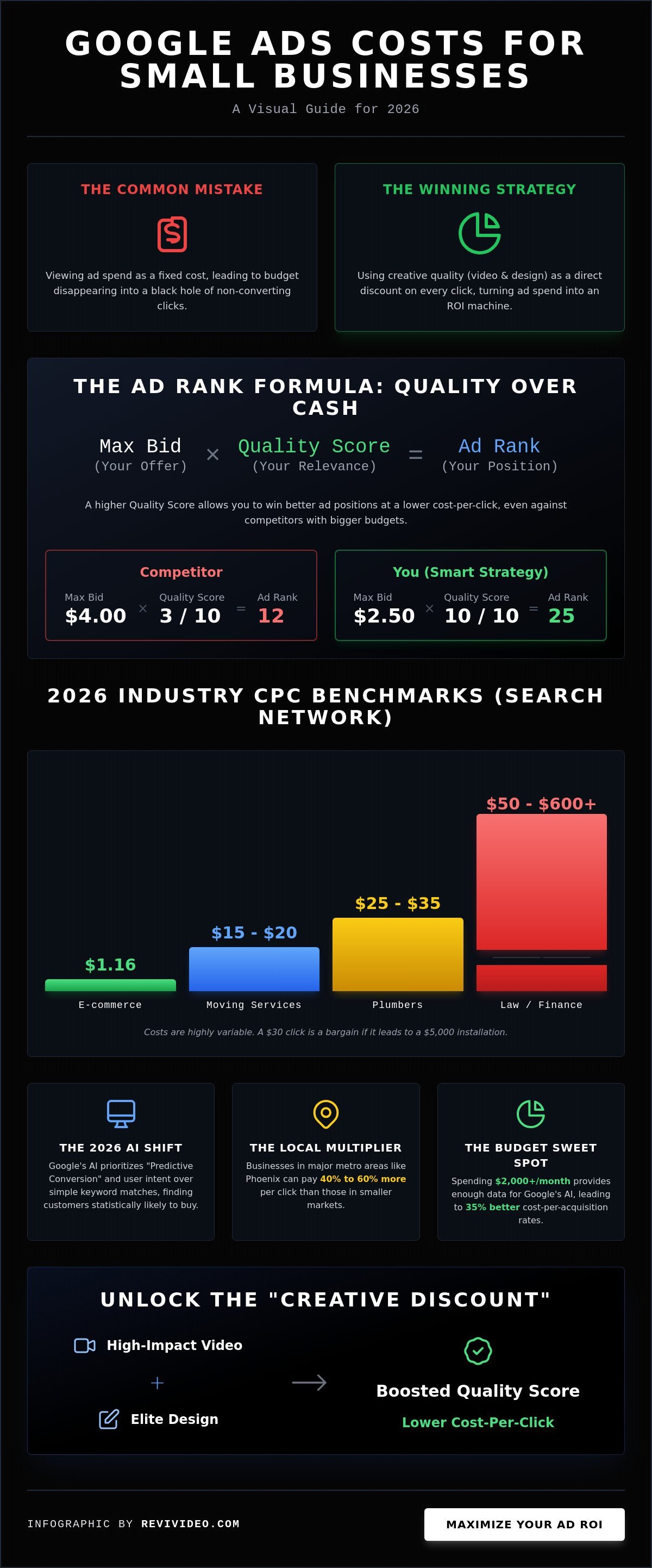
Ad Rank is the secret sauce that determines your position and your actual cost. It’s a balance between your maximum bid and your Quality Score. Relevance is the ultimate currency here. Google rewards ads that provide immediate, high-value answers. If your landing page delivers exactly what the user wants, Google lowers your cost to keep that user happy. Small businesses win by being more relevant, not just more expensive. Elite design and website development aren’t just aesthetic choices; they are functional tools that boost your Quality Score and slash your CPC.
The Role of AI and Machine Learning in 2026 Bidding
The 2026 landscape is dominated by Smart Bidding. Google’s machine learning models now prioritize “Predictive Conversion” over simple click volume. Instead of just chasing traffic, the system identifies users who are statistically likely to buy based on their behavior across the web. This shift from “exact match” keywords to “intent-based” targeting means your historical data is your most valuable asset. The more the system learns about your successful conversions, the more efficiently it can spend your budget. You aren’t just buying space. You’re buying access to a sophisticated prediction engine that finds your next customer. This automation removes the guesswork, allowing you to scale your impact without needing a massive internal marketing team. Every data point helps the algorithm lower your future costs by refining who sees your ad and when they see it.
Average Costs and Industry Benchmarks for Small Businesses
Stop obsessing over the cost of a single click. Start measuring the value of a customer. When you ask how much do google ads cost for a small business, the answer depends entirely on your industry’s gravity and your local market’s heat. A click for a local boutique costs pennies compared to a click for a personal injury attorney. Most small businesses find their sweet spot with a monthly spend between $1,000 and $10,000. This range allows for enough data to feed Google’s AI while maintaining a lean operation. Effective marketing and sales strategies require you to look past the CPC and focus on your Cost Per Lead (CPL).
Industry-Specific CPC Estimates
Competition dictates your entry fee. In the high-stakes world of professional services like Law or Finance, search network clicks can range from $50 to over $600 in competitive metros. Home services also command a premium due to high immediate intent. Plumbers typically see costs between $25 and $35 per click, while moving services average $15 to $20. Conversely, e-commerce brands enjoy much lower barriers, often seeing CPCs around $1.16. The key is balancing your margins with these costs. A $30 click is a bargain if it leads to a $5,000 HVAC installation. A $1 click is a waste if the user never buys. High-performance ad buying ensures you only bid on the traffic that actually moves the needle.
The Local Factor: Phoenix Metro Competition
Geography is the most overlooked variable in your budget. Local businesses in major metropolitan areas pay 40% to 60% more than those in smaller markets. In the Phoenix valley, Scottsdale and Paradise Valley keywords often command a massive premium because of the high average household income. If you’re a service provider, bidding on “Scottsdale” might drain your budget faster than “Mesa” or “Chandler.” You can stretch your advertising dollars by identifying “under-bid” neighborhoods where competition is thinner but intent remains high. Use granular geographic targeting to exclude expensive, low-converting zones. This tactical precision allows you to dominate specific zip codes without fighting national brands for every broad search term. By refining your reach, you transform a generic campaign into a local lead-generation powerhouse that respects your bottom line.
The Creative Discount: How Video and Design Lower Your Ad Costs
High-quality creative is your secret weapon against rising ad costs. Most people asking how much do google ads cost for a small business assume the price is fixed by the market. It isn’t. Google rewards high-performing ads with a “Quality Score” discount. When your ad gets more clicks than your competitors, Google’s algorithm sees it as more valuable. This higher click-through rate (CTR) signals relevance, which directly lowers your cost-per-click. Better creative means you pay less for the same traffic. You’re effectively buying a discount through superior performance.
Professional design and video are not luxuries; they are performance variables. If your ad looks like everyone else’s, you’ll pay the standard market rate. If your ad stops the scroll, you win. REVI specializes in building these high-impact assets that force the algorithm to favor your brand. We don’t just make things look pretty. We make them perform. By reducing bounce rates and increasing engagement, we signal to Google that your brand is a high-value destination. This lowers your entry price into the auction and keeps you at the top of the search results.
Video Assets as a Quality Score Multiplier
Video is the most powerful way to skyrocket your CTR. In 2026, YouTube and Display campaigns rely heavily on commercial video production to capture attention in a saturated market. A compelling video increases user dwell time and conversion probability, proving to Google that your content is worth showing. “Cheap” video production is a trap. Poor quality leads to low engagement, which tanks your Quality Score and forces you to bid higher just to stay visible. Investing in professional video is the fastest way to lower your long-term ad spend.
Landing Page Optimization: Converting Clicks into Customers
Driving traffic is only half the battle. Your landing page must finish the job. Technical performance is non-negotiable in 2026. High-performing pages load instantly and provide a frictionless mobile experience. Integrating custom website development with your ad strategy ensures that the “Scent of Information” remains consistent from the first click to the final checkout. If your ad promises a solution but your page design is confusing, users will bounce. Google tracks this behavior. High bounce rates tell the algorithm your page is low-value, which drives up your costs. We align your messaging and design to keep users engaged, turning expensive clicks into profitable customers.
Budgeting Strategies for Small Business ROI
Stop guessing and start calculating. Setting a budget is a dynamic process that requires constant refinement. When determining how much do google ads cost for a small business, you must first establish a “Test and Learn” phase. This initial period allows you to identify which keywords actually convert without burning your entire treasury. Success in 2026 relies on allocating your budget based on the Lifetime Value (LTV) of your average customer. If a single client brings in $10,000 over three years, paying $100 for that lead is a massive victory.
You also need to guard your budget with negative keywords. These are the terms you don’t want to show up for, such as “free” or “DIY.” By excluding irrelevant searches, you ensure every dollar targets high-intent buyers. Adjust your daily budgets to match peak performance times in your specific city. If your Phoenix-based customers are most active during the morning commute, front-load your spend to capture that attention when it’s most valuable. This level of control prevents your budget from bleeding out on low-intent traffic.
Setting Your Initial Monthly Ad Spend
Follow the 70/20/10 rule for your digital marketing allocation. Devote 70% to proven keywords, 20% to testing new intent, and 10% to experimental creative. The Phoenix market is notoriously aggressive. A $1,000 monthly budget that dominates a rural town will barely make a dent in Scottsdale. You must be surgical. Calculate your “Break-Even CPC” by dividing your profit per sale by your conversion rate. This number is your absolute ceiling. If you pay more than this, you’re losing money. If you pay less, you’re scaling. This clarity removes the fear of how much do google ads cost for a small business because you’re no longer spending; you’re investing.
Advanced Tactics: Geo-Fencing and Remarketing
Geo-fencing allows you to target high-value zip codes like 85253 or 85018 with absolute precision. Don’t waste money on areas where your services aren’t a fit. Pair this with remarketing to capture the visitors who didn’t convert on their first visit. Use brand video production to tell a story that brings them back to your site. Remarketing often delivers the highest ROI because you’re bidding on a warm audience that already knows your name. Ready to stop wasting spend? Get a professional ad buying strategy that turns clicks into revenue.
Maximized Impact: Why Professional Ad Management Wins
Attempting to manage your own campaigns often leads to what insiders call the “Idiot Tax.” This is the hidden cost of wasted spend on broad match terms that attract clicks but zero conversions. When you ask how much do google ads cost for a small business, you must factor in the price of inefficiency. A DIY approach might save you a management fee, but it usually costs you five times that amount in burned ad spend. Professional agencies like REVI eliminate this waste by combining technical ad buying with elite creative production. We don’t just set your bids; we optimize your entire presence to ensure you win the auction at the lowest possible price.
Strategic branding and design ensures your ads look like a market leader from the first impression. This isn’t just about aesthetics; it’s about authority. When a user sees a professional, cohesive brand, they are more likely to click and convert. Our team monitors your performance around the clock, adjusting bids and targeting in real-time to capitalize on market shifts. This allow you to focus on running your business while experts handle the complexities of the 2026 auction environment.
The REVI Advantage: Integrated Creative and Strategy
Separating your “ad guy” from your “video guy” is a recipe for disaster. In the fast-moving 2026 landscape, your creative must respond to your data. If the data shows users are dropping off at the three-second mark, we edit the video immediately to fix the hook. This feedback loop is only possible when ad buying and creative production live under one roof. We build a cohesive local video production presence in Phoenix that speaks directly to your neighborhood’s needs. Data-driven creative isn’t just a buzzword; it’s the ultimate shortcut to a professional-grade digital presence.
Next Steps: Launching Your 2026 Campaign
Before you spend a single dime, you must audit your current digital footprint. Is your website ready for high-intent traffic? Are your conversion actions correctly tracked? Without proper tracking, you’re flying blind. We help you set up the technical infrastructure to measure every lead and sale with precision. This clarity transforms the question of how much do google ads cost for a small business into a predictable calculation of profit. Ready to dominate the Phoenix market? Let REVI manage your spend and creative to turn your ad account into a high-performance engine.
Secure Your Market Share Today
You now have the blueprint to transform your ad account from a draining expense into a high-velocity growth engine. Success in the 2026 landscape isn’t about outspending the giants; it’s about outsmarting them through relevance and elite creative. You’ve seen how quality video production and strategic design act as a direct discount on your bids. By mastering these mechanics, you move beyond the surface-level question of how much do google ads cost for a small business and start focusing on your actual profit margins.
Stop guessing with your budget and start scaling with precision. REVI offers Phoenix-based expertise in ad buying and video production to ensure every dollar works harder. We deliver data-driven creative that lowers your costs while building a dominant brand presence. Stop wasting ad spend—Get a professional strategy from REVI today. You have the tools and the strategy. Now, go capture the growth your business deserves.
Frequently Asked Questions
Is Google Ads worth it for a small business with a limited budget?
Yes, because you only pay when a potential customer actually clicks your ad. Small budgets win by targeting specific, local keywords rather than fighting for broad, expensive terms. This platform provides immediate visibility that organic efforts can’t match. You can start small, prove your ROI, and scale your spend as your revenue grows.
What is the average cost-per-click for small businesses in 2026?
Average CPC on the Search Network typically falls between $3 and $6 for most industries. High-value sectors like legal or home services often see much higher rates due to the massive value of a single lead. Display Network clicks remain significantly cheaper, often averaging under $1. Understanding how much do google ads cost for a small business requires analyzing your specific local competition and industry density.
How much should a small business spend on Google Ads per month?
Most local businesses see the best results with a minimum spend of $1,000 per month. Data shows that businesses spending at least $2,000 monthly achieve a 35% better cost-per-acquisition than those with smaller budgets. This level of investment provides enough data for Google’s AI to optimize your bidding and find your ideal customers. Smaller spends often struggle to generate the volume needed for machine learning to work effectively.
Can I run Google Ads myself or do I need an agency?
You can run them yourself, but DIY management often leads to wasted spend on irrelevant traffic. Professional ad buying combines technical strategy with elite video production and design to maximize every dollar. Experts navigate complex bidding models and AI shifts that most business owners don’t have time to monitor. Partnering with a specialist ensures your budget drives actual leads instead of just empty clicks.
How long does it take to see results from Google Ads?
You can see traffic within minutes of launching, but true optimization usually takes about 60 to 90 days. This “learning phase” allows the algorithm to gather data on user behavior and conversion patterns. We use this time to refine your keyword targeting and creative assets for maximum efficiency. Consistent performance typically stabilizes after the first three months of active management.
Why are my Google Ads so expensive compared to my competitors?
Your costs are likely higher because of a lower Quality Score or a poor landing page experience. If your ad doesn’t perfectly match the searcher’s intent, Google charges you a premium for the placement. Competitors who invest in high-quality website development and professional design often pay less for the top spot. High bounce rates signal to Google that your site isn’t useful, which drives up your entry price in the auction.
How does Quality Score affect the cost of my Google Ads?
Quality Score acts as a direct discount or penalty on your bid. A high score allows you to win better ad positions even if you bid less than a competitor. Google rewards relevance, high click-through rates, and fast-loading landing pages. Improving your creative assets is the fastest way to lower the total how much do google ads cost for a small business for your specific account.
What is the difference between Google Ads and SEO for a small business?
Google Ads provides immediate, paid visibility while SEO is a long-term organic strategy. Ads allow you to jump the line and appear at the top of search results instantly. SEO requires months of content creation and technical website development to earn a ranking. Most successful brands use both to capture maximum market share and dominate the search results page from every angle.