

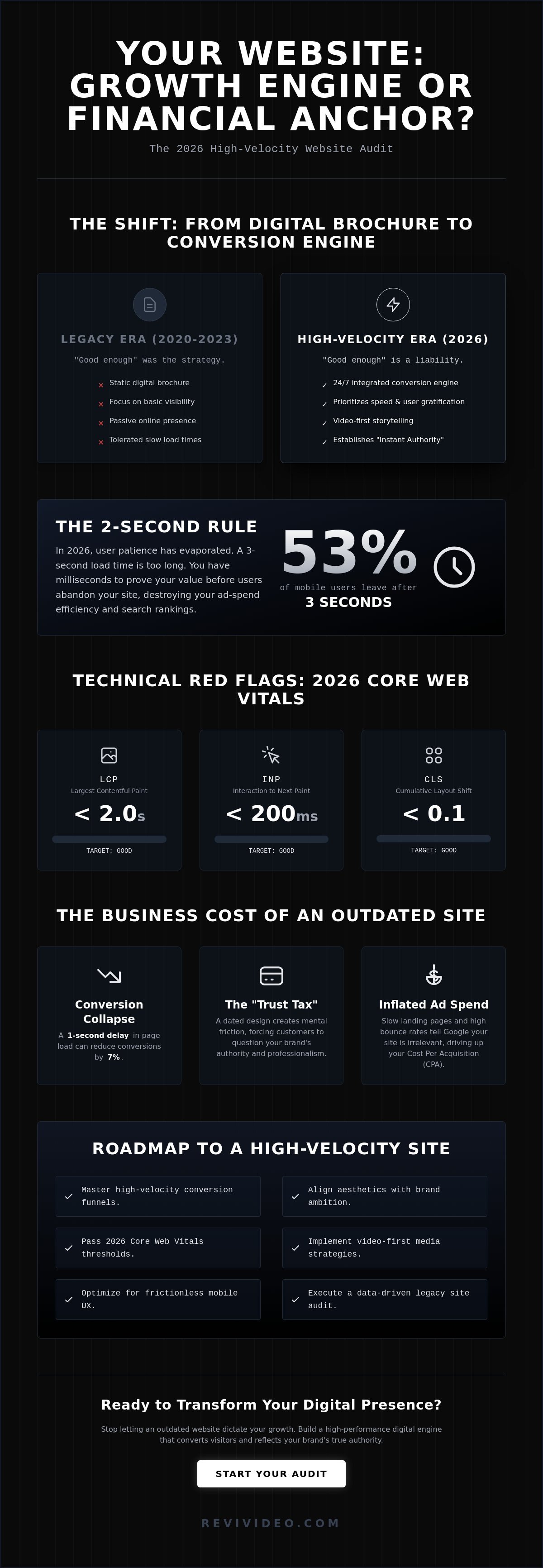
Your website is either a high-velocity growth engine or a silent anchor dragging down your entire marketing budget. If you are watching ad spend climb while conversion rates stall, you are likely ignoring the subtle signs you need a new website that are already costing you revenue. In a world where 53% of mobile users abandon a page if it takes longer than three seconds to load, “good enough” is no longer a viable strategy. It is a recipe for digital irrelevance.
It’s frustrating to see competitors with a premium digital presence outpace your results because their site feels more modern and responds faster. You want a digital home that reflects your brand’s authority and converts visitors into loyal customers without friction. We’ll show you exactly how to identify the critical red flags killing your performance and transform your site into a high-performance growth engine. This audit covers everything from the 2026 Core Web Vitals thresholds to the essential video-first storytelling strategies that define today’s market leaders. By the end, you’ll have a clear checklist to justify your redesign and a roadmap to a site that actually works as hard as you do.
Key Takeaways
- Master the shift from static pages to high-velocity conversion engines that dominate the 2026 digital landscape.
- Spot the technical signs you need a new website, including outdated Core Web Vitals and mobile UX friction that kills your search rankings.
- Close the aesthetic gap by aligning your digital presence with your brand’s true ambition through high-impact custom website development.
- Bridge the video gap with advanced media hosting strategies that capture attention without sacrificing site performance.
- Execute a data-driven audit of your legacy site against 2026 benchmarks to unlock immediate growth and scalability.
The 2026 Website Standard: Why ‘Good Enough’ is Costing You Revenue
Digital standards shifted overnight. The Legacy Era (2020-2023) focused on static presence and basic visibility. It was the age of the digital brochure. Back then, having a site that simply “worked” kept you in the game. Welcome to the High-Velocity Era. In 2026, your website is no longer a passive page; it is an integrated sales tool and a 24/7 conversion engine. If your growth hit a plateau, you are likely ignoring the obvious signs you need a new website to maintain your market share.
A high-performance site integrates seamlessly with modern web design standards to prioritize speed, video-first storytelling, and instant user gratification. For businesses in Phoenix and Scottsdale, a site that merely functions is a massive liability. It creates friction. It slows your sales cycle. Most importantly, it destroys your ad-buying efficiency. If your landing pages lag, you are essentially throwing your ad budget into a furnace. High bounce rates tell Google your content isn’t relevant, which drives up your costs and kills your visibility.
The Cost of Inaction in a Competitive Market
An outdated site does more than look bad. It inflates your Cost Per Acquisition (CPA) by forcing your marketing to work twice as hard for half the results. When users land on a dated digital storefront, they pay a “trust tax.” This is the mental friction a customer feels when your online presence doesn’t match your professional reputation. In high-competition markets like Scottsdale, consumers judge your brand’s capability based on your interface. If your site looks like 2021, they assume your service is just as stagnant. Signs you need a new website often appear first in your declining conversion data rather than your visual layout.
The 3-Second Rule: 2026 Edition
User patience has evaporated. In 2026, the “3-second rule” is actually the “2-second rule.” Research confirms that 53% of mobile visits end if a page takes longer than three seconds to load. You have mere milliseconds to establish “Instant Authority.” This metric determines whether a user stays or bounces before they even read your first headline. Your digital identity must be sharp, fast, and authoritative. If your brand feels disconnected from your site’s performance, check out the ultimate guide to choosing a branding agency in Phoenix to align your visual identity with modern performance standards. Don’t let a slow site kill your momentum.
Technical Red Flags: When Your Infrastructure Becomes a Liability
Your website’s backend is either an accelerator or a choke point. In 2026, the “Big Three” technical killers, Speed, Mobile UX, and Security, determine whether you scale or stall. Legacy code drag and plugin bloat act like digital anchors. They slow down your response times and frustrate high-intent users. If you feel like your marketing is fighting against your technology, these are clear signs you need a new website built on a modern, lean stack. High-performance infrastructure isn’t a luxury; it’s the baseline for survival.
Google’s 2026 Core Web Vitals standards are stricter than ever. Largest Contentful Paint (LCP) must hit under 2.0 seconds to be considered “Good.” Interaction to Next Paint (INP) is now a primary ranking signal, requiring a response under 200ms. These aren’t just technical benchmarks. They are direct reflections of user satisfaction. If your site fails these, your search rankings will plummet. You must also adhere to current technical and accessibility standards to avoid legal risks. For public entities serving over 50,000 people, the April 24, 2026, deadline for WCAG 2.1 Level AA compliance has already passed. Updates are now mandatory to ensure every user can engage with your brand.
Performance Metrics That Actually Matter
Speed is the ultimate conversion lever. A one-second delay in page load time can reduce conversions by 7%. Beyond raw speed, watch out for the “Jank Factor,” known as Cumulative Layout Shift (CLS). On modern high-res devices, elements that jump around while loading destroy trust instantly. A “Good” CLS score is now under 0.1. Try this 30-second audit: open your site on your smartphone using a cellular connection. If you can’t interact with the main call-to-action within two seconds, your infrastructure is failing you. Modern website development focuses on eliminating this friction from the very first line of code.
SEO Decay: Why Your Rankings are Slipping
Old site architecture is invisible but deadly. Outdated structures prevent Google from crawling your latest content effectively. This leads to “SEO decay” where your best pages lose visibility. If your site relies on legacy SSL certificates or outdated security protocols, browsers will flag your site as “Not Secure.” This kills your credibility in milliseconds. Your structure must also support modern AI search behaviors. AI crawlers prioritize clean, semantic HTML and fast-loading media. If your site is a maze of legacy code, you’re invisible to the next generation of search. Being “Mobile-Responsive” was a 2020 goal. In 2026, you need a “Mobile-First” build to capture the 64% of global traffic moving through handheld devices.
The Aesthetic Gap: Does Your Site Match Your Brand’s Ambition?
Your business is not the same as it was three years ago. You’ve scaled your operations, refined your service, and elevated your team. If your digital presence still looks like a relic from 2022, you are suffering from Brand Drift. This disconnect between your professional reality and your online image is one of the most dangerous signs you need a new website. When your site lags behind your ambition, you lose the “Aesthetic Gap” battle. You aren’t just losing clicks; you’re losing the right to charge premium prices. High-end design directly correlates to higher price-point tolerance. If your site looks cheap, your leads will haggle.
Templates are the ultimate trap. In a crowded digital landscape, using the same “industry standard” layout as your three closest competitors makes you invisible. Custom website development is no longer just an option for enterprise giants. It is the only way to achieve true brand distinction in 2026. A custom build allows you to engineer a unique visual language that captures attention and commands respect. It transforms your site from a generic placeholder into a high-performance asset that reflects your actual market position.
Visual Storytelling and First Impressions
First impressions happen in milliseconds. In 2026, users expect “Immersive Web Design.” This includes frosted glass effects, organic shapes, and maximized typography that guides the eye. For brands in the Phoenix and Scottsdale markets, the competition for attention is fierce. Your photography and graphics must be professional-grade to survive. Low-quality stock images scream “amateur.” To truly dominate your niche, your visual assets must work in perfect harmony with your site’s architecture. Use this local video production company guide to learn how to integrate high-impact media for maximum brand growth.
User Journey Friction: The Silent Conversion Killer
Is your navigation a maze? If users spend more than five seconds trying to figure out what you do, they leave. This is the “Confusion Gap,” and it is a silent conversion killer. In 2026, the average bounce rate for e-commerce sites sits between 20% and 45.68%, but mobile bounce rates are often 10% to 20% higher. If your mobile UX is clunky, you’re effectively handing customers to your competitors. Streamlined UX design removes every hurdle between a visitor and your “Book Now” button. Identify your high-bounce pages immediately. If your data shows people are dropping off at your most important conversion points, your current site is a liability you can’t afford to keep.
The Video Gap: Is Your Site Built for High-Impact Media?
Video is the primary language of 2026. If your site treats video as an afterthought, you’re invisible to your target audience. In a world of infinite scrolls and instant gratification, a “video-first” architecture is the only way to capture and hold attention. If your current platform stutters when playing a 4K brand story or forces users to wait through a buffering wheel, you are facing definitive signs you need a new website. Legacy sites often struggle with the sheer weight of modern high-impact media because they were built for a text-heavy era that no longer exists.
The technical challenge is significant. You need high-bitrate quality without destroying your Largest Contentful Paint (LCP) score. When video is integrated correctly, it significantly increases “Time on Page.” This is a key SEO and trust metric. Dwell time signals to Google that your content is valuable, which directly boosts your rankings. If your site feels like a static ghost town, you are leaving money on the table. Modern consumers expect a cinematic experience that loads in under two seconds. Anything less is a signal to bounce.
Beyond the Hero Background
Visual strategy in 2026 goes far beyond a simple looping hero background. You need interactive testimonials, dynamic product deep-dives, and immersive brand stories that respond to user behavior. Bolting a YouTube link onto a site designed years ago looks unprofessional. It creates a disjointed experience and often pulls users away from your site and into the YouTube rabbit hole. To win today, your media must be native, responsive, and lightning-fast. Explore our commercial video production in Phoenix guide to learn how to craft a content strategy that drives viral growth.
The Synergy of Video and Web Performance
The most successful brands treat video and web development as a single, unified engine. This synergy is essential for lowering your ad-buying costs. When your video assets are technically optimized for your site’s specific infrastructure, your landing pages convert at a much higher rate. This efficiency rewards your marketing spend with a massive ROI. You create a seamless loop from a high-energy social media ad to a high-converting, video-rich landing page. This frictionless journey is what separates market leaders from stagnant businesses. It’s time to stop fighting your technology and start using it as a weapon. Elevate your brand with professional Video Production that integrates perfectly with a high-performance digital presence.
Revitalizing Your Digital Presence: From Legacy Site to Growth Engine
Identifying the signs you need a new website is only the beginning. The real work starts with a strategic pivot from a passive presence to an active growth engine. You’ve seen the technical red flags and the aesthetic gaps. Now, you must execute. Transitioning to a high-performance site requires a disciplined approach that treats your digital home as a primary sales asset rather than an IT expense. Speed, strategy, and storytelling must converge to create a platform that wins in 2026.
- Step 1: Audit your data. Look beyond surface-level traffic. Compare your current conversion rates and bounce rates against 2026 industry benchmarks. If your mobile e-commerce bounce rate is hovering near 50%, your current infrastructure is failing your customers.
- Step 2: Align with 2026 goals. Your website must be a bridge to your future revenue targets. If you plan to scale your Ad buying, your site must be ready to handle high-velocity traffic without a dip in performance.
- Step 3: Invest in custom development. Avoid the template trap. Custom Website Development ensures your site architecture supports your specific marketing funnel and removes every barrier to entry.
- Step 4: Integrate brand storytelling. High-end video and cinematic Brand Building shouldn’t be bolted on later. They must be baked into the design from day one to maximize user engagement.
Choosing the Right Partner for the 2026 Market
The biggest mistake you can make is hiring siloed agencies. A development firm that doesn’t understand marketing will build a site that is beautiful but expensive to drive traffic to. A video team that doesn’t understand web performance will create assets that slow your site to a crawl. You need a visionary partner that integrates these disciplines into a single, cohesive strategy. This alignment ensures your brand remains consistent and your technology remains fast. For a deeper dive into finding the right creative match, read the ultimate guide to choosing a video production agency in Phoenix.
The REVI Roadmap to Digital Dominance
We don’t just build websites; we engineer growth. Our results-driven philosophy means every pixel must earn its place on the screen. We blend technical precision with high-impact Video Production to create a frictionless user journey. This approach turns visitors into advocates and clicks into revenue. Don’t let your business be held back by an outdated digital presence. It’s time to build a site that matches your ambition and dominates your market. Stop losing leads to a legacy site; build your 2026 engine with REVI.
Dominate the 2026 Digital Landscape
Your website is the heart of your growth engine. If your current site fails the 2026 Core Web Vitals or lacks a video-first structure, you’re leaking revenue every second. These signs you need a new website serve as a clear warning that your infrastructure is no longer compatible with modern consumer expectations. You now have the checklist to justify a total redesign and the roadmap to align your brand identity with high-performance technology. Don’t let a legacy site act as an anchor for your marketing budget.
Stop losing leads to a legacy site; build your 2026 growth engine with REVI. Our team delivers a lethal combination of Expert Ad Buying Integration, Award-Winning Video Production, and High-Performance Custom Web Development. We remove the tedious barriers to production and replace them with a seamless, high-converting user journey. Success in the High-Velocity Era belongs to the brands that refuse to settle for “good enough.” Your audience is waiting for a premium experience; give it to them today. Take the lead and watch your conversion rates soar.
Frequently Asked Questions
How often should a business update its website in 2026?
You should plan for a major infrastructure update every two to three years to keep pace with evolving performance standards. In 2026, technology moves at a high velocity that makes a five-year cycle obsolete. If you ignore the signs you need a new website for too long, your competitors will simply outpace your load speeds and search rankings. Constant micro-updates are the baseline; a total rebuild ensures your backend remains lean and efficient.
What is the average lifespan of a modern website design?
The average lifespan of a high-performance design is now 24 to 36 months. Design trends like glassmorphism and neobrutalism define the current era, and sites that cling to early 2020s aesthetics feel dated to savvy consumers. Visual decay happens fast. A fresh build every few years ensures your brand identity stays aligned with your market ambition and maintains the trust of your high-intent audience.
Can I just update my theme, or do I need a completely new website?
Theme updates are often surface-level patches that fail to fix deep-seated technical debt or legacy code drag. If your site suffers from plugin bloat or slow database queries, a new theme is just a fresh coat of paint on a crumbling foundation. You need a clean, custom build to truly eliminate friction. Modern Website Development focuses on a lean architecture that themes simply cannot replicate, giving you a decisive edge in performance.
How does an old website affect my Google ad campaigns?
An outdated website destroys your ad ROI by driving up your bounce rates and lowering your Quality Score. Google rewards fast, relevant landing pages with lower costs per click. If your site lags, you’re paying a premium just to watch users leave before the page even loads. Investing in a high-performance engine makes your Ad buying significantly more efficient, turning every dollar of spend into more measurable growth.
What are the most important features of a high-converting website in 2026?
Video-first storytelling, sub-two-second load times, and frictionless mobile UX are the mandatory pillars of conversion. Your site must also feature a semantic HTML structure that supports AI search behaviors and full WCAG 2.2 accessibility compliance. Every pixel must serve a purpose. High-converting sites remove all distractions and guide the user through a cinematic journey that leads directly to your primary call to action without any mental friction.
How much does a custom website redesign cost for a Phoenix business?
Redesign costs depend entirely on the complexity of your sales funnel and the depth of your media requirements. You should view a custom build as a revenue-generating asset rather than a sunk cost. While specific prices vary based on your goals, the ROI of a professional build comes from increased lead quality and lower marketing costs. Focus on the value of a high-performance engine that scales with your business ambitions.
Will a new website help my local SEO in Scottsdale and Gilbert?
Yes, a modern build significantly boosts local SEO by optimizing for Phoenix-area search behaviors and localized schema markup. Google prioritizes sites that provide a superior mobile experience and fast load times in specific geographic regions. By building a site that passes all Core Web Vitals, you’ll rank higher in local map packs. This visibility is essential for dominating the competitive Scottsdale and Gilbert markets where consumers expect instant results.
How do I know if my website speed is actually ‘slow’?
Check your Largest Contentful Paint (LCP) and Interaction to Next Paint (INP) using professional diagnostic tools. In 2026, an LCP over 2.0 seconds is the definitive benchmark for a slow site. You can also perform a “real-world” test by loading your site on a mobile device using a standard cellular connection. If you feel any hesitation or “jank” while scrolling, your infrastructure is a liability that is likely costing you conversions every day.