

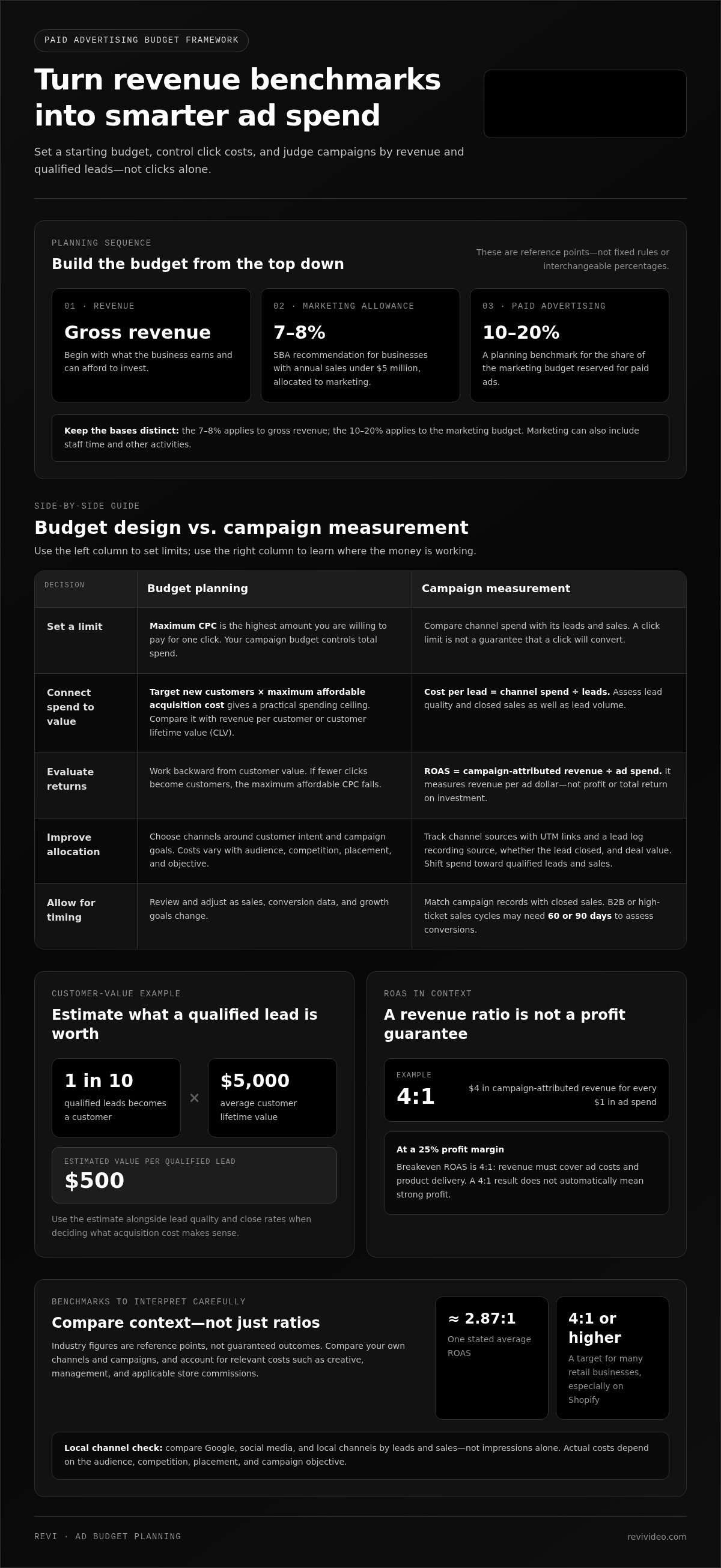
Start with your total marketing budget, then set aside a portion for paid ads. The U.S. Small Business Administration recommends that businesses with annual sales under $5 million allocate 7-8% of gross revenue to marketing; a possible paid-ad allocation is 10-20% of that marketing budget. To calculate ad spend for a small business in Tempe, weigh those benchmarks against your growth stage, maximum cost per click (CPC), and the revenue your campaigns generate.
It’s easy to focus on a monthly ad limit, but a sound budget starts with what your business needs to achieve and can afford to spend to acquire a customer. A startup building awareness may need a different approach from an established business aiming to sustain growth.
This guide explains how to use industry benchmarks as reference points, not fixed rules. You’ll learn how a maximum CPC can help control click costs, how to calculate return on ad spend (ROAS), and how to adjust your budget as your business grows. The goal is to make every ad dollar easier to plan, track, and improve.
Key Takeaways
- Set an ad budget that fits your growth stage, then use Tempe-relevant benchmarks as a starting point rather than a fixed rule.
- Use a maximum CPC bid to keep clicks within your acquisition economics, and compare customer value with the cost of winning new business.
- Measure ROAS by comparing campaign-attributed revenue with ad spend, then use the results to guide where you invest next.
- Adjust your marketing allocation as your business grows, and use REVI’s ad buying to help plan and manage campaigns.
Using industry and location benchmarks to plan an ad budget
Use revenue benchmarks to set an initial range, then refine it using campaign results from Tempe. Keep advertising separate from your broader marketing budget, which may also include staff time and other marketing activities.
Choosing an Advertising Share
The advertising share is the portion of your marketing budget reserved for paid placements. The U.S. Small Business Administration recommends that businesses with annual sales under $5 million allocate 7-8% of gross revenue to marketing. A separate planning benchmark puts paid advertising at 10-20% of that marketing budget. These are starting points, not interchangeable percentages: calculate your total marketing allowance first, then choose an ad share that supports your current customer-acquisition goals.
Track conversions by channel with UTM links and a simple lead log that records each lead’s source, whether it closed, and its deal value. Use analytics to shift spending toward channels that generate qualified leads and sales.
Budget Differences by Business Size
A revenue-based budget ties marketing investment to business size, while a growth-stage budget reflects how quickly the business aims to expand. The distinction matters: the same percentage of revenue can produce very different ad budgets for businesses with different sales.
Those figures cover marketing, not advertising alone. Before choosing the share allocated to paid ads, a Tempe business should consider whether its priority is awareness, a steady flow of leads, or expansion. Review results regularly and adjust as sales and conversion data change.
Using Tempe Channel Cost Benchmarks
Channel benchmarks can help compare options, but actual costs vary with the audience, competition, placement, and campaign objective. To divide an ad budget across Google, social media, and local channels, start with the channel that best captures customer intent. Compare conversion results before shifting more budget.
What is the average cost per click for Google Ads in Tempe, Arizona? Newspaper, radio, and outdoor advertising costs vary by format, placement, audience, and campaign duration. Compare leads and sales from each channel, not impressions alone.
How does setting a maximum CPC bid help me control my overall ad spend?
A maximum cost-per-click (CPC) bid sets the highest amount you’re willing to pay for one ad click. It limits the price per click, while your campaign budget controls total spending. Together, they help keep customer acquisition aligned with your business economics.
To calculate an advertising budget from sales goals and customer acquisition cost, multiply your target number of new customers by the maximum acquisition cost your business can support. Compare the result with revenue per customer or customer lifetime value (CLV). This sets a practical spending ceiling, not a guarantee that every click will convert.
To calculate ad spend for a small business in Tempe, work backward from customer value. Estimate what a new customer is worth, then use your click-to-customer conversion rate to set a CPC limit. If fewer clicks convert, the maximum affordable bid falls. Track qualified leads and closed sales, not clicks alone.
Lead value can also guide your limit. If one in ten qualified leads becomes a customer with an average lifetime value of $5,000, each qualified lead has an estimated value of $500. Use that estimate alongside lead quality and close rates before deciding what acquisition cost makes sense.
Industry and competition affect CPC because advertisers compete for attention from similar audiences and search terms. Keep paid placement separate from broader marketing costs such as salaries and software. For profitability analysis, include relevant creative costs too. One Meta Ads example counts a graphic designer’s fee in its $3,000 total campaign cost.
In short, how to calculate ad spend for a small business in Tempe means connecting your bid limit to customer value, conversion performance, and the full costs you’re evaluating. Align those inputs with campaign planning, then refine your limits using qualified leads and closed revenue.
Calculating return on ad spend
Return on ad spend (ROAS) shows the revenue campaigns generate for each advertising dollar. Calculate it by dividing campaign-attributed revenue by ad spend. A 4:1 ROAS means $4 in revenue for every $1 spent. It’s a revenue metric, not profit or total return on investment.
How can Tempe small businesses estimate cost per lead and return on ad spend? Divide a channel’s total spend by its leads to find cost per lead. For ROAS, divide the revenue attributed to its campaigns by ad spend. Include the ad budget and relevant management costs when assessing overall lead efficiency.
A B2B Google Search campaign can be assessed by comparing attributed value with ad spend, while remembering that estimated lead value is not collected revenue. That result helps compare platforms, but estimated lead value isn’t the same as collected revenue. Match campaign records with closed sales, and use a suitable attribution window for the sales cycle. A B2B or high-ticket business may need 60 or 90 days to assess conversions.
Set a target that reflects your margins. At a 25% profit margin, breakeven ROAS is 4:1: revenue must cover ad costs and product delivery. A 4:1 result therefore doesn’t automatically mean strong profit. Account for deductions and store commissions when they apply.
Industry averages offer context, not a guaranteed outcome. One stated average is approximately 2.87:1, while many retail businesses, especially on Shopify, target 4:1 or higher. Compare your own campaigns and metrics across platforms, then shift dollars toward channels producing stronger revenue and qualified leads. Review pipeline data alongside ROAS so low-cost clicks don’t distract from sales quality.
Use these results to decide whether to hold, reduce, or increase spend, based on tracked sales and margins. A higher ROAS may support scaling, while weak lead quality or delayed conversions may call for a closer review before you change the budget.
Typical marketing-spend percentages by business growth stage and size
Choose your investment level by matching revenue goals to business stage, then separate marketing from paid advertising. Stable businesses can use 3-5% of revenue as a low-end ad-spending benchmark. Growth-focused businesses may allocate 5-10% or more, while aggressive, high-growth plans may use 10-15%. These ranges frame the decision; the right level depends on whether your priority is steady demand or faster expansion.
How much should a small business spend on advertising as a percentage of revenue? A stable business can start with the 3-5% ad benchmark, while a growth-focused company might consider 5-10% or more. Aggressive growth plans may reach 10-15%, with customer acquisition economics and cash flow guiding the choice.
A new business with little sales history has less past performance to guide its budget. Startups or expanding businesses may invest 10-20% of projected revenue in marketing to build awareness. Treat that as a total marketing allocation, not an advertising-only target. Test a focused mix, such as Google Ads for active search demand and social media for discovery, then measure leads and sales before expanding.
Business size also changes the context. Most companies spend 5-10% of gross revenue on marketing; higher-growth companies often approach 10%, while stable-growth or slow-growth companies stay near 5%. Large companies may spend 9-12%. B2C firms tend to use 5-10% of revenue for marketing, compared with 2-5% for B2B businesses. These are marketing-spend benchmarks, not direct ad-budget rules.
Use a stage-based review: estimate projected revenue, select a marketing allocation, then decide what share supports advertising. Compare campaign outcomes with growth goals and available cash, and adjust as real sales data replaces assumptions. For a focused next step, turn growth targets into a campaign plan built around the audience and channels you need to reach.
REVI: Ad buying
REVI’s Ad Buying & Management can turn your budget, CPC limits, and ROAS targets into a focused campaign plan. It’s a practical next step when you’ve set your goals and want support aligning channel choices and spending with them.
Use conversion and revenue data to clarify what each campaign should achieve. If the plan also calls for stronger creative or landing pages, REVI offers Video Production and Web services. These can support your advertising strategy, while campaign results still need to be measured.
For a coordinated approach to advertising and business growth, contact REVI to discuss your goals.
Make Your Next Budget Move With Purpose
Your next ad budget doesn’t have to be a permanent commitment. Treat it as a decision you can refine: define the business result you want, choose a signal that shows progress, and set a review point before changing direction. This keeps spending connected to customer behavior rather than assumptions.
When calculating ad spend for a small business in Tempe, focus on the relationship between campaign activity and the outcomes your business values. A click matters only when it advances a meaningful goal, such as a qualified inquiry or sale. Keep that principle in mind as your priorities change.
When you’re ready to shape your next campaign around your goals, contact REVI about your ad budget. Bring your objectives and the questions your campaign data has raised. A clearer plan can help you move forward with confidence and keep your growth strategy intentional.
Frequently Asked Questions
How Much Should A Small Business Spend On Paid Ads?
Choose an amount your business can sustain while testing whether campaigns bring in customers. A practical starting point is to allocate a defined portion of your marketing funds to paid ads, set a review date, and compare results with sales goals. For a new campaign, avoid spreading a limited budget across too many audiences or channels. Focus the test so its results can guide your next decision.
How can you calculate ad spend?
Add the amounts paid to place ads across the platforms you’re measuring for the same period. Keep this figure separate from production, software, and staff costs, and track those expenses separately to assess total marketing investment. For example, a monthly report should compare that month’s media spend with leads and sales attributed during a consistent reporting window.
How do I determine the right Google Ads budget for my business?
Base your Google Ads budget on the campaign’s goal, the value of a new customer, and how much qualified traffic the budget can test. One suggested approach is to start with $1,000 per month on one advertising platform and monitor performance for 1-3 months. Use the test to learn which searches bring valuable inquiries, then adjust based on conversion quality and sales.
Should I Include Agency Fees in My Ad Costs?
Separate agency or campaign-management fees from media spend to see what went toward ad placement and what supported campaign work. For a fuller picture of efficiency, review both figures alongside leads and closed sales. Use the same accounting method each reporting period to make campaign comparisons clearer and avoid confusing management expenses with platform charges.
What factors affect advertising costs in the Tempe market, including seasonality and competition?
Costs can shift with advertiser competition, audience demand, targeting, placement, and campaign timing. In Tempe, Phoenix, Scottsdale, Gilbert, Mesa, Chandler, and Paradise Valley, compare your campaign performance across similar periods instead of assuming there is one market-wide rate. Seasonal demand can also affect which offers attract attention, so assess lead volume and quality before moving budget between campaigns.
How can a small business track ad spend and measure campaign results?
Use campaign-specific UTM links and a lead log to connect inquiries with their sources. Record each lead’s source, whether it became a customer, and the resulting deal value. For longer B2B or high-ticket sales cycles, consider a 60- or 90-day attribution window so delayed conversions aren’t overlooked. Review platform metrics alongside closed-sale data to see which campaigns contribute to revenue.